Why Do Holdings Change Even When No Trades Occur?
This lesson explores the issuer system, explaining the meaning and schedule of corporate actions such as dividends, stock splits, and mergers. It analyzes their impact on spot securities holdings and distinguishes the different handling logic for securities, CFDs, and tokenized products under the same event.
After purchasing stocks or ETFs, your account will not always remain unchanged. Sometimes, your account automatically receives a cash deposit; other times, your share count suddenly increases while the stock price drops proportionally; in some cases, existing stocks are replaced by new securities or trading is temporarily suspended.
These changes are not system errors—they are normal mechanisms in the securities market, collectively known as Corporate Actions. Unlike airdrops, forks, or staking rewards in crypto assets, corporate actions have clear legal procedures and scheduled timelines. The amount of dividend, payment timing, and post-split holding changes are all announced in advance by the listed company or fund manager and gradually executed through exchanges, registries, and custody systems.
Therefore, even without active trading, your holding quantity, cash balance, and asset structure may still change. This lesson will focus on common corporate actions such as cash dividends, stock splits, ETF allocations, and mergers, explaining how these changes affect holding performance.
1. What Are Corporate Actions?
Corporate actions refer to a series of matters initiated by listed companies or fund managers and executed according to securities market rules. Common corporate actions include:
-
Cash dividends
-
Stock dividends
-
Stock splits
-
Reverse stock splits
-
Mergers and acquisitions
-
Delisting
-
ETF dividends and rebalancing
These events directly or indirectly affect holding quantity, stock price, or cash balance, making them essential knowledge for stock investors.
Unlike airdrops in crypto assets, corporate actions usually announce a complete schedule in advance, including declaration date, record date, ex-dividend date, and payment date. Relevant information can be found via company announcements, exchange notices, and platform bulletins.
2. Dividends: Why Does Your Account Automatically Receive Cash?
Dividends are a way for listed companies to distribute part of their profits to shareholders. Based on the distribution form, they are typically categorized as cash dividends or stock dividends.
Cash Dividend is the most common method. The company pays shareholders a fixed amount of cash per share. For example, if a company declares a $1 cash dividend per share and an investor holds 100 shares, they will theoretically receive $100 in cash dividends.
Stock Dividend distributes earnings to shareholders in the form of additional shares. For example, if a company announces 1 new share for every 10 held, an investor with 100 shares will receive 10 extra shares after the dividend. Here, the holding quantity increases but total assets do not necessarily grow at the same rate since the stock price is usually adjusted accordingly.
In the US stock market, both cash and stock dividends typically involve four important dates:
-
Declaration Date: The company announces the dividend plan
-
Ex-Dividend Date: Buying shares after this date generally does not qualify for this dividend
-
Record Date: The company confirms the list of eligible shareholders
-
Payment Date: Cash or shares are officially distributed to shareholders
When you hold eligible stocks through Gate Stocks, cash dividends or stock dividends are usually automatically credited to your account per platform rules—no manual application needed. Specific timing and processing methods are subject to platform announcements.
Note that dividends come from company operating profits and are not fixed income. Companies may adjust dividend policies based on operational status, cash flow management, and development plans—the amount may increase, decrease, or even be suspended.
Therefore, seeing cash deposited in your account or an increase in share count does not mean you have created equivalent value. Understanding dividend distribution methods and asset change logic is more important than simply focusing on dividend amounts.
3. Stock Splits and Reverse Splits: Why Does Asset Value Stay the Same Even If Share Count Changes?
Stock splits are a very common corporate action in the stock market.
Suppose a company performs a 1-for-4 split. Originally:
-
10 shares held
-
Each share priced at $400
-
Total assets: $4,000
After the split:
-
Holdings become 40 shares
-
Price per share adjusts to $100
-
Total assets remain around $4,000
As shown above, what changes is share count and price—not total asset value.
Conversely, reverse splits reduce share count and increase price; total assets remain unchanged in principle.
Thus, in the stock market, you must track both: holding quantity × share price = market value. You cannot only watch price changes and ignore quantity adjustments. At Gate Stocks, splits and reverse splits are usually completed automatically by the custody system; holding quantity and cost info are adjusted per official rules—no extra action required.
4. ETFs Change Too
Besides stocks, ETFs also experience corporate actions.
ETFs hold a basket of stocks; therefore, when underlying stocks pay dividends, split shares, or delist, it affects the ETF's net asset value.
Additionally, index providers regularly adjust index constituents; ETFs rebalance holdings to maintain tracking accuracy. For example:
-
If a company is added to an index, the ETF increases its holdings
-
If a company is removed from an index, the ETF reduces its holdings
-
If an industry weight increases, the ETF's risk exposure changes accordingly
Therefore, even without active buying or selling, ETFs themselves are constantly being adjusted.
5. Mergers, Delisting, and Trading Suspensions
Corporate actions aren't limited to dividends and splits.
When a listed company undergoes a merger or acquisition, existing shares may be bought out for cash or replaced by another company's shares.
If a company delists, its stock may move to over-the-counter trading—liquidity and convenience will be affected.
Additionally, securities markets have trading suspension mechanisms. When major events occur at a company, exchanges may halt trading until related information is fully disclosed before resuming.
Unlike crypto markets' 24/7 trading, suspensions are a key risk in securities markets and an important aspect of long-term investing.
6. Different Products May Handle the Same Event Differently
For corporate actions like dividends or splits, handling rules can vary significantly across different products.
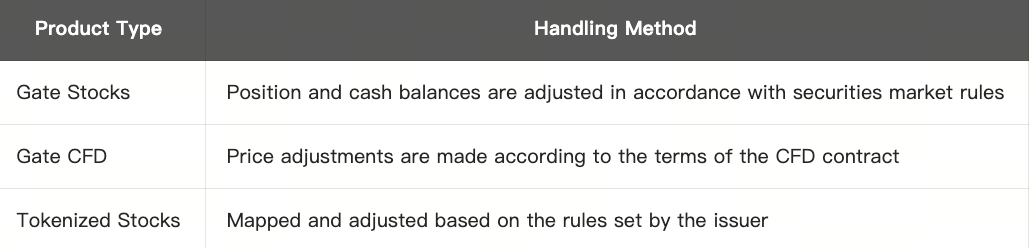
Therefore, even if they correspond to the same company, account changes for different products may vary. Please refer to the product description and platform announcements for specific rules.
Lesson Summary
Corporate actions are not special events, but an inevitable part of the stock investment process. Cash dividends will change the account's cash balance; stock splits and reverse splits will change the number of shares and share price; ETFs continue to change due to dividends and rebalancing; mergers, delistings, and suspensions may directly affect portfolio structure and trading status.
When participating in stock investments through securities spot products such as Gate Stocks, these changes in the account are usually completed automatically according to securities market rules. Understanding how corporate actions operate helps you correctly recognize account changes and avoid confusing securities market rules with on-chain asset logic.
The next lesson will further discuss another important topic: why US stocks, the Nasdaq Index, and BTC are often discussed together, and what connections and differences exist among them.
Lesson 1:Why Do Securities Markets Have Their Own Time Rules?
Lesson 2:Do Buying Stocks and Buying ETFs Solve the Same Problem?
Lesson 3:Why "Buying US Stocks with USDT" Is Not the Same Product
Lesson 4:Why Do Holdings Change Even When No Trades Occur?
Lesson 5:US Stocks and Crypto Assets—Why Are They Linked, and Why Do They Sometimes Decouple?
Lesson 6:Where Does the Real Risk Lie When Participating Across Markets?
Related Courses

Tokenized Stocks: The Real Path for Bringing TradFi Assets On-Chain and the Boundaries of Risk

Reconstructing the TradFi System: How Blockchain Is Transforming Financial Infrastructure

TradFi Asset Migration On-Chain: From Traditional Financial Products to Crypto Trading Instruments

TradFi Risk Pricing and Derivatives Logic: How Traditional Finance Is Reborn in the Crypto Market

Derivatives Market Structure Analysis: Capital Flows and Risk Pricing Mechanisms