Where Does the Real Risk Lie When Participating Across Markets?
This lesson starts from account structure and compliance boundaries, summarizes the main risk types in securities, CFDs, and crypto markets, explains the USDT allocation principles when multiple sub-accounts coexist within the Gate ecosystem, and provides a checklist framework for both pre-participation and review.
The previous lessons covered trading hours in securities markets, the differences between stocks and ETFs, ways to participate in US stocks, corporate actions, and the interconnections between US stocks and crypto markets.
However, risks in the market are not limited to price fluctuations. In reality, many investment losses are not due to incorrect directional judgments but result from unbalanced fund management. For example, frequently using long-term stock positions as trading funds, or constantly replenishing funds from long-term allocation accounts after short-term trading losses, eventually causing the overall investment plan to lose its original rhythm.
Therefore, cross-market investing requires not only an understanding of products but also the establishment of a clear account and fund management system.
This lesson will focus on account segmentation, sources of risk, and USDT fund management, serving as the final summary for the entire course.
1. Risk Is Not Just About Price Fluctuations
When it comes to risk, price rises and falls often come to mind first.
But in cross-market investing, sources of risk go far beyond that.
Different products have different trading rhythms:
-
Crypto spot and perpetual contracts support 24/7 trading;
-
Stocks and ETFs in Gate Stocks must be traded according to securities market hours;
-
Gate CFD features leveraged trading, requiring attention to trading hours and holding costs;
-
Tokenized stocks may be affected by on-chain liquidity and issuance mechanisms.
Therefore, even with the same investment direction, risks borne by different products are not identical.
Price volatility is only part of the risk; trading rules, liquidity, and fund management also impact the final outcome.
2. Compliance and Regional Restrictions Matter
The premise of cross-market investing is that products and services can be used normally.
Due to varying regulatory requirements across countries and regions, some securities products and derivative services may not be available in all areas.
Therefore, before participating in Gate Stocks or Gate CFD, you need to confirm:
-
Whether your region supports the relevant products;
-
Whether identity verification (KYC) is completed;
-
Whether you have read the product rules and risk disclosures.
Compliance requirements may not directly affect returns but determine whether products can be used sustainably and reliably.
3. Account Segregation Is More Important Than Frequent Trading
As investment types increase, account management becomes increasingly important.
A common approach is to allocate funds according to investment goals:
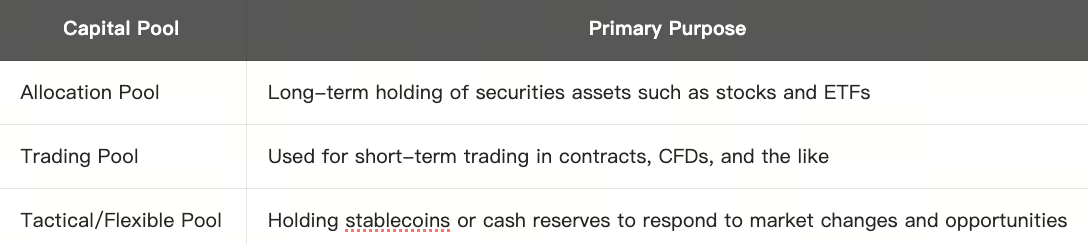
The significance of this division is as follows:
-
Long-term allocation funds are not affected by short-term trades, and short-term trading funds do not frequently occupy long-term investment positions.
-
Different capital pools serve different objectives, helping maintain overall investment rhythm stability.
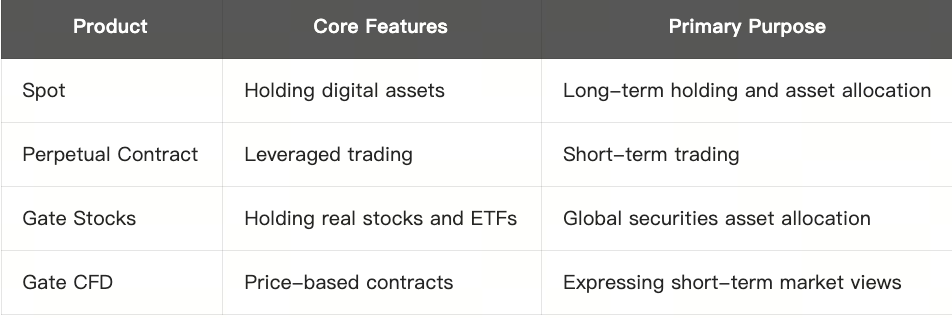
Gate's different products should be understood separately
Although Gate Stocks, Gate CFD, Spot, and Futures can all be accessed through the same platform, they correspond to different asset types.
Cross-Market Investing Principles
On the surface, all these products can be accessed using USDT, but their trading mechanisms, risk structures, and fund management methods differ. Therefore, maintaining independent management between different products is usually more important than frequently switching funds.
USDT is a tool that connects different markets, not a risk eliminator
USDT facilitates cross-market investments. Through USDT, it is easier to participate in digital asset trading, as well as enter various markets such as stocks, ETFs, or CFDs. However, it is important to note that USDT is merely a funding medium and does not eliminate the inherent risks of investment. Buying stocks means taking on stock price fluctuation risk; participating in CFDs involves leverage and position risk; investing in digital assets requires facing market volatility and industry changes.
Therefore, when using USDT for investments, understanding the assets being purchased is more important than focusing solely on the funding channel itself.
Three basic principles for cross-market investing
-
First, keep long-term allocation and short-term trading separate.
-
Second, use different fund pools for different products to avoid frequent mutual transfers of funds.
-
Third, prioritize understanding product rules before considering trading opportunities.
Market opportunities always exist, but a stable investment system is often built on rules and discipline.
Course summary
This lesson provided a summary of the entire course. From why securities markets have fixed trading hours, to the differences between stocks and ETFs; from the various ways to access US stocks, to corporate actions and the interconnections between US equities and crypto markets, it all leads back to one core issue:
Different markets and products require distinct investment logic and fund management approaches. Gate Stocks, Gate CFD, digital asset spot trading, and contract trading may all coexist within a single account system, but each corresponds to a different risk structure and investment objective. USDT can connect various markets, but it cannot replace risk management; understanding product rules and establishing clear fund segmentation are fundamental for the long-term stable operation of a cross-market investment system.
From understanding markets to comprehending products and building account systems, this provides a clearer cognitive framework for cross-market asset allocation.
Lesson 1:Why Do Securities Markets Have Their Own Time Rules?
Lesson 2:Do Buying Stocks and Buying ETFs Solve the Same Problem?
Lesson 3:Why "Buying US Stocks with USDT" Is Not the Same Product
Lesson 4:Why Do Holdings Change Even When No Trades Occur?
Lesson 5:US Stocks and Crypto Assets—Why Are They Linked, and Why Do They Sometimes Decouple?
Lesson 6:Where Does the Real Risk Lie When Participating Across Markets?
Related Courses

Tokenized Stocks: The Real Path for Bringing TradFi Assets On-Chain and the Boundaries of Risk

Reconstructing the TradFi System: How Blockchain Is Transforming Financial Infrastructure

TradFi Asset Migration On-Chain: From Traditional Financial Products to Crypto Trading Instruments

TradFi Risk Pricing and Derivatives Logic: How Traditional Finance Is Reborn in the Crypto Market

Derivatives Market Structure Analysis: Capital Flows and Risk Pricing Mechanisms