Why "Buying US Stocks with USDT" Is Not the Same Product
This lesson explains the fundamental differences in rights structures and product mechanisms by comparing four different paths—overseas brokers, platform spot securities, CFDs, and tokenized stocks. It clarifies the core distinctions between Gate Stocks and Gate TradFi CFD in terms of account setup, cost, and applicable scenarios.
Understanding the Four Different Paths
The phrase "buying US stocks with USDT" is very common in crypto communities but often obscures four entirely different legal and economic arrangements. Some people actually hold securities listed on NYSE or Nasdaq; some only hold contracts for difference that track stock prices; some hold on-chain mapping tokens; others settle in USD through traditional broker accounts, which have nothing to do with crypto accounts. The trading hours, corporate actions, leverage, overnight costs, and regulatory boundaries of these four approaches are all different.
If you treat both Stocks and CFDs under the TradFi section of the Gate App as "US stocks," you might easily apply the right macro view to the wrong product: for example, using CFD logic to hold "stocks" long-term or using the spot securities path for high-leverage overnight speculation. Gate Stocks connects to securities market execution and is not tokenized stock; it is independent from CFD accounts. Understanding these distinctions is not just product promotion—it's the baseline to avoid mixing accounts or expectations.
To participate in US stocks, you need to understand what exactly you're buying through each of the four paths.
Path One: Traditional Overseas Broker
You open an account through a licensed securities broker, complete identity verification and cross-border remittance or currency exchange, and settle in USD or other broker-supported currencies. Orders are routed to the US stock market for matching, where you hold actual stocks or ETFs and follow trading hours, disclosure, and corporate action rules.
This path is usually separate from crypto accounts, with relatively mature compliance and investor protection frameworks (varying by region). Friction mainly comes from currency conversion, deposit speed, and managing multiple accounts. If your assets are already in USDT on a digital asset platform, you'll need to plan your funding route further—this may not be the shortest path, but it's often most familiar to those already using broker accounts.
Path Two: Platform Spot Securities (Gate Stocks)
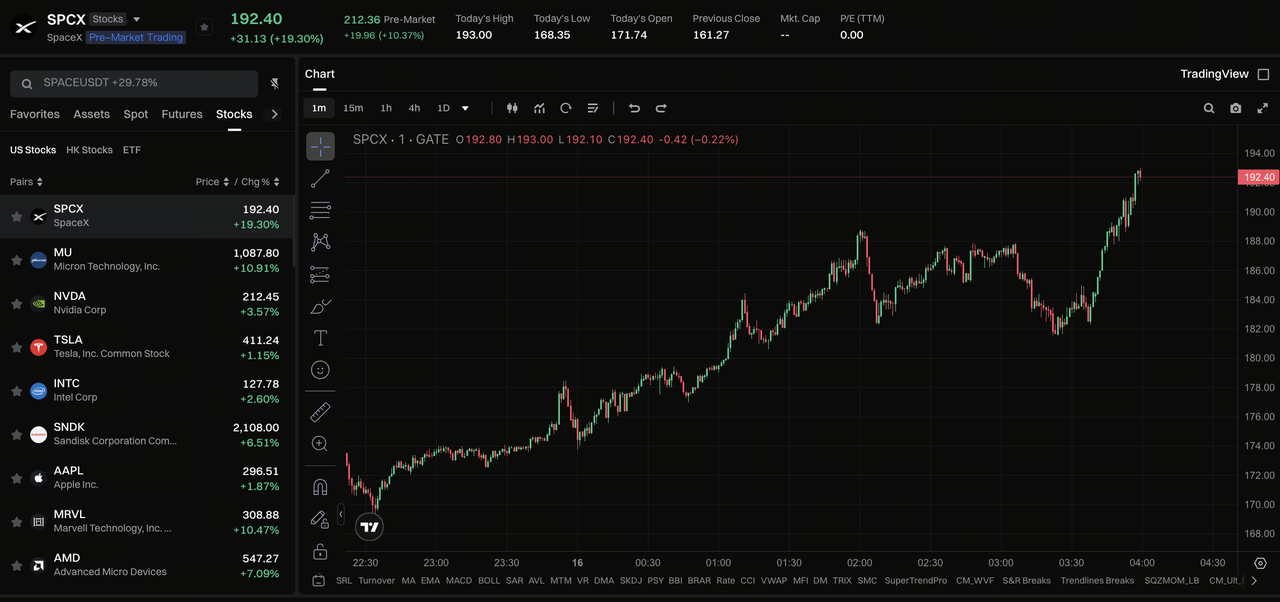 Source: Gate Market Data page
Some digital asset platforms offer spot services connected to the securities market. On Gate, after completing KYC and meeting regional requirements, you can transfer USDT into a Stocks sub-account to buy and sell stocks and ETFs listed on major US exchanges. Orders are matched within the securities market system, with prices sourced from real market liquidity.
Structural Features of Gate Stocks
Compared with CFDs, several structural features of Gate Stocks are especially noteworthy:
-
Funds are managed separately from CFD accounts; they should not be treated as the same USDT pool for arbitrary transfer.
-
There are no perpetual contract funding rates or typical CFD swap overnight fees—the structure is closer to a buy-and-hold allocation.
-
US stock trading hours must be followed; there is no 24/7 continuous trading.
-
Corporate actions such as dividends and splits are handled according to partner and custody rules and reflected in your account.
Applicable Scenarios
You already hold USDT on the platform and want to allocate to US stocks or broad-based ETFs for medium- to long-term holding without opening a separate broker account. Not applicable if you need complex options structures, rely on specific broker research tools, or if service is unavailable in your region.
The operation path can be summarized as: Gate account → Transfer USDT to Stocks sub-account → Place order during market hours → Holdings show shares or fund units.
Path Three: CFD (Gate TradFi)
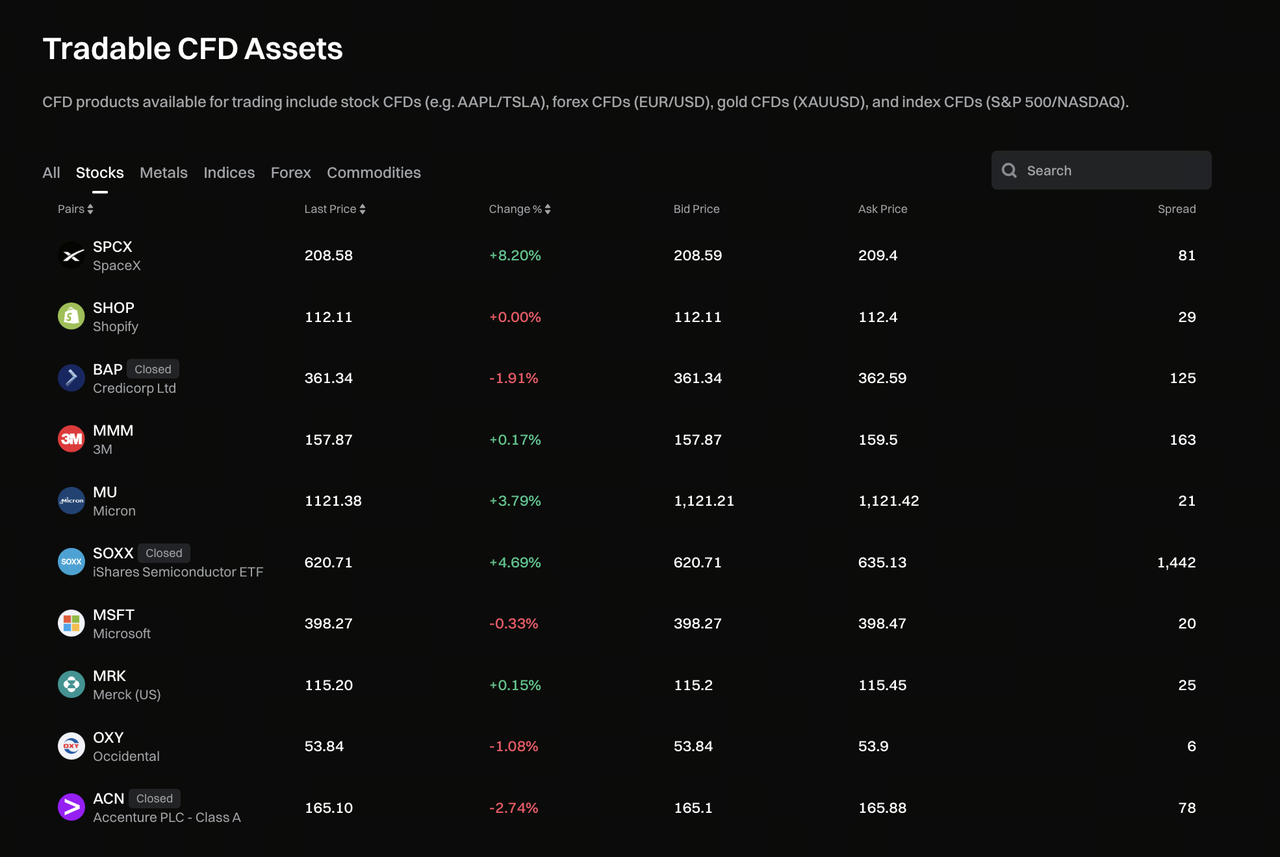 Source: Gate TradFi page
CFDs (Contracts for Difference) trade on price movements without usually holding the underlying stocks. Gate TradFi offers stock CFDs (such as AAPL, TSLA), index CFDs (such as S&P 500, NASDAQ), forex, gold, and more—all using USDT as margin, supporting both long and short positions. Leverage on stock CFDs is generally lower than on forex or indices (about 5x per official statement; forex and indices may allow higher multiples). There are overnight financing fees (Swaps) and trades follow TradFi session and holiday rules.
Users familiar with BTC perpetuals may think of CFDs as a "US stock version of perpetuals": similarities include margin and bi-directional trading; differences include session closures, Swaps instead of funding rates, liquidation, and contract terms governed by TradFi rules. The primary use case for CFDs can be risk management or directional expression, but in retail settings high-leverage speculation is more common—regardless of intent, by design it is not just "another way to buy stocks."
Key Comparison Between Gate Stocks and Gate CFD
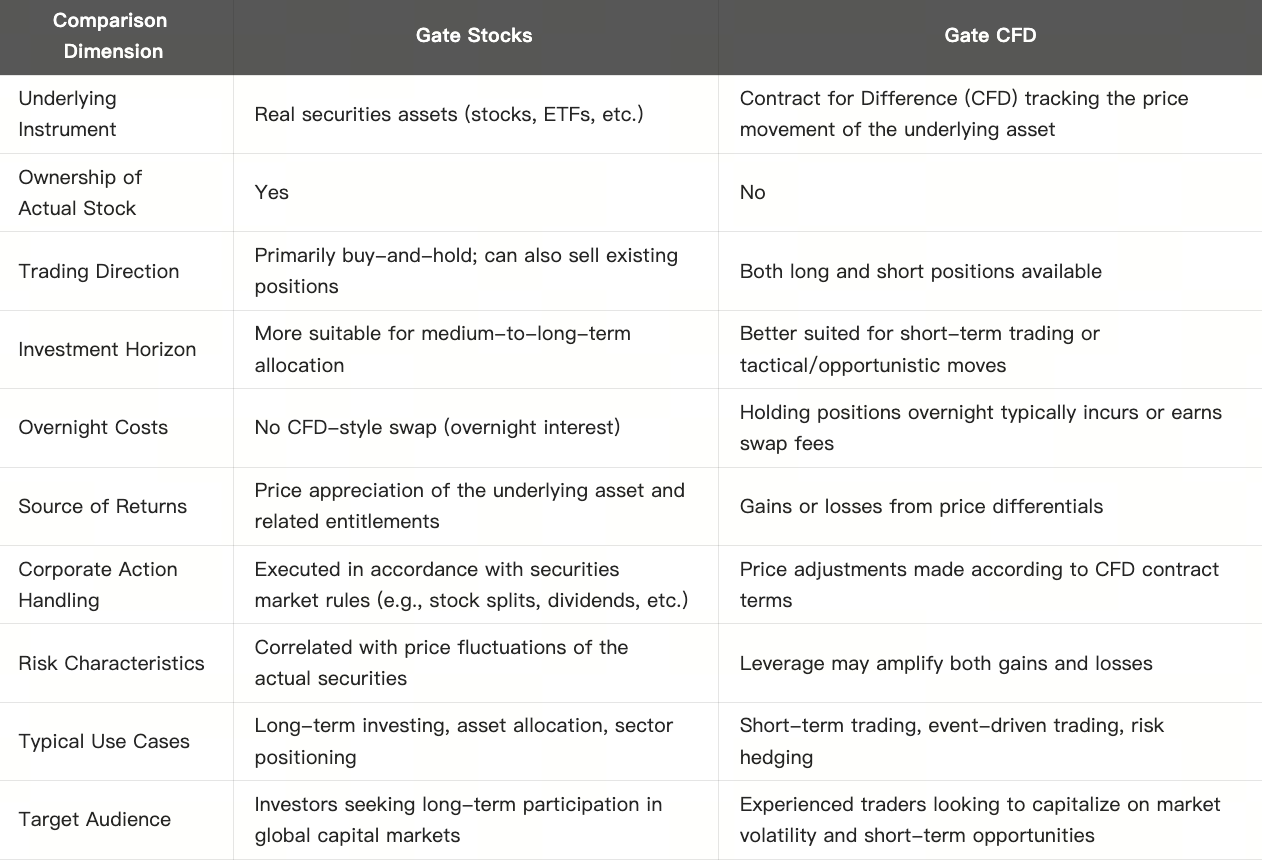
Gate Stocks is more like "buying assets," sharing in the long-term growth of companies and markets; Gate CFD is more like "trading prices," focusing on trading opportunities brought by market fluctuations. Neither is absolutely better or worse—each suits different investment goals and trading strategies.
Path Four: Tokenized Stocks
In recent years, with the development of the RWA (Real World Asset) concept, the market has seen the emergence of tokenized stocks as a new asset class.
Tokenized stocks typically map stock prices through on-chain tokens, so investors hold digital tokens instead of actual stocks in a securities account. These products usually reference the corresponding stock's market price for trading, but there may be significant differences between issuers regarding asset custody, redemption mechanisms, price tracking, and investor rights.
Therefore, tokenized stocks and traditional securities are not directly equivalent. Holding tokens does not necessarily grant shareholder rights identical to those of real stocks; specific rules depend on the issuer's product design.
It's important to note that Gate Stocks provides spot securities trading services, not tokenized stocks. Gate Stocks connects to actual stocks and ETF assets in the securities market, with trading rules following the securities market system. Tokenized stocks are on-chain assets, and there are clear differences between the two in terms of trading mechanisms, holding methods, and rights structures.
From an investment logic perspective, real securities are more suitable for long-term asset allocation, while tokenized stocks are innovative products in the RWA field, making them an important area for research and understanding within the on-chain asset ecosystem.
Investment Costs: Different Paths, Different Fee Structures
Each investment path comes with a different cost structure.
-
Traditional brokers mainly involve trading commissions, currency exchange costs, and some account service fees. If cross-currency trading is involved, exchange rate fluctuations will also affect overall investment costs.
-
Spot securities trading mainly includes transaction fees and bid-ask spreads. With Gate Stocks as an example, investors can directly use USDT to participate in securities trading without going through traditional bank currency exchange processes, improving convenience for cross-market investments. However, greater convenience does not eliminate risks—stock price volatility remains a key factor affecting returns.
-
CFD fee structures are relatively complex; in addition to spreads and commissions, holding positions overnight usually involves swaps. Under leverage mechanisms, both returns and risks are amplified.
-
Tokenized stocks may involve not only transaction fees but also on-chain gas fees, trading slippage, and price deviation costs.
Therefore, when comparing different investment paths, you need to consider holding period, investment goals, and trading costs comprehensively—not just judge based on a single fee item.
Regional Restrictions and Compliance Requirements
Regardless of how you participate in the global stock market, you must comply with local laws and platform compliance requirements.
Because countries and regions differ in their regulatory rules for securities products, derivatives, and digital assets, some products and services may not be available in all jurisdictions.
The service scope of Gate Stocks and Gate CFD is also subject to jurisdictional restrictions. Before participating in related products, you should first complete identity verification and confirm whether your region supports the corresponding services, while also understanding relevant rules for securities products and derivatives under your local regulatory framework.
This course focuses on product mechanisms and investment knowledge and does not constitute legal, tax, or investment advice.
Course Summary
This lesson introduced four main paths to participate in the US stock market: traditional brokers, spot securities, CFDs, and tokenized stocks.
Among these, traditional brokers and spot securities trading involve holding actual securities assets—suitable for long-term investment and asset allocation; CFDs are price contracts that emphasize trading opportunities from market volatility; tokenized stocks are an on-chain asset innovation whose trading rules and rights structures must be analyzed according to each specific project.
Although all these products offer US stock investment opportunities, their underlying assets, trading mechanisms, risk structures, and applicable scenarios differ. Understanding the distinctions among these products is a crucial foundation for building a global stock investment system.
The next lesson will further introduce common corporate actions in securities investing—such as cash dividends and stock splits—and analyze how these changes impact account assets and positions.
Lesson 1:Why Do Securities Markets Have Their Own Time Rules?
Lesson 2:Do Buying Stocks and Buying ETFs Solve the Same Problem?
Lesson 3:Why "Buying US Stocks with USDT" Is Not the Same Product
Lesson 4:Why Do Holdings Change Even When No Trades Occur?
Lesson 5:US Stocks and Crypto Assets—Why Are They Linked, and Why Do They Sometimes Decouple?
Lesson 6:Where Does the Real Risk Lie When Participating Across Markets?
Related Courses

Tokenized Stocks: The Real Path for Bringing TradFi Assets On-Chain and the Boundaries of Risk

Reconstructing the TradFi System: How Blockchain Is Transforming Financial Infrastructure

TradFi Asset Migration On-Chain: From Traditional Financial Products to Crypto Trading Instruments

TradFi Risk Pricing and Derivatives Logic: How Traditional Finance Is Reborn in the Crypto Market

Derivatives Market Structure Analysis: Capital Flows and Risk Pricing Mechanisms