What Is a CFD—Definition, Nature, and Differences from Spot and Futures
This lesson explains the definition of CFDs and how profits and losses are generated. It clarifies that CFDs do not grant ownership of the underlying asset and only trade price differences, while comparing them with spot and futures.
1. What Does “CFD” Mean?
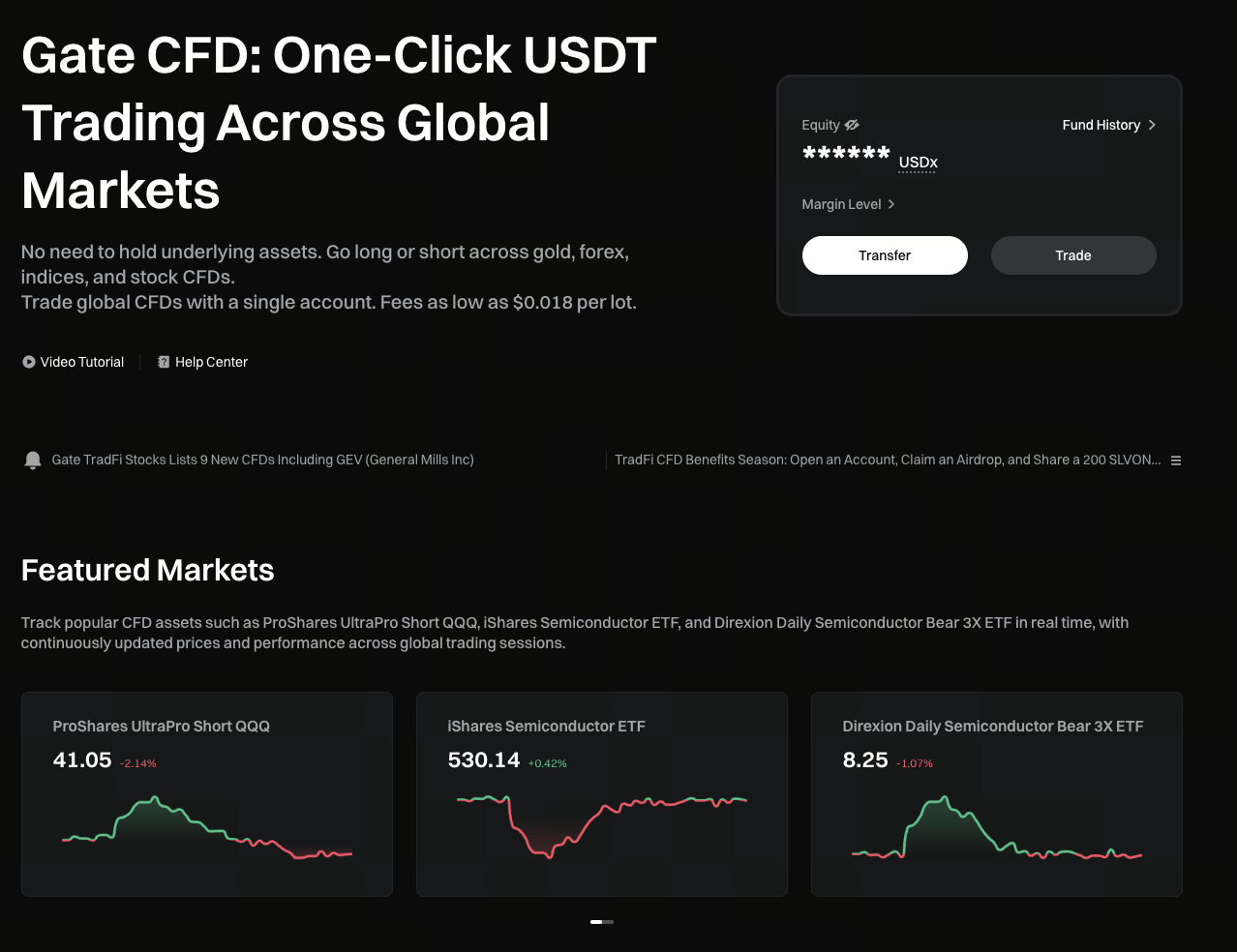
Image source: Gate CFD page
CFD stands for Contract for Difference. The name captures the essence: both parties agree to settle based on the “price difference,” rather than delivering an actual asset or security to an account as in traditional models.
In a typical CFD structure, a trader and a broker (or liquidity provider) enter into a contract based on an underlying asset (such as gold quotes, EUR/USD rates, an index, a stock, etc.). Between opening and closing a position, if the price moves in favor of the position, a positive cash flow is generated; if it moves against, a negative cash flow occurs. Profits and losses are settled in cash, functioning more like “contractual gains and losses settled by rules” rather than “buying and holding the asset itself.”
Therefore, the fundamental concept for this lesson is: a CFD is first a contract and settlement mechanism, and only then a tool for long or short trading. Mixing up this order can lead to misunderstandings, such as thinking of CFDs as a “cheaper way to buy stocks” or a “more convenient way to buy gold”—which is not accurate legally or economically.
2. Not Holding the Underlying Asset: What Exactly Is Missing?
The course outline emphasizes: CFDs do not confer ownership of the underlying asset. This statement needs to be understood on three levels.
2.1 No shareholder rights such as voting or dividends (unless specifically simulated in product terms)
Stock CFDs typically track the price of the underlying asset but do not equate to holding shares of a listed company. Whether dividend adjustments or corporate actions apply depends entirely on specific product rules and terms.
2.2 No right to physical delivery of commodities
Profits and losses from gold CFDs come from price movements; they do not mean you own withdrawable gold bars in a vault. The same applies to energy, agricultural products, etc. If physical delivery or futures positions are needed, choose the corresponding market and product.
2.3 No psychological anchor of “the coin/note in your wallet”
Many beginners interpret CFDs with a spot trading mindset, thinking “buying means holding.” CFDs are closer to “contracts with counterparties to settle based on price paths” (regulatory language may vary by region). Account changes reflect margin and equity, not the underlying asset itself.
Understanding what is missing allows for correct expectations: CFDs provide price exposure, not asset collection or long-term shareholder status.
3. Where Do Profits and Losses Come From: Trading Only the “Price Difference”
Profits and losses from CFDs can be summarized as: entry price and exit price (plus contract size and direction) together determine cash flow.
- Long: Expecting the price to rise. If the closing price is higher than the opening price (excluding costs and leverage details), there is a theoretical profit; otherwise, a loss.
- Short: Expecting the price to fall. If the closing price is lower than the opening price, there is a theoretical profit; otherwise, a loss.
Actual settlement also includes spread, overnight fees (swap), commissions, slippage, etc. (covered in later lessons). For now, remember: direction is only part of profit and loss—costs and execution quality also matter.
4. Core Differences from Spot
Spot typically refers to “buying or selling the actual asset at current prices” (such as stocks, physical gold, spot FX, etc.). Main features include:
- Holding the asset itself (or corresponding rights/liabilities);
- Price risk tied to asset ownership;
- Leverage, if present, usually involves financing or margin trading with rules different from CFD margin systems.
Key differences between CFDs and spot can be summarized as:
Content cannot be displayed outside Lark Docs
In short: Spot answers “do you own something”; CFD answers “are you willing to take on risk and return from a certain price path.”
5. Similarities and Differences with Futures: Don’t Oversimplify as “Both Are Derivatives”
CFDs and futures are both derivatives, but important differences should be highlighted from the start (details depend on each exchange/broker contract):
5.1 Expiry date and settlement logic
Traditional futures often have expiration months, delivery or roll-over arrangements; many retail CFDs have no fixed physical delivery process, settling mainly in cash differences with positions extendable as rules allow. For users, this means convenience—no need to manage rollovers—but also responsibility for managing overnight costs and terms risks.
5.2 Degree of standardization
Futures contracts are typically highly standardized on exchanges; CFDs are mostly OTC or broker-quoted, with contract terms, fees, overnight rules set by each provider.
5.3 Regulation and investor protection
Regulatory strength, leverage limits, and marketing restrictions for CFDs vary widely by jurisdiction. Be aware: similar product names do not mean identical legal attributes or protections.
Similarity: Both allow leveraged views on price and may trigger margin-related actions during extreme volatility.
6. Why Does the Market Need CFDs?
From a functional perspective, CFDs offer:
- Expression efficiency: Take positions on multiple asset classes within one account system;
- Two-way trading: Ability to go short during downturns or sideways markets (within rule limits);
- Portfolio management integration: Serve as macro or risk-hedging components (understanding costs and tail risks is essential).
These values rely on correctly understanding their contractual nature. Misinterpreting CFDs as “discounted spot” will hinder grasping margin, liquidation, and cost concepts in later lessons.
7. Common Misconceptions
Misconception 1: “CFDs are just a cheap way to buy stocks/gold”
In reality, it’s about contract price differences and margin mechanisms; rights and obligations differ from spot.
Misconception 2: “Shorting means it’s safer”
Shorting also faces unlimited upside risk (before leverage constraints), with potentially more complex cost structures.
Misconception 3: “Open an account first, then learn”
You should first understand ownership boundaries, settlement logic, and risk disclosures before considering live trading.
Summary
The key conclusions of Lesson 1 are as follows. First, CFD (Contract for Difference) trading settles in cash based on price changes in the underlying asset—the core is the “price difference,” not ownership of the asset. Second, compared to spot trading, CFDs do not automatically provide rights or structures associated with owning the asset itself; instead, they offer leveraged price exposure. Third, while both are derivatives like futures, there are significant differences in expiry/delivery arrangements, standardization, and contract terms that must be reviewed per platform and product documentation. Fourth, correctly understanding “no ownership, only contract settlement” is foundational for learning about trading mechanisms, margin, costs, and risk management going forward.
Lesson 1:What Is a CFD—Definition, Nature, and Differences from Spot and Futures
Lesson 2:CFD Trading Mechanism—How Buying, Selling, and Profit & Loss Are Formed
Lesson 3:Asset Classes—Which Traditional Markets Can CFDs Cover
Lesson 4:Margin and Leverage—Why Returns Are Amplified and How Risks Can Quickly Spiral Out of Control
Lesson 5:Trading Costs—Spreads, Overnight Fees, and the Real Friction in Short-Term Trading
Lesson 6:Trading Hours and Market Interactions—When Is Liquidity Best, When Is Volatility Higher
Lesson 7:Risk Management—Single Trade Risk, Position Sizing, Stop Losses, and Event Window Discipline
Lesson 8:Practical Case Study—A Complete Walkthrough Using Gate CFD
Lesson 9:Course Summary—CFD Opportunities, Costs, Risks, and Suitable Participants
Related Courses

The Beginner's Guide to Blockchain-based Airdrops

Crypto Mining Equipment

Identity in Crypto: Main Projects
Introduction to Masternode Tokens

Crypto Mining