ZAMA Protocol In-Depth Analysis: The Confidential Blockchain Protocol Reshaping the Era of On-Chain Privacy
What Is the ZAMA Protocol?
The ZAMA Protocol serves as a Confidential Blockchain privacy layer for existing public blockchains. Its central goal is to enable end-to-end encrypted execution of smart contracts. Unlike conventional Layer 1 or Layer 2 solutions, ZAMA is not a new blockchain. Instead, it functions as an independent privacy layer over current chains, allowing users to deploy privacy-focused smart contracts on platforms like Ethereum and Solana, while maintaining access to native assets and ecosystem benefits.
ZAMA leverages fully homomorphic encryption (FHE) technology developed by Zama, enabling the direct computation of smart contract data in its encrypted state. Even network nodes and operators cannot decrypt contract inputs or states, significantly strengthening blockchain privacy protections.
Key Technical Highlights of the ZAMA Protocol
The ZAMA Protocol’s architecture is built around three core innovations:
1. Fully Homomorphic Encryption (FHE)
FHE enables operations on encrypted data without decryption, addressing blockchain’s fundamental privacy challenge: data exposure. While traditional blockchains make all states and transactions publicly accessible, FHE ensures that even contract execution occurs in an encrypted state.
2. Multi-Party Computation (MPC)
To prevent key centralization, ZAMA uses MPC to distribute key shares across multiple nodes. This avoids single points of failure and ensures that decryption requires collaboration among nodes, enhancing decentralization and network security.
3. Zero-Knowledge Proofs (ZK)
ZK mechanisms verify the correct encryption of user-submitted ciphertext, preventing malicious inputs and reducing verification overhead for more efficient protocol operations.
By integrating these technologies, ZAMA delivers privacy support for on-chain applications without altering the underlying host chain protocol.
The Real-World Value of Confidential Blockchain
Traditional blockchain transparency boosts security and trustlessness but also exposes sensitive data—such as asset balances, transaction amounts, and identity details—making it unsuitable for compliant financial or enterprise environments.
The ZAMA Protocol enables:
- Asset transactions without revealing balance information
- Privacy-preserving computation compatible with regulatory compliance
- Smart contracts that control decryption rights for sensitive data
This approach not only protects individual privacy but also transforms data security frameworks in DeFi, identity management, and on-chain governance.
Primary Use Cases for the ZAMA Protocol
With its Confidential Blockchain capabilities, the ZAMA Protocol is well-suited for:
1. Confidential DeFi
Users can keep position sizes and transaction data private, mitigating front-running (MEV) risks and safeguarding large holders’ privacy.
2. On-Chain Identity and Governance
Homomorphic encryption enables private identity verification and confidential voting, ensuring that votes and identity information remain protected.
3. Data Markets and Confidential AI Training
Users can selectively encrypt data for model training, keeping actual content undisclosed.
Advantages over Traditional Privacy Solutions
Conventional blockchain privacy solutions, such as zero-knowledge rollups and private chains, have various strengths and limitations.
ZAMA stands out by:
- Preserving the original chain ecosystem without cross-chain bridges or asset migration
- Encrypting data throughout contract execution for enhanced security
- Offering composability, allowing integration with non-confidential contracts
In contrast, traditional privacy solutions often sacrifice composability or ecosystem compatibility.
Future Roadmap and Ecosystem Development
According to the official litepaper, the ZAMA Protocol has launched testnets on several public blockchains and plans to expand support to more ecosystems. Performance will be further optimized through hardware acceleration and advanced ZK technology to meet higher concurrency requirements.
This cross-chain privacy solution is positioned to become a leading blockchain privacy technology, driving broader enterprise and compliance adoption.
Conclusion
By combining innovative FHE, MPC, and ZK technologies, the ZAMA Protocol introduces a new paradigm for privacy computation in blockchain. It protects sensitive user data while enhancing the composability and security of smart contracts. As the mainnet progresses, its ecosystem potential merits close attention.
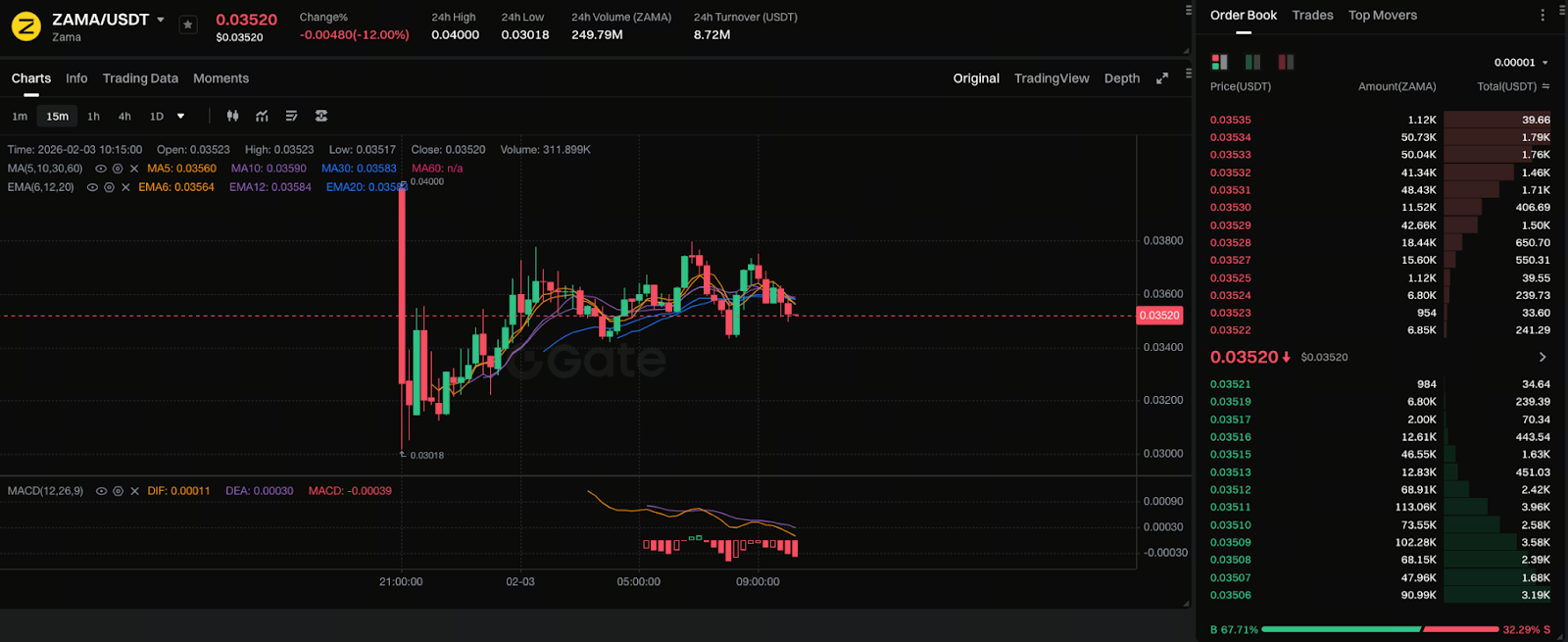
Image: https://www.gate.com/trade/ZAMA_USDT
As of February 3, 2026, ZAMA is priced at approximately $0.035. The token is highly volatile; please exercise caution and manage risk when trading.
Related Articles

AI-Native Settlement Layers: How United Stables Is Building the Next Financial Rail

The ve(3,3) Flywheel Explained: How AERO Tokenomics Powers Aerodrome’s DeFi Economy

How Does PAXG Work? In-Depth Overview of the Physical Gold Tokenization Mechanism

Aerodrome Tokenomics: How ve(3,3) Powers Base's Most Profitable DEX

How is the price of PAXG determined? Pegging mechanism, trading depth, and influencing factors
