With a big year for the crypto market approaching, Bitcoin (BTC) developers are gathering to resume work.
Jameson Lopp reports that key metrics tracking Bitcoin Core development indicate 2025 is shaping up to be a banner year for the blockchain, with more developers contributing more code than ever before.

Latest News
According to Bitcoin advocate Jameson Lopp, the developers who maintain the software powering most blockchain nodes have been especially active in 2025, with a growing number of contributors submitting more code.
Lopp, co-founder of the crypto management platform Casa, stated on Sunday, January 4, that 135 unique developers contributed code to Bitcoin Core last year, up from just over 100 in 2024, continuing a steady growth trend. The record for contributors was set in 2018, nearing 200 participants.
The volume of code changes has also risen. Lopp noted that 285,000 lines of code were modified last year, a more than 3% increase from the 276,000 lines changed in 2024.
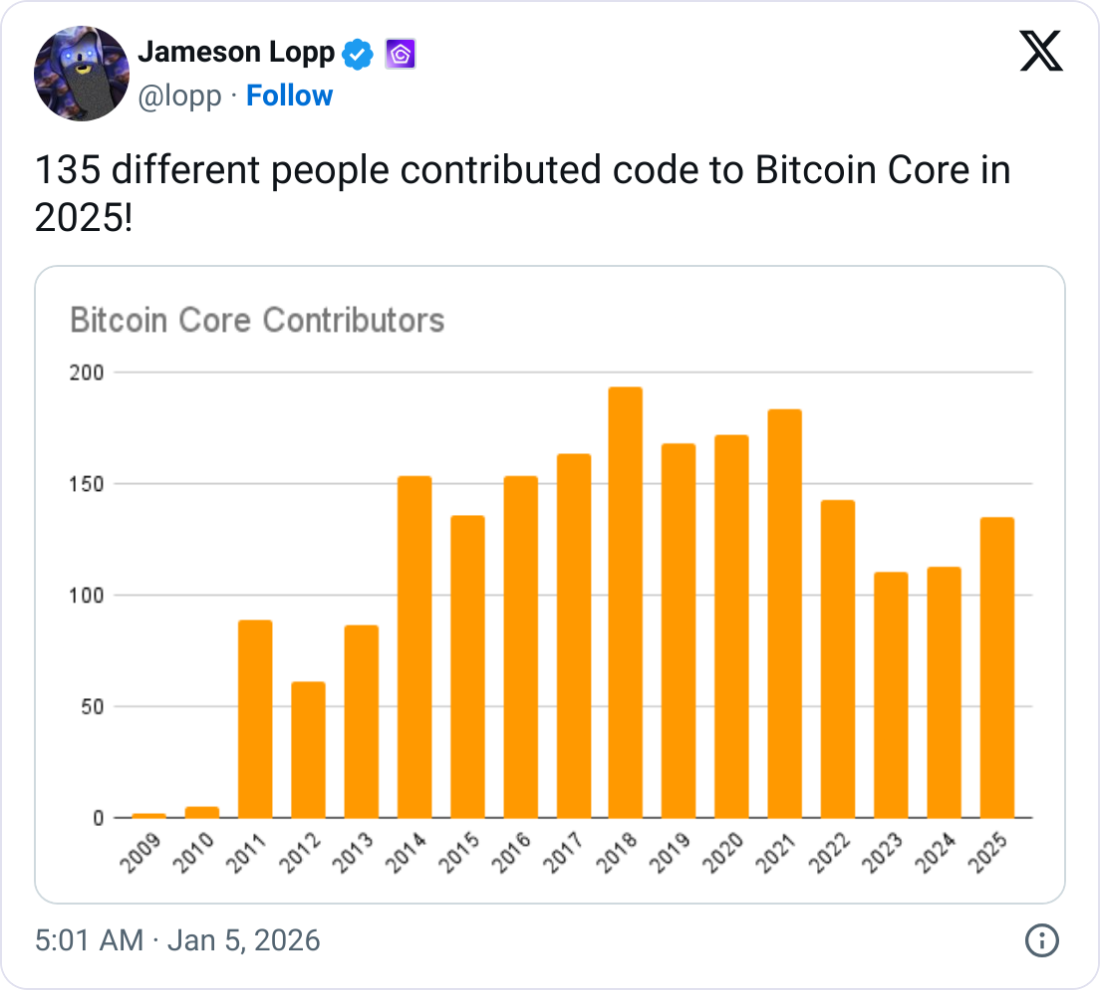
Source: Jameson Lopp
As Bitcoin (BTC) enters a milestone year, developer activity has accelerated. In 2025, Bitcoin set new all-time highs, with its price surpassing $126,000 in October. Meanwhile, major financial institutions have placed significant bets on the digital asset under the crypto-friendly Trump administration.
Metrics Indicate Increased Developer Engagement
Lopp also highlighted that Bitcoin Core code commits—which represent updates to the codebase—rose 1% year-over-year to 2,541, marking continued growth since 2023 after a dip from the nearly 3,500 peak in 2021.
The Bitcoin Development mailing list, which serves as a forum for discussing network changes, saw its email volume surge 60% year-over-year in 2025.
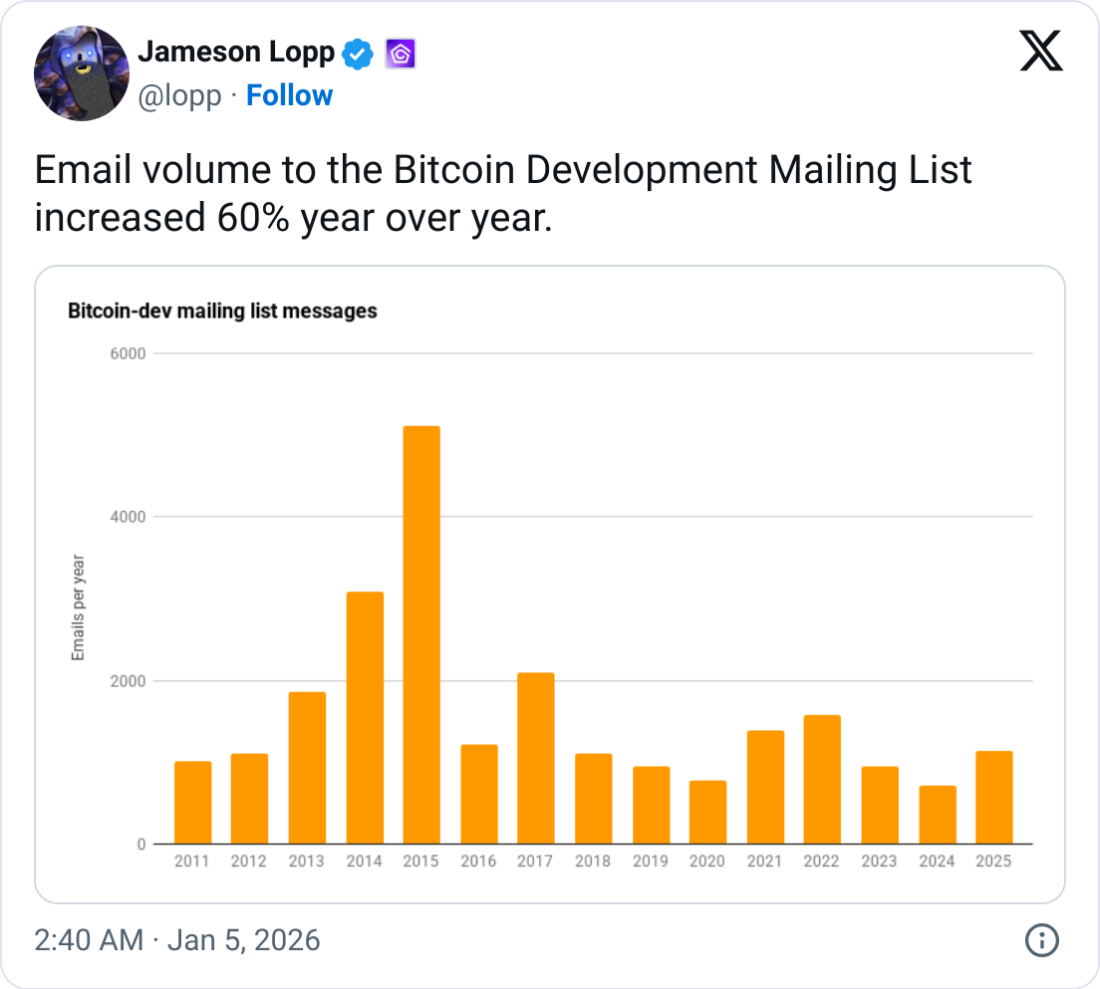
Source: Jameson Lopp
Still, this remains well below the all-time high of around 5,000 messages recorded in 2015.
The uptick in these metrics underscores a landmark year for Bitcoin Core development, including renewed debate over the OP_RETURN data limit. In October, this limit was raised, enabling more non-financial data to be embedded within Bitcoin transactions.
Further, Bitcoin Core underwent its first third-party security audit in November. Security firm Quarkslab concluded that the blockchain’s software is “mature and thoroughly tested,” with no high- or medium-severity vulnerabilities found.
Statement:
- This article is republished from [Cointelegraph], with copyright held by the original author [Jesse Coghlan]. For any concerns regarding republication, please contact the Gate Learn team, which will address inquiries promptly according to established procedures.
- Disclaimer: The views and opinions expressed in this article are those of the author alone and do not constitute investment advice.
- Other language versions of this article are translated by the Gate Learn team. Unless Gate is cited, reproduction, distribution, or plagiarism of the translated content is strictly prohibited.
Related Articles

In-depth Explanation of Yala: Building a Modular DeFi Yield Aggregator with $YU Stablecoin as a Medium
BTC and Projects in The BRC-20 Ecosystem

What Is a Cold Wallet?

Blockchain Profitability & Issuance - Does It Matter?
What is the Altcoin Season Index?