Why Most ETH Stays Unstaked — How Gate GTETH Reframes Ethereum Staking
Consistently Conservative Staking Participation
After Ethereum transitioned to PoS consensus, staking became the foundation of network operation and security. Yet, actual participation rates show that ETH staking hasn’t achieved the expected level of adoption. Most holders understand the potential returns but remain hesitant to get involved.
For most investors, staking isn’t a routine portfolio allocation. Instead, it represents a long-term commitment that requires locking up funds and giving up flexibility. When market volatility increases and strategies need quick adjustments, staking restricts asset agility.
The Real Barrier: Conflicting Asset Usage Habits
Staking barriers go beyond technical challenges. Even when using third-party platforms, users must contend with locked funds, complex yield tracking, and unintuitive processes. These factors have led staking to be seen as unsuitable for frequent adjustments, rather than as a flexible asset management tool.
When earning yield means sacrificing liquidity, most users choose to preserve flexibility. This is why ETH staking remains concentrated among a small group of participants.
GTETH: Redefining Participation
GTETH is designed to eliminate the need for users to understand PoS or node operations. Instead, it streamlines the entire process into a single asset conversion. By converting ETH to GTETH, users complete the staking process. From that point on, the system automatically handles all node operations, yield generation, and distribution. For holders, staking becomes a simple asset status change, not an ongoing management task—making participation nearly effortless.
Returns Directly Reflected in Value
Most staking products require users to calculate, wait for, and manually claim rewards. GTETH offers a different approach. Staking rewards generated from Ethereum PoS, along with GT incentives provided by Gate, are directly reflected in the value of GTETH over time. As long as you hold GTETH, its corresponding ETH value continues to grow automatically—no extra steps required. On-chain transparency ensures these returns are easily verifiable and align with the preferences of long-term holders.
Liquidity as the Standard, Not a Trade-Off
The main issue with traditional staking is the loss of immediate access to funds once staked. GTETH removes this limitation at the structural level, enabling users to benefit from both yield and liquidity. While holding GTETH, you can redeem ETH at any time or trade on the market—no waiting for a fixed unlock period. This means staking no longer forces a choice between returns and flexibility. Assets can adjust in real time to market conditions.
From Yield Tool to Strategic ETH Allocation
With liquidity no longer a constraint, GTETH’s role evolves. It’s not just a staking alternative—it’s a dynamic ETH allocation tool. Whether reducing exposure during market swings or reallocating capital to new opportunities, GTETH serves as a flexible component in asset management. For the first time, staking can be integrated into a broader investment strategy, rather than being an isolated portfolio segment.
Transparent and Predictable Yield Structure
GTETH yields are clearly divided into two components:
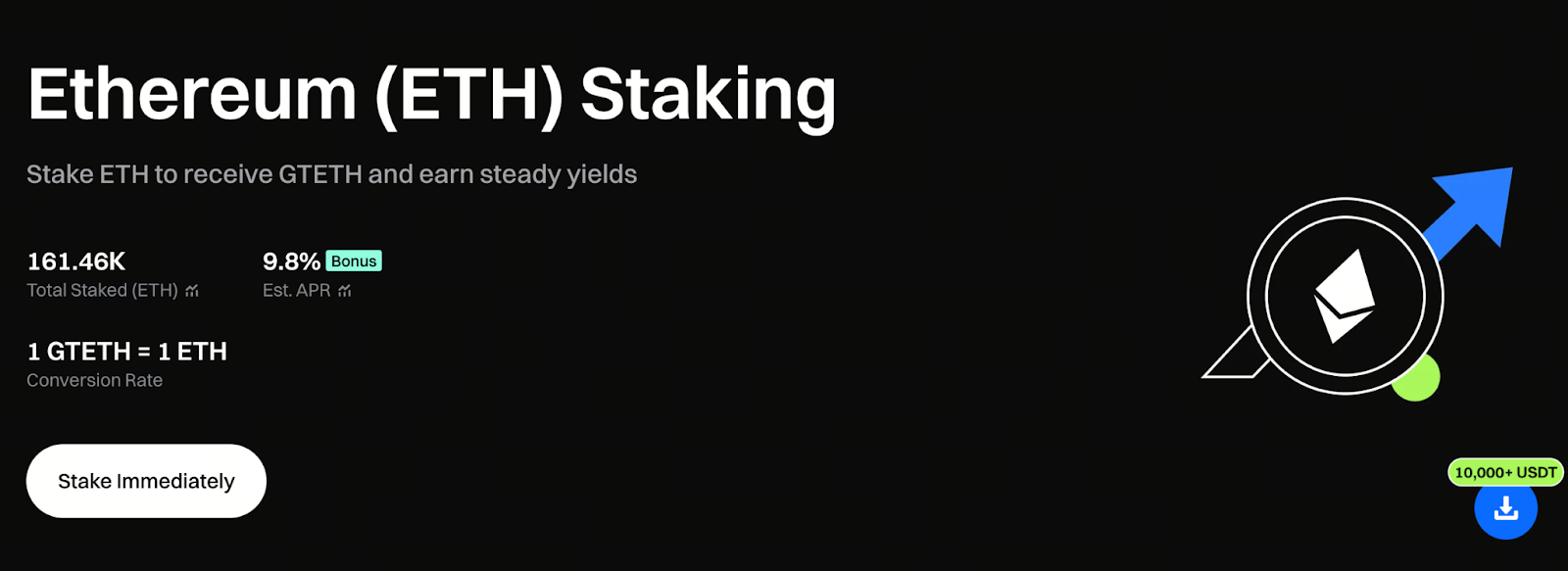
- Ethereum PoS staking rewards: approximately 2.8% annualized
- Additional GT incentives from Gate: approximately 7% annualized
When you redeem ETH, all accumulated rewards are immediately reflected in the redemption—no extra applications or waiting periods required.
Start your on-chain mining journey with Gate ETH staking now: https://www.gate.com/staking/ETH?ch=ann46659
VIP Level Drives Long-Term Efficiency
GTETH features a fee structure tied to VIP level. The base fee rate is 6%, with discounts at higher VIP tiers:
- VIP 5 – 7: 20% fee discount
- VIP 8 – 11: 40% fee discount
- VIP 12 – 14: 60% fee discount
While the short-term impact may be minimal, over the long term and with compounding, fee levels become a major factor in overall returns.
How GTETH Differs from Mainstream LSTs
Most liquid staking tokens are essentially certificates for locked assets, making them difficult to adjust in real time. GTETH, however, functions more like a daily asset management tool. Its value tracks yield, and it offers both liquidity and return potential. In this model, staking is no longer a static portfolio allocation but a flexible ETH strategy that adapts to your needs.
Conclusion
GTETH’s core value lies not in technological novelty but in redefining staking’s role in asset management. It eliminates the psychological and capital constraints of lock-up, preserves PoS yield potential, and builds trust through transparent on-chain mechanisms. With PoS now the standard for Ethereum, staking doesn’t have to be a rigid, long-term commitment. Instead, it can be a flexible allocation that adapts to market changes. For users seeking both liquidity and stable returns, GTETH provides a solution aligned with modern Web3 asset management logic.
Related Articles

AI-Native Settlement Layers: How United Stables Is Building the Next Financial Rail

The ve(3,3) Flywheel Explained: How AERO Tokenomics Powers Aerodrome’s DeFi Economy

How Does PAXG Work? In-Depth Overview of the Physical Gold Tokenization Mechanism

Aerodrome Tokenomics: How ve(3,3) Powers Base's Most Profitable DEX

How is the price of PAXG determined? Pegging mechanism, trading depth, and influencing factors
