Why Is Ethereum Falling? In-Depth Analysis of the Drop Below $2,200 and Market Trends
1. Current Ethereum Market Performance Overview
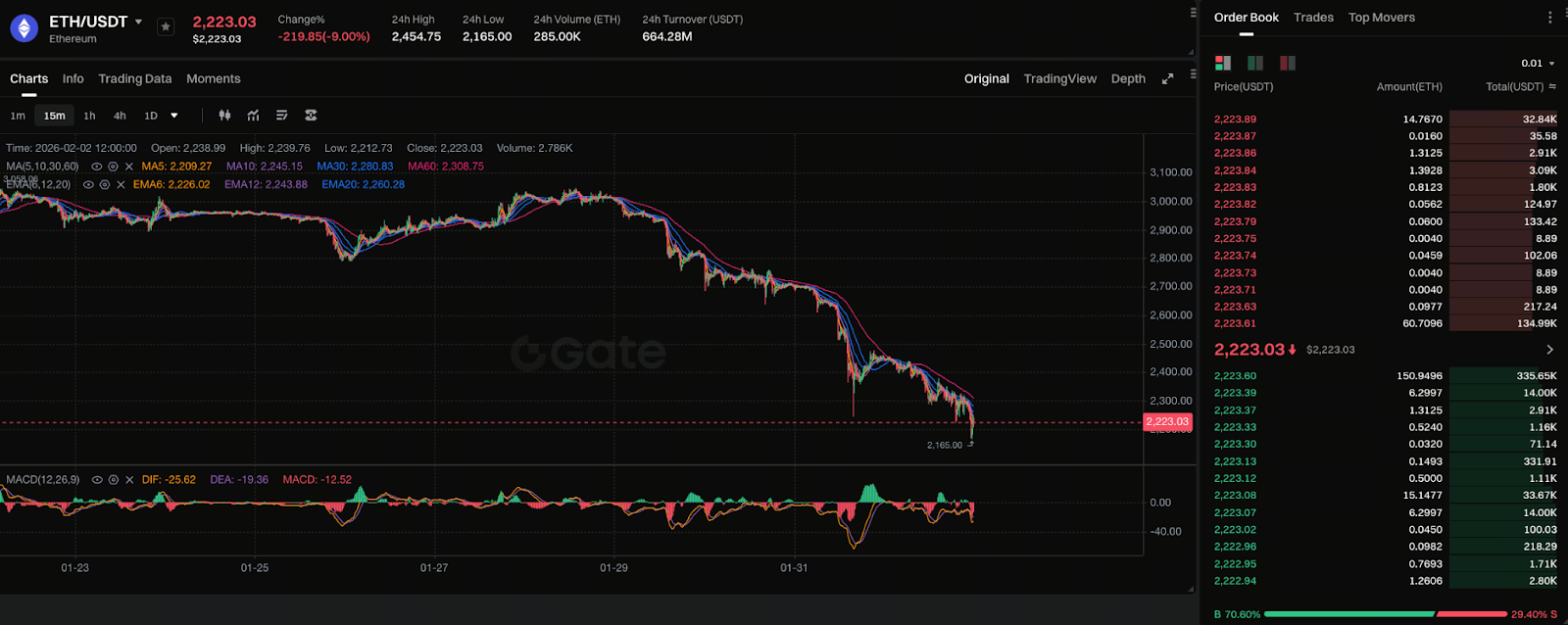
Chart: https://www.gate.com/trade/ETH_USDT
Recently, the cryptocurrency market—including Bitcoin and Ethereum—has experienced a sharp downturn, with ETH breaking below key support levels and overall market panic intensifying. Data indicates that Ethereum’s price has retreated significantly from multi-month highs, and the balance of bullish and bearish forces has shifted. As of February 1, 2026, based on the 15-minute interval data above, ETH/USDT is trading around $2,223, down approximately 9% over the past 24 hours, with a low of $2,165. This marks a classic high-volume sell-off. The price has successively breached crucial psychological levels at $2,500, $2,400, and $2,300, with the overall structure showing a clear downward trend as both highs and lows continue to fall. Technically, ETH is trading below the MA5, MA10, MA30, and MA60 moving averages, which are aligned in a standard bearish formation, and any rebound faces strong selling pressure. Trading volume has surged during the decline, while rebound volume remains weak, reflecting that sellers are currently dominating the market. The MACD indicator is below the zero line, with brief signs of convergence but no confirmed bullish crossover, and no clear signals of a trend reversal. Order book depth reveals concentrated sell orders above and scattered buy orders below, with no evident support forming around the $2,200 level. Overall, this ETH decline is primarily driven by sentiment release and technical breakdowns. In the near term, the market remains defensive, and attention should focus on further support in the $2,160–$2,100 range.
2. Downward Pressure Across the Crypto Market as the Main Driver
Why is Ethereum dropping? From a broader perspective, ETH’s price movement is highly correlated with Bitcoin. When Bitcoin declines, Ethereum typically faces pressure as well, which is especially pronounced in the current market. Macroeconomic uncertainty, global equity volatility, and trade tensions have weighed on risk assets, reducing investor risk appetite and impacting crypto prices.
3. ETH’s Growing Sensitivity to Macroeconomic Factors
As the correlation between crypto and traditional financial markets deepens, macro factors such as Federal Reserve policy shifts, interest rate expectations, and dollar trends have an increasingly significant impact on Ethereum’s price. For instance, a more cautious Fed and slower rate cut expectations have heightened pressure on the already volatile crypto market. These macroeconomic shifts are among the key reasons for ETH’s recent price decline.
4. Technical Factors and Supply Dynamics
Technical indicators also signal downward pressure. After ETH lost multiple key support levels, technical traders have reduced their positions, amplifying price volatility. Additionally, Ethereum’s supply dynamics have shifted. While the transition to Proof of Stake (PoS) initially produced deflationary effects, recent changes in network activity and upgrade outcomes have resulted in renewed supply growth, weakening expectations of scarcity.
5. Intensified Competition and Evolving Network Activity
Another critical factor is ecosystem competition. Ethereum continues to face challenges from other blockchains such as Solana and BNB Chain, while Layer-2 scaling solutions have diverted substantial transaction volume and fee revenue. These shifts mean that, even though the Ethereum mainnet remains vital, structural changes in market demand and network activity may exert downward pressure on its price.
6. Investor Sentiment and Derivatives Market Impact
On-chain data shows declining participation in the ETH derivatives market, with open interest falling and trader confidence weakening. A negative funding rate—where short sellers pay long holders—also reflects a bearish market bias. Investor sentiment indices, such as the Fear and Greed Index, indicate an extreme fear phase, further driving selling activity.
Conclusion: Outlook and Risk Advisory
In summary, the question “why is Ethereum dropping?” cannot be attributed to a single cause. Instead, it results from the combined effects of market structure, macroeconomic conditions, and technical factors. In the short term, ETH is likely to remain volatile until the broader market stabilizes. Over the long term, Ethereum’s core position, ecosystem development, and technical upgrades continue to underpin its value. Investors should remain vigilant about risks and monitor for potential signs of recovery, such as improvements in the derivatives market, growth in Layer-2 businesses, and shifts in macroeconomic trends.
Related Articles

AI-Native Settlement Layers: How United Stables Is Building the Next Financial Rail

The ve(3,3) Flywheel Explained: How AERO Tokenomics Powers Aerodrome’s DeFi Economy

How Does PAXG Work? In-Depth Overview of the Physical Gold Tokenization Mechanism

Aerodrome Tokenomics: How ve(3,3) Powers Base's Most Profitable DEX

How is the price of PAXG determined? Pegging mechanism, trading depth, and influencing factors
