What Is Wallitelli (WALLI)? A Complete Guide to the On-Chain Intelligence Layer for the AI Agent Era
Wallitelli is an intelligence infrastructure designed for AI Agents and on-chain finance. By analyzing wallet behavior, on-chain data, and protocol risks, it generates on-chain risk insights that both humans and AI systems can use directly. As Autonomous Finance, AgentFi, and AI Wallets continue to develop, traditional on-chain data platforms are becoming less capable of meeting the needs of automated decision making. Wallitelli aims to build an “on-chain Intelligence Layer,” turning complex on-chain data into structured, actionable risk signals and behavioral analysis.As concepts such as AgentFi, DataFi, and AI Wallets continue to expand, on-chain intelligence analytics is gradually evolving from a tool used mainly by professional institutions into a key infrastructure layer for the AI era.
This also gives Wallitelli a different position from traditional on-chain data platforms. Its focus leans more toward AI native Intelligence and Wallet native Intelligence.
What Is Wallitelli?
As an intelligence platform built for on-chain wallets and AI Agent, Wallitelli focuses on wallet risk analysis, asset behavior identification, and on-chain risk monitoring. Unlike traditional blockchain explorers or data analytics platforms, Wallitelli places greater emphasis on “intelligence generation,” rather than simply displaying data.

The core logic behind Wallitelli is to turn large amounts of fragmented on-chain activity into structured information that AI can understand. For example, if a wallet is interacting with multiple DeFi protocols, facing potential liquidation risk, and transacting with high risk addresses, these originally scattered data points can be integrated by the system into a unified risk profile.
This model is similar to a “risk control layer” in traditional finance, but its subjects are on-chain wallets, protocols, and AI Agents. As automated trading and autonomous agents continue to develop, on-chain systems increasingly need intelligent analytics tools that can understand risk and behavior in real time.
How Does Wallitelli Work?
Wallitelli’s operating logic mainly consists of four parts: data collection, behavior analysis, risk modeling, and AI output.
First, the system collects wallet activity, transaction records, liquidity changes, and protocol interaction data from different blockchain networks and protocols. AI models then identify patterns within these behaviors.
For example, if a wallet suddenly increases leverage, repeatedly transfers assets across chains, or frequently enters high risk protocols, the system may recognize these actions as high risk signals.
After the analysis is complete, Wallitelli generates structured risk summaries, including:
-
Wallet risk level
-
Multi protocol risk exposure
-
Potential liquidation risk
-
Asset concentration
-
Abnormal behavior signals
-
DeFi yield risk
These results can be viewed by human users and can also be called by AI Agents or other automated systems.
What Is the WALLI Token Used For?
WALLI is the native utility token in the Wallitelli ecosystem, mainly used to access advanced analytics capabilities and ecosystem permissions.
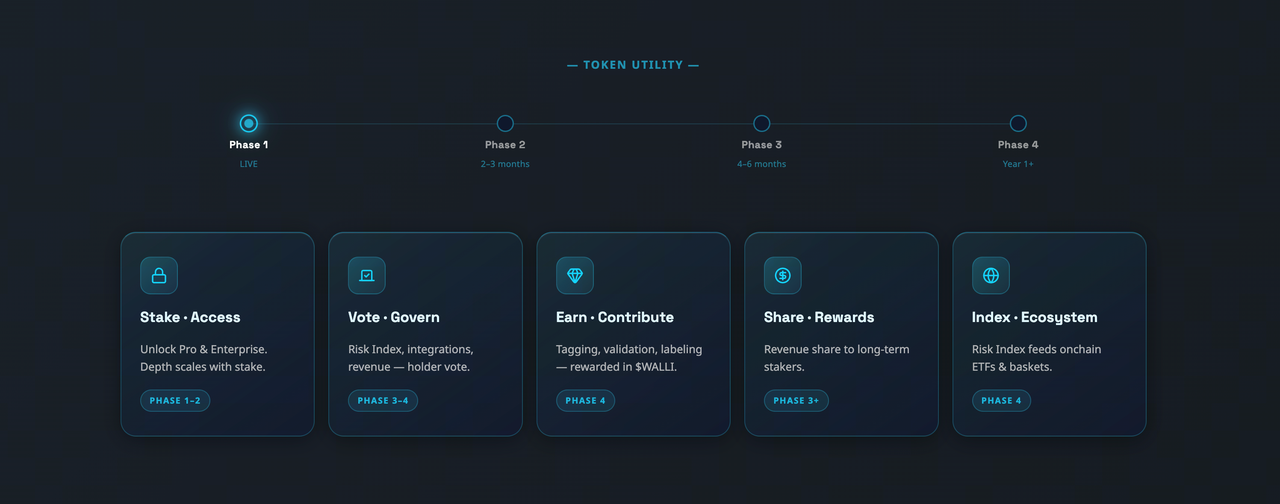
In many AI data platforms, the core value is not just the data itself, but access to high quality intelligence and analytics capabilities. WALLI functions more like an “intelligence analytics access layer.”
Potential functions of WALLI may include:
As the Agent Economy develops, AI Agents may also become potential users of WALLI. For example, an autonomous agent could use WALLI to call advanced risk models and complete automated decision making.
How Is Wallitelli Different From Traditional On-Chain Data Platforms?
Wallitelli is often compared with on-chain analytics platforms, but their priorities are not exactly the same.
Traditional platforms usually emphasize:
-
Data visualization
-
Wallet tracking
-
On-Chain labeling systems
-
Transaction monitoring
-
Address analysis
Wallitelli, by contrast, focuses more on:
-
AI risk detection
-
Behavioral pattern analysis
-
Wallet level intelligence profiles
-
Agent executable intelligence
-
Automated risk output
This difference means Wallitelli is closer to an “on-chain intelligence decision layer,” rather than just a data tool.
This is especially important in AI Agent scenarios. Structured risk information is more valuable than simple data charts because AI systems need executable logic, not purely visual information.
What Are the Use Cases of Wallitelli?
Wallitelli’s use cases are mainly concentrated in on-chain risk management and AI powered automated finance.
In DeFi scenarios, users can use Wallitelli to analyze asset risk across multiple protocols. For example, a wallet may be exposed to several yield protocols at the same time, while the system can identify potential risk concentration issues.
In DAO Treasury management, Wallitelli can be used to monitor asset distribution, stablecoin risk, and fund flow behavior.
For AI Agents, Wallitelli functions more like a “risk awareness module.” AI Agents can call the risk summaries generated by the system to decide whether to execute trades, adjust strategies, or exit protocols.
What Challenges Does Wallitelli Face?
The development of on-chain intelligence systems still faces several challenges.
First, on-chain data itself is highly complex, and data structures vary significantly across different protocols. Building a unified risk model is an important challenge for AI based on-chain analytics.
Second, AI risk judgments are not always completely accurate. Some on-chain behaviors may be mistakenly classified as risky, which means risk models still need continuous optimization.
In addition, AI Agents and automated finance are still in an early stage. The real market demand for the Agentic Economy, the regulatory environment, and the maturity of the infrastructure all remain uncertain.
Because on-chain systems are highly open, any intelligence analytics tool may also face problems such as data pollution, forged behavior, and model bias.
Conclusion
As an on-chain intelligence infrastructure for the AI Agent era, Wallitelli provides executable on-chain insights for users and automated systems through AI risk analysis, wallet behavior identification, and on-chain data modeling.
Compared with traditional on-chain analytics platforms, Wallitelli places greater emphasis on AI native Intelligence and Agent ready Intelligence, allowing AI systems to directly understand and use on-chain risk information.
FAQs
How Is Wallitelli Different From Traditional On-Chain Analytics Platforms?
Wallitelli places greater emphasis on AI risk detection, behavioral pattern analysis, and structured intelligence output, while traditional on-chain analytics platforms usually focus on data display, address tracking, and visual analysis.
What Is an On-Chain Intelligence Layer?
An On-Chain Intelligence Layer refers to an on-chain intelligence layer that converts complex on-chain data into structured risk information, behavioral analysis, and AI executable decision signals.
Why Do AI Agents Need On-Chain Intelligence Analytics?
AI Agents need to understand on-chain risk, asset exposure, and protocol status in real time. Traditional on-chain data is often difficult to use directly for automated decision making, so an intelligence layer is needed to provide structured risk output.
What Are the Main Use Cases of Wallitelli?
Wallitelli can be used for wallet risk analysis, DAO Treasury management, DeFi risk monitoring, AI Agent risk control, and multi protocol asset behavior analysis.
What Is the Agentic Economy?
The Agentic Economy refers to an economic system in which AI Agents, autonomous systems, and automated digital entities participate together. In this system, AI is not just an assistive tool, but a participant capable of independently carrying out economic activities.
Related Articles

In-depth Explanation of Yala: Building a Modular DeFi Yield Aggregator with $YU Stablecoin as a Medium

Sui: How are users leveraging its speed, security, & scalability?

What Is a Yield Aggregator?

Dive into Hyperliquid

Aster vs Hyperliquid: Which Perp DEX Will Prevail?