What Is TradFi? Definition, Market Significance, and the Latest Trends Heading into 2026
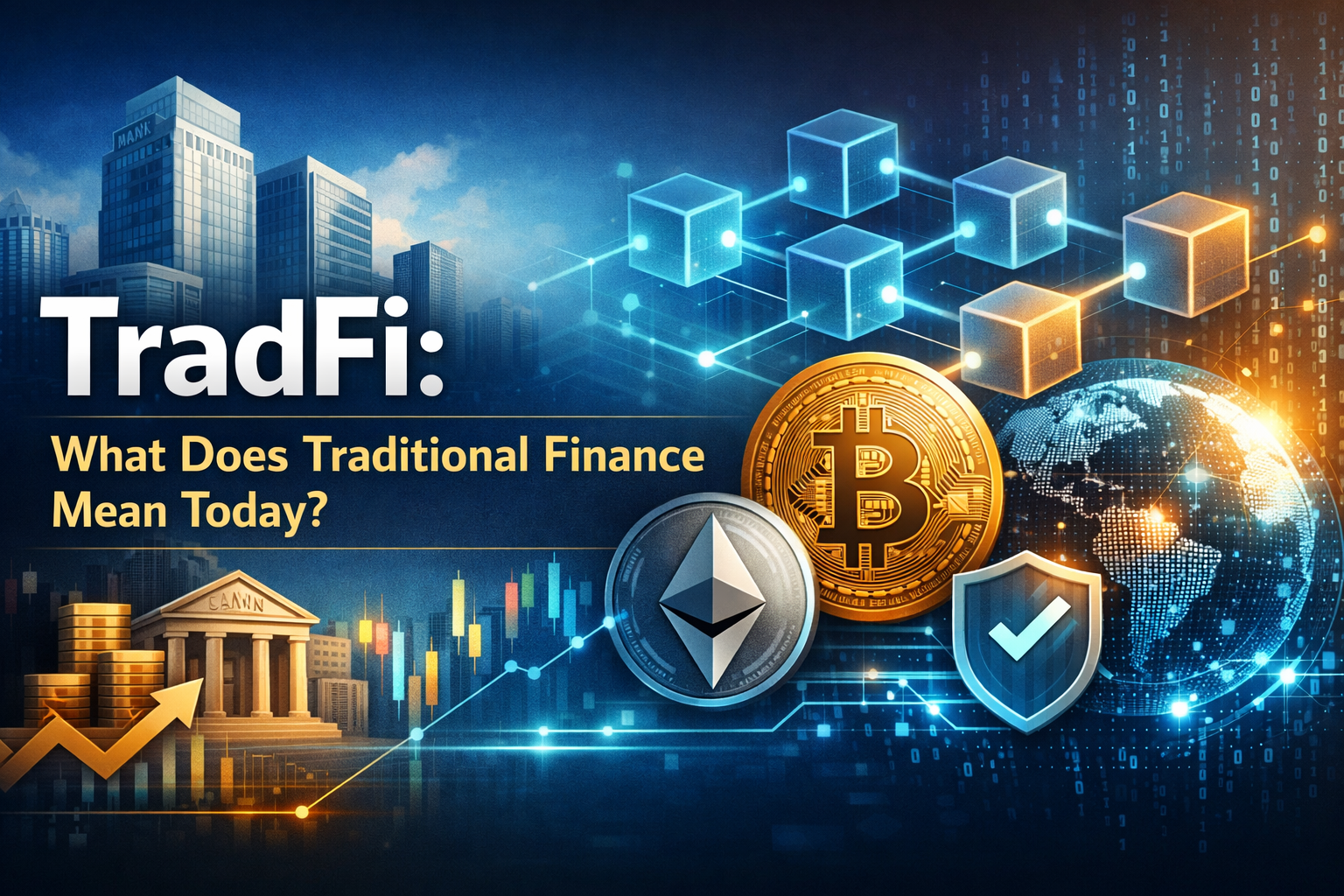
What Is TradFi? (TradFi Meaning)
TradFi stands for “Traditional Finance,” the conventional financial system. As the crypto ecosystem has rapidly evolved in recent years, the term TradFi has become increasingly common—primarily to distinguish traditional finance (TradFi) from decentralized finance (DeFi).
TradFi forms the backbone of the global economy, encompassing banking, securities markets, insurance, clearing systems, and cross-border payment networks. When you apply for a credit card, initiate a bank transfer, purchase stocks, or invest in savings, you are engaging with the TradFi system.
Compared to DeFi, TradFi places greater emphasis on regulation, stability, and risk management. As a result, it remains the dominant force in most countries.
Key Components of TradFi
The TradFi system is vast, complex, and highly sophisticated, consisting mainly of:
- Banking system: Banks handle deposits, lending, payment settlement, and corporate financing, serving as the foundation for market liquidity.
- Securities markets: These venues facilitate trading of financial products such as stocks, bonds, and ETFs, providing capital for companies and growth opportunities for investors.
- Insurance institutions: Through risk assessment and underwriting, insurance protects individuals and businesses, serving as a critical component of asset and operational security.
- Risk regulatory frameworks: Mechanisms such as KYC (Know Your Customer), AML (Anti-Money Laundering), and capital adequacy requirements help ensure the safety of funds and systemic stability.
Decades of development have established a robust structure, earning TradFi a high level of market trust.
Core Differences Between TradFi and DeFi
While not shown in a table, the key comparisons are:
• Centralization vs. Decentralization: TradFi depends on centralized entities like banks and exchanges; DeFi operates on-chain through smart contracts.
• Regulation vs. Openness: TradFi is heavily regulated with high entry barriers; DeFi is globally open and permissionless.
• Transaction speed: TradFi (especially for cross-border payments) is slower; DeFi enables real-time settlement, 24/7.
• Different risk structures: TradFi risks arise from institutional credit and policy changes; DeFi risks stem from code vulnerabilities and market volatility.
Despite significant differences, TradFi and DeFi are complementary rather than mutually exclusive.
TradFi Industry Trends for 2026
With the acceleration of global fintech, TradFi is experiencing major shifts:
Trend 1: Institutions Rapidly Embrace Digital Assets
In 2025–2026, more banks and wealth management firms are offering crypto asset trading, custody, and research services. As regulations become clearer, traditional financial institutions are no longer shying away from the crypto market—they are actively building their presence.
Trend 2: On-chain TradFi Emerges
Many traditional assets—such as bonds and real estate revenue rights—are being tokenized and traded on-chain. This enables TradFi assets to benefit from blockchain-driven efficiency and transparency.
Trend 3: RWA (Real World Assets) Become a Mainstream Innovation
With regulatory frameworks established in the US and EU, the on-chain RWA market is expanding, driving further integration of traditional assets and crypto technology.
Trend 4: Accelerated Digitization of Cross-Border Payments
Central banks across multiple countries are advancing CBDC (Central Bank Digital Currency) pilots, boosting payment and settlement efficiency in TradFi.
Real Progress in TradFi and Digital Asset Integration
Traditionally, finance and crypto markets were clearly separated, but from 2024 to 2026, a turning point has arrived:
– Multiple banks now offer digital asset custody, allowing institutional investors secure access to the crypto market.
– ETFs—especially Bitcoin and Ethereum ETFs—have entered mainstream finance, acting as vital bridges between TradFi and the crypto sector.
– Collaboration between decentralized and centralized ecosystems is growing. Many trading platforms now provide both on-chain and off-chain services, shaping a “hybrid finance” landscape.
These trends show that TradFi is moving from exclusion to openness and integration.
How Should Investors View the Future of TradFi?
Both traditional and crypto investors need to understand TradFi trends for several reasons:
- TradFi will remain; it is a cornerstone of economic stability. While DeFi is expanding rapidly, the majority of global capital is still held within TradFi.
- The integration of TradFi and DeFi will be the true mainstream going forward.
- TradFi’s regulatory strengths make its risk management more advanced.
- The digital transformation of TradFi is a long-term trend. Investors should monitor related opportunities.
Ultimately, TradFi’s evolution will shape the financial landscape for the next decade. Understanding TradFi’s significance is a crucial step to staying ahead of emerging trends.
Related Articles

AI-Native Settlement Layers: How United Stables Is Building the Next Financial Rail

The ve(3,3) Flywheel Explained: How AERO Tokenomics Powers Aerodrome’s DeFi Economy

How Does PAXG Work? In-Depth Overview of the Physical Gold Tokenization Mechanism

Aerodrome Tokenomics: How ve(3,3) Powers Base's Most Profitable DEX

How is the price of PAXG determined? Pegging mechanism, trading depth, and influencing factors
