What Is MCO (Moody's)? Comprehensive Understanding of the Credit Rating Business, Financial Data Ecosystem, and Market Position
Moody's (MCO) is a leading global credit rating and risk analysis firm, providing credit risk assessment and decision support to corporations, governments, financial institutions, and investors through credit ratings, financial data, risk management software, and analytical services. In modern capital markets, credit information is a fundamental basis for capital allocation. Whether it's corporations issuing bonds, banks extending loans, or institutional investors making asset allocation decisions, all parties need to assess the creditworthiness of borrowers. Credit rating agencies play a critical role in this process.As one of the world's three largest credit rating agencies, Moody's does more than just evaluate bond market credit risk. It has built a massive financial infrastructure ecosystem through its risk analysis platforms, financial data products, and enterprise software services. For anyone studying global financial markets, understanding Moody's business model is essential to grasping how capital markets measure and manage risk.
What Is MCO (Moody's)
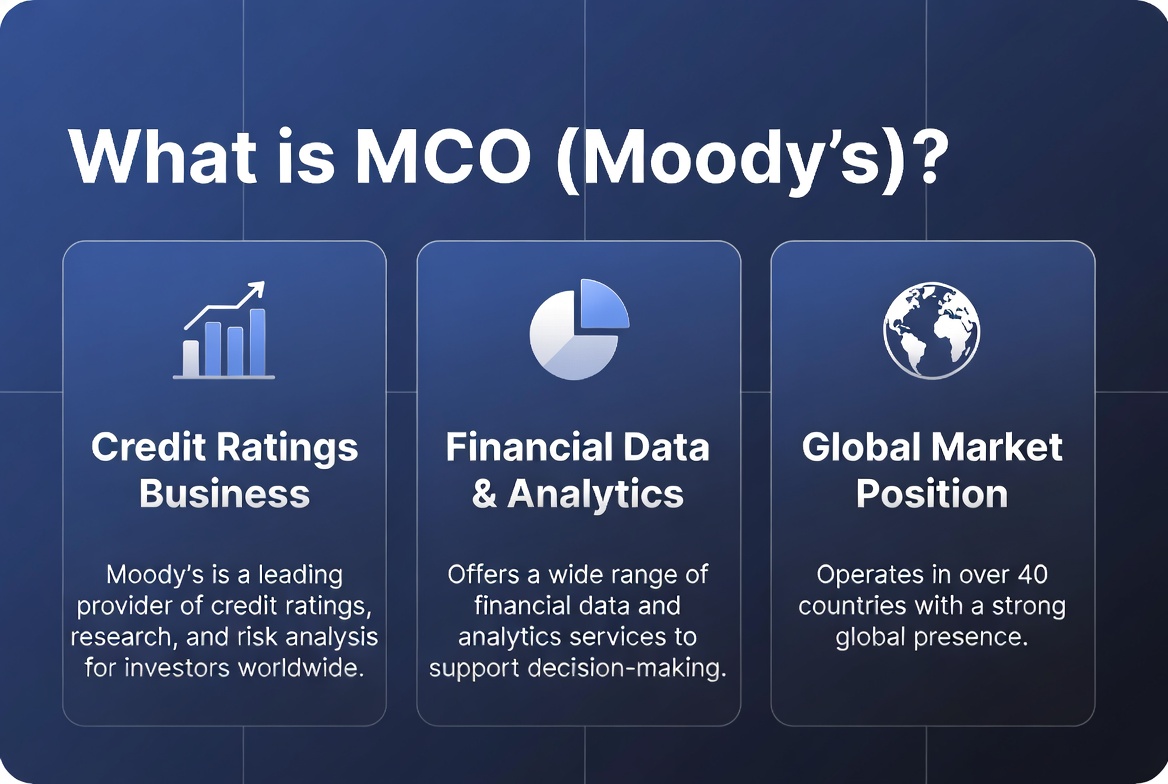
MCO is the stock ticker for Moody's Corporation. Based in New York City, Moody's is one of the most influential credit rating agencies worldwide.
Moody's core operations fall into two main segments:
- Moody's Investors Service (MIS): Credit ratings
- Moody's Analytics (MA): Analytics and risk management
The credit ratings business assesses the credit risk of bond issuers and borrowers, while the analytics arm provides data, models, software, and research to banks, insurers, asset managers, and corporate clients.
Moody's ratings are widely used across the global bond market, making its rating scale a key reference standard in international capital markets.
Moody's History and Market Position
Moody's history dates back to 1909, when financial analyst John Moody began publishing railroad bond analysis reports and gradually built a systematic credit rating framework. As U.S. capital markets grew, Moody's rating business expanded to cover corporate bonds, municipal bonds, financial institution debt, and sovereign debt.
Over more than a century, Moody's has evolved from a traditional rating agency into a vital component of global financial infrastructure.
Today, the global credit rating market is dominated by three agencies:
| Agency | Headquarters |
|---|---|
| Moody's | United States |
| S&P Global Ratings | United States |
| Fitch Ratings | United States |
Because rating systems require years of market credibility and historical data, barriers to entry are high, resulting in a highly concentrated industry.
How Moody's Credit Rating Business Works
Credit ratings are Moody's most iconic business line.
The core goal is to evaluate a debt issuer's ability and willingness to meet future payment obligations.
When a corporation, financial institution, or government plans to issue bonds, they typically engage a rating agency for assessment. Moody's analyzes financial data, operations, industry conditions, cash flow structure, and macroeconomic factors, then assigns a rating.
Moody's rating scale includes:
| Rating | Category |
|---|---|
| Aaa | Highest credit quality |
| Aa | High credit quality |
| A | Upper-medium credit quality |
| Baa | Lowest investment grade |
| Ba and below | Speculative grade |
Investment-grade ratings are considered low-risk debt, while speculative-grade ratings indicate higher default risk.
Credit ratings directly affect borrowing costs. The higher the rating, the lower the interest rate an issuer can typically obtain.
Moody's Analytics and Risk Data Services
As financial markets digitized, Moody's expanded its analytics and software business.
Moody's Analytics has become a major growth driver for the company.
This segment offers:
- Risk management software
- Credit analysis tools
- Macroeconomic research
- ESG risk analysis
- Financial data services
- Stress testing models
Banks use Moody's Analytics platforms to assess loan portfolio risk.
Insurers use the models to estimate potential losses.
Asset managers rely on data platforms for credit research and investment decisions.
Unlike one-time rating assignments, analytics services are typically subscription-based, generating more predictable recurring revenue.
Moody's Role in the Global Bond Market
Moody's is a key credit information provider in the global bond market.
The core challenge in bond markets is information asymmetry. Investors often cannot directly gauge an issuer's true risk, so they rely on third-party assessments.
Moody's ratings serve multiple market functions:
- Issuers use them to increase financing transparency.
- Institutional investors use them to screen investments.
- Banks use them to evaluate loan risk.
- Regulators use them as reference points in capital frameworks.
For many large bond issuances, obtaining a rating from an international agency has become standard practice.
How Moody's Differs from S&P Global and Fitch
While all three agencies provide credit ratings, their business structures differ.
Moody's has long been known for credit ratings and risk analysis.
S&P Global has a broader data and index business, including the famous S&P 500.
Fitch has a smaller market size but is influential in certain regions and debt sectors.
Key differences:
| Dimension | Moody's | S&P Global | Fitch |
|---|---|---|---|
| Core strength | Credit ratings and analytics | Indexes and ratings | Ratings |
| Data business | Strong | Very strong | Limited |
| Market share | Global leader | Global leader | Third |
| Software services | Comprehensive | Expanding | Limited |
In recent years, Moody's has been strengthening its analytics platform and software services to reduce reliance on bond issuance cycles.
Major Use Cases for Moody's
Moody's serves a wide range of financial market participants.
- Corporations use ratings to lower financing costs.
- Banks use data to assess credit risk.
- Insurers use risk models for capital management.
- Fund managers use ratings to screen portfolios.
- Governments use ratings to enhance bond market transparency.
- Sovereign nations seek Moody's ratings when issuing international bonds.
As a result, Moody's business is deeply embedded in the global fixed-income market.
How to Buy MCO (Moody's) Stock
MCO is listed on the New York Stock Exchange and is a key public company in the U.S. financial information and credit rating industry.
Investors can buy MCO stock through traditional brokers, gaining exposure to the company's performance and associated capital market risks and rewards.
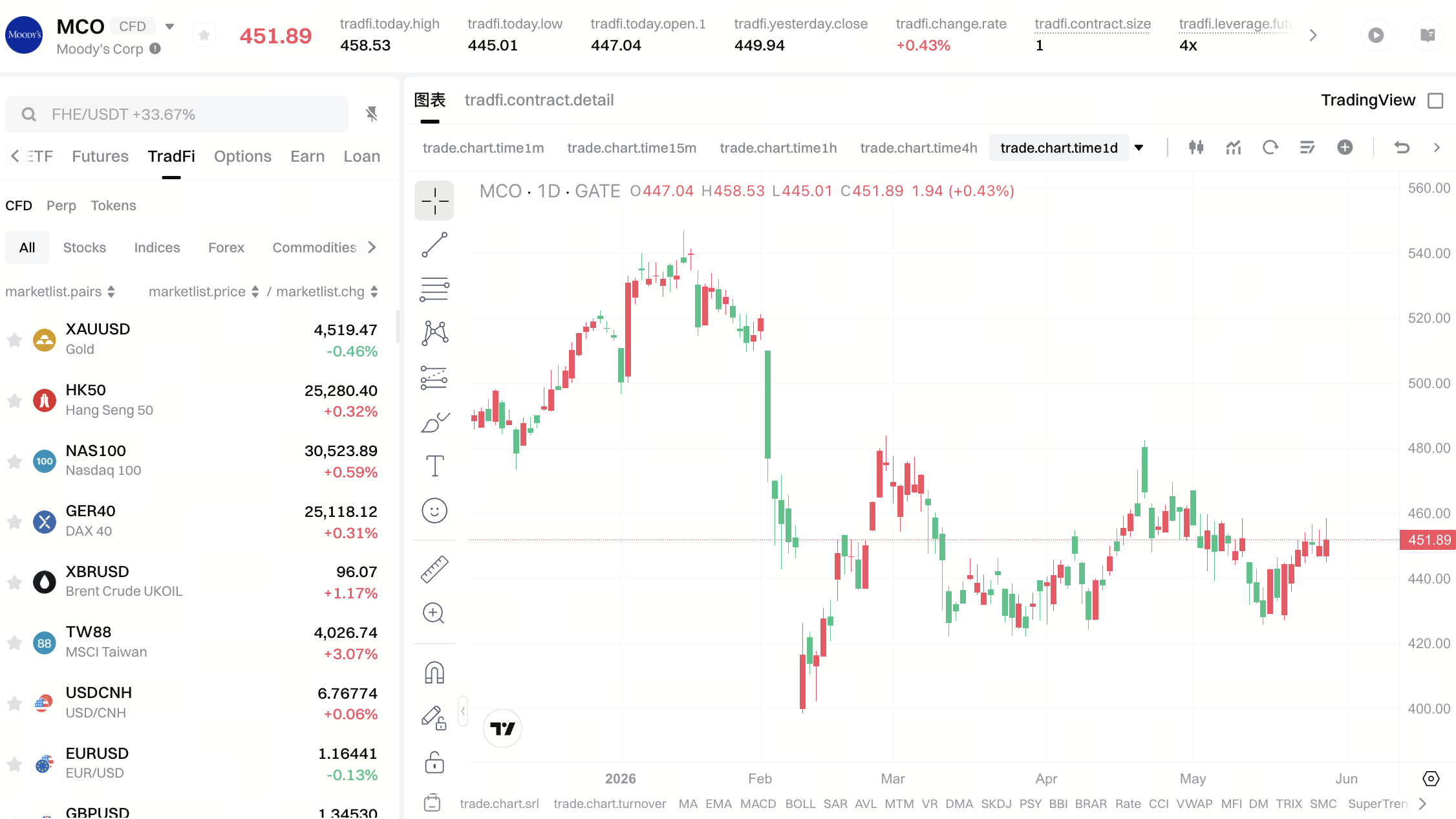
Beyond the traditional stock market, some digital asset platforms offer CFD products tied to U.S. stock prices. Through markets like Gate CFD, users can trade price fluctuations of related stocks using digital assets.
CFDs are leveraged derivatives with distinct trading mechanics, risk profiles, and differences from actual stocks. Participants should fully understand the product rules and potential risks before trading.
Moody's Advantages and Limitations
Moody's greatest strength is its long-established brand reputation and industry barriers.
Credit rating requires years of market trust, making it extremely difficult for new entrants to gain quick recognition.
Moody's also benefits from a rich historical database, expert analysis teams, and a global client network—all reinforcing its competitive moat.
On the other hand, Moody's faces some limitations.
Credit rating revenue is closely tied to bond issuance activity. When capital market financing demand drops, rating revenue can suffer.
In addition, the rating industry has long faced scrutiny over conflicts of interest. Since issuers pay for ratings, market participants continually question the independence of those ratings.
Summary
MCO (Moody's) is a flagship company in the global credit rating industry, spanning credit ratings, risk analysis, financial data, and software services. As a critical infrastructure provider for global capital markets, Moody's helps investors, financial institutions, and corporations assess credit risk and improve market transparency. With rising demand for risk management, analytics and data services have become central to Moody's business model, transforming the company from a traditional rating agency into a comprehensive financial information services enterprise.
FAQ
What is Moody's main business?
Moody's primarily provides credit ratings, risk analysis, financial data services, and enterprise risk management software to clients including corporations, banks, insurers, governments, and investment firms.
Why is Moody's important in financial markets?
Moody's supplies independent credit risk assessments that help investors judge debt issuers' repayment capacity, thereby boosting market transparency and capital allocation efficiency.
What does Aaa represent in Moody's ratings?
Aaa is Moody's highest credit rating, indicating extremely low default risk and very strong repayment ability.
What is the difference between Moody's and S&P Global?
Moody's focuses more on credit ratings and risk analysis, while S&P Global also has extensive data, index, and market information services.
What are Moody's revenue sources?
Moody's revenue comes from credit rating services and Moody's Analytics, which provides data, software, research, and risk management solutions.
What industry does MCO stock belong to?
MCO is generally classified under financial services and financial information, spanning credit ratings, financial data, risk management, and enterprise software.
Related Articles

How Does PAXG Work? In-Depth Overview of the Physical Gold Tokenization Mechanism

How is the price of PAXG determined? Pegging mechanism, trading depth, and influencing factors

Gate Research: 2024 Cryptocurrency Market Review and 2025 Trend Forecast

What Are the Risks of TSLA? Understanding Tesla’s Competitive Landscape and Investment Challenges

GoldFinger Use Cases in DeFi: How Gold Assets Enter the On-chain Financial System