What Is Genius? A Complete Guide to the Privacy-Focused On-Chain Trading Terminal, Points Mechanism, and Pre-TGE Outlook
What Is Genius?
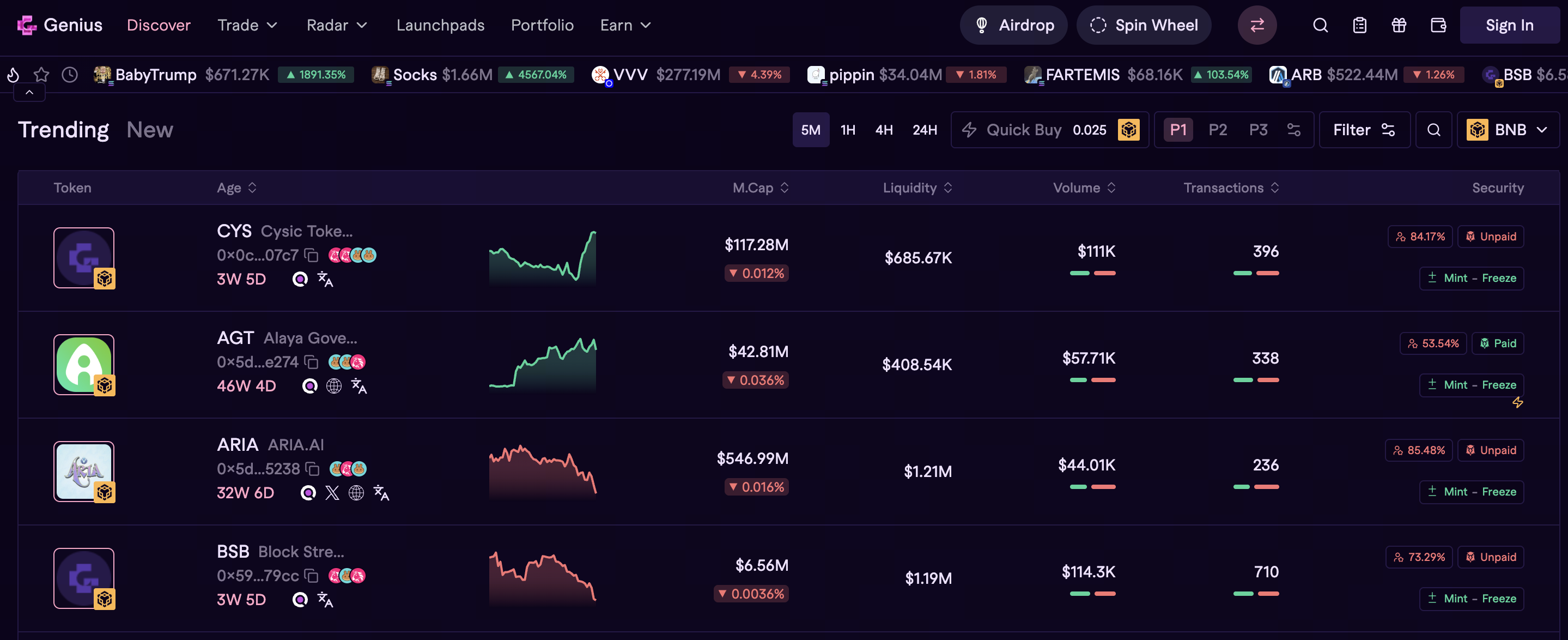 Image source: Genius Official Website
Genius is best described as an “on-chain professional trading terminal.” Rather than functioning as a traditional, single-purpose exchange, Genius serves as an execution-layer platform that consolidates multi-chain, multi-market, and diverse trading actions into one unified interface. According to the project’s official site and documentation, Genius is not focused on the question of “can you trade on-chain,” but instead addresses “why on-chain trading remains inefficient.”
While on-chain trading offers self-custody, composability, and open access, the real-world user experience is often inconsistent. Users must frequently switch between wallet approvals, bridges, aggregators, various frontends, and multiple accounts. For high-frequency traders, narrative-driven participants, or those prioritizing execution speed, this fragmented process imposes significant costs.
Genius directly tackles these pain points by streamlining disparate steps into a single entry point, offering users the experience of a professional trading terminal—rather than a patchwork of DeFi tools.
Genius: Product Logic and Differentiation
From a structural perspective, Genius stands out for several core features:
- Unified trading interface: Spot, Perpetual Futures, Cross-Chain Transactions, and more—all accessible in one place.
- Non-custodial by design: Users retain full control of their Private Keys; Assets are never surrendered to a centralized platform.
- Privacy-centric execution: Genius emphasizes robust privacy features in its trade execution.
- Multi-chain support: Trade seamlessly across Solana, Ethereum, BNB Chain, Base, Arbitrum, Optimism, Polygon, Avalanche, Sonic, and additional blockchains.
- Professional trading focus: Built not just for casual swaps, but for active traders seeking frequent rebalancing, cross-market agility, and execution efficiency.
Crucially, Genius isn’t simply “another aggregator with more chains”—it’s engineered to deliver a trading experience akin to a professional terminal.
1. Terminal, Not Just a Protocol Frontend
Genius’s documentation repeatedly stresses its ambition to be the unified operating system for on-chain trading—not just another frontend. The value here is abstraction: users don’t need to worry about which protocols, bridges, or liquidity sources are connected behind the scenes. The terminal handles complexity, letting users focus solely on price, depth, speed, and results.
This approach is much closer to a traditional finance trading workstation than a single DEX interface.
2. Privacy Execution as a Core Differentiator
In the current on-chain environment, public addresses, transparent transaction paths, and exposed positions can all undermine the trading experience. Large-volume traders, in particular, are wary of copy trading, frontrunning, or having their strategies revealed to the market.
Genius introduces an advanced privacy execution model—described as Ghost Orders and related privacy features—to obscure large trades through complex execution and order splitting. For users who value position privacy, this is a compelling innovation.
3. Cross-Chain and Multi-Market Integration to Reduce Friction
For most on-chain trading products, the problem isn’t feasibility—it’s complexity. Cross-Chain Transactions are especially cumbersome: users must identify the correct chain, bridge, approve, then Place Order, all in a lengthy, error-prone process.
Genius minimizes these hurdles by automating cross-chain actions and market switching within the terminal, enabling trades with fewer steps. For traders moving swiftly between ecosystems, this unified experience is a major draw.
Why Genius Is Gaining Market Attention
Genius has recently become a hot topic—not just for its airdrop potential, but because it addresses several pressing needs in on-chain trading:
- There’s still strong demand for an “on-chain experience that rivals CEX platforms.”
- The trading terminal sector is evolving from simple aggregation to competition based on execution efficiency, data, and multi-market integration.
- After multiple rounds of airdrop speculation, the market is increasingly focused on whether projects have real products and sustainable use cases.
Genius’s traction is driven by two main factors:
- Product potential: If Genius can deliver stable, multi-chain, multi-market, and privacy-centric execution, it could become the go-to entry point for high-frequency on-chain traders.
- Narrative amplification: A project with tangible trading scenarios and a clear credit and token roadmap naturally attracts traders, airdrop hunters, and ongoing media attention.
Still, attention is not the same as validation. For on-chain terminals to succeed, they must prove themselves against several concrete benchmarks:
- Can active users be retained over time?
- Is multi-chain execution robust and reliable?
- Are Trading Fee and point mechanisms sustainable?
- After token launch, will user engagement persist?
GP Credit, Season 1, and the Pre-TGE Timeline
Currently, Genius’s Season 1 is the key to understanding its momentum.
Based on official documentation and recent disclosures, these are the main milestones:
- Season 1 ends on April 12, 2026.
- The $GENIUS token will be created before April 12, 2026.
- Community airdrops will account for 21% of total token supply.
- This 21% is split evenly across three seasons—Season 1, Season 2, and Season 3—at 7% each.
- Season 1’s GP cap is 200 million, with the total fixed and not subject to expansion.
This framework provides high certainty around Season 1’s credit cap, end date, and token creation window.
Why Genius’s Credit Mechanism Is Sparking Debate
Genius’s GP system is designed around real trading activity. Per official docs, subsequent weekly distributions will be retrospective, focusing on Spot Trading volumes and actively mitigating bot and Sybil attacks.
Three factors make this model noteworthy:
- The total credit pool is transparent, enabling participants to estimate their expected share.
- The TGE window is imminent, making the mapping between credits and potential tokens easy for the market to price in.
- On-chain traders are already accustomed to rapidly pricing “cost versus expected Return.”
A recent, much-discussed change is Genius’s substantial Trading Fee reduction. As Season 1 nears its close, platform fees have dropped to highly competitive levels. Direct impacts include:
- Lower costs for volume generation
- Potential spike in trading activity in the final phase
- The marginal cost of acquiring GP is recalibrated by the market
As a result, Genius entered a classic convergence phase in early April—combining product usage, airdrop anticipation, and a narrowing time window.
Genius: Opportunities and Risks
Narratively, Genius stands out among current on-chain trading projects. Objectively, its opportunities and risks are both clear.
Opportunities: Addressing Real Market Pain Points
On-chain trading has ample traffic—but lacks truly user-friendly terminals. If Genius can deliver on cross-chain, privacy, and professional trading experience, it could become a long-term value gateway, not just an airdrop-driven hype project.
Key opportunities include:
- Serving higher-frequency, professional on-chain traders
- Capturing the growing demand for multi-chain trading
- Increasing user retention and trading depth with a unified terminal
- Post-TGE, converting the token narrative into ecosystem incentives and platform stickiness
Risks: Intense Competition in Terminal Products
Genius also faces significant challenges:
- Terminal product competition is fierce; differentiation requires sustained proof.
- Privacy execution must be robust and user-friendly to establish a real moat.
- Airdrop-driven activity may not convert to long-term users.
- Missteps in token pricing, distribution, or expectation management post-TGE could quickly sour community sentiment.
In today's market, users are less patient with “farm points now, see what happens later” models. Any project that disappoints on distribution, fairness, or value capture will rapidly lose trust.
A Balanced View: Assessing Genius’s Future
In summary, Genius deserves attention—but should be evaluated through the lens of both product and timeline, not just as an airdrop play.
A prudent assessment focuses on three areas:
- Does the product deliver real value as a high-frequency trading gateway? The focus is on execution speed, cross-chain fluidity, depth, and user retention—not marketing slogans.
- Are credit and token distributions transparent and predictable? For any project with point-based expectations, rule stability matters more than hype.
- Will users continue to engage post-TGE? Many projects lose momentum after launch; for Genius, post-Season 1 engagement will be the true test.
Ultimately, Genius’s recent buzz isn’t just about airdrops. It’s about meeting multiple market criteria: clear product positioning, an understandable credit system, a converging timeline, and strong privacy and professional trading credentials.
But what will determine Genius’s long-term standing is not Season 1’s hype—but whether it can win and retain users who stay for the trading experience, not just the credit incentives.
Related Articles

In-depth Explanation of Yala: Building a Modular DeFi Yield Aggregator with $YU Stablecoin as a Medium

The Future of Cross-Chain Bridges: Full-Chain Interoperability Becomes Inevitable, Liquidity Bridges Will Decline

Solana Need L2s And Appchains?

Sui: How are users leveraging its speed, security, & scalability?

Navigating the Zero Knowledge Landscape
