What Is an Ephemeral Rollup? How AltLayer Enables Temporary App Chains
As modular blockchains and application-specific Rollups continue to develop, more on-chain applications need dynamic scaling capacity rather than fixed Layer2 networks that run indefinitely. AltLayer’s Ephemeral Rollup model is a new modular infrastructure solution that emerged in response to this need.
AltLayer sits in the modular Rollup ecosystem as something closer to an appchain infrastructure and shared security provider. Through Rollup-as-a-Service, or RaaS, Restaked Rollups, and AVS networks, the protocol gives developers flexible temporary Rollup deployment capabilities.
What Is an Ephemeral Rollup?
An Ephemeral Rollup is a Rollup network with a limited lifecycle. It can run during a specific task or event and shut down once demand has ended.
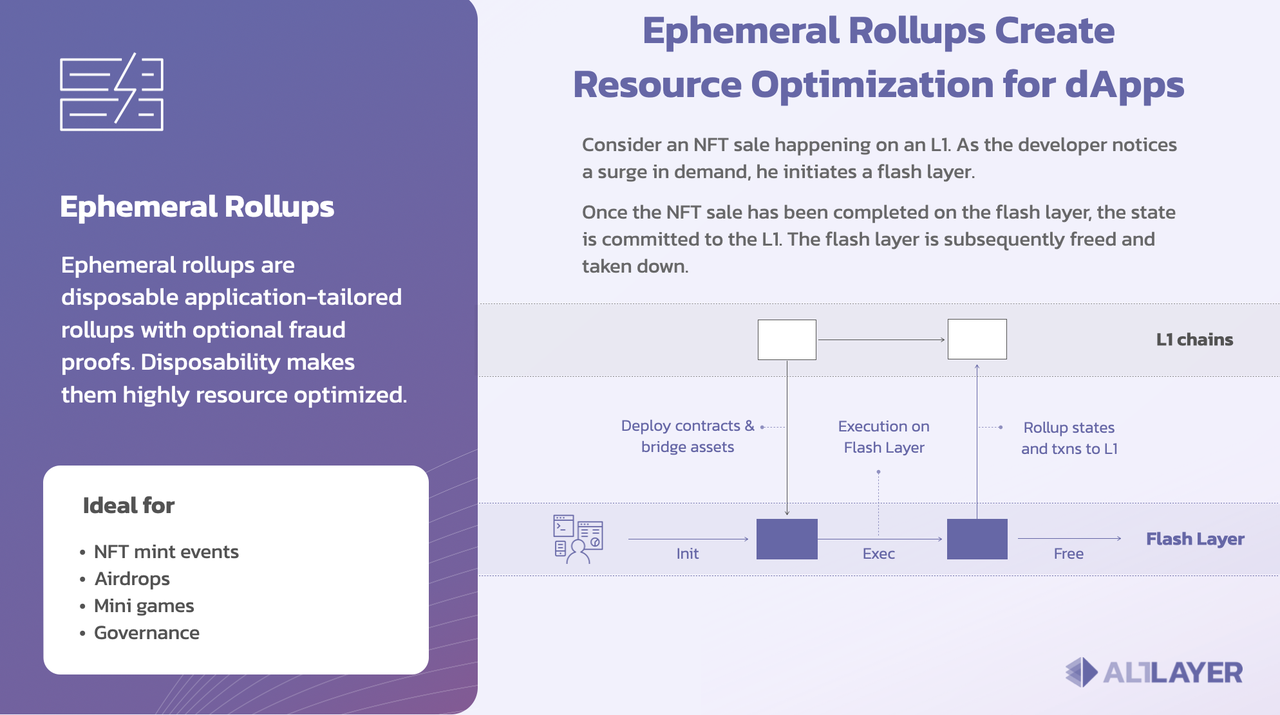
Traditional Rollups usually require long-term maintenance of nodes, sequencers, and validation structures, making them better suited to applications that operate continuously. An Ephemeral Rollup is more like an on-demand scaling tool that can dynamically create an independent execution environment based on business peaks.
This structure can reduce long-term maintenance costs while improving the efficiency of network resource use.
How Does AltLayer Enable Ephemeral Rollups?
AltLayer enables the rapid deployment of Ephemeral Rollups through Rollup-as-a-Service, or RaaS.
Developers can use a modular console to select the execution layer, data availability layer, sequencer, and settlement layer, then generate a new Rollup network in a short period of time.
AltLayer also supports different Rollup technology stacks, including OP Stack, Arbitrum Orbit, Polygon CDK, and ZK Stack, so developers can configure the network structure flexibly according to their needs.
This modular deployment approach significantly lowers the barrier to creating temporary appchains.
What Is the Full Workflow of an Ephemeral Rollup?
The workflow of an Ephemeral Rollup usually includes four stages: creation, operation, settlement, and shutdown.
First, developers create a temporary Rollup based on business needs and configure the execution environment and data availability layer. User transactions then enter the Rollup, where the Sequencer handles ordering and block generation.
While the network is running, AltLayer’s AVS and Restaked Rollup mechanisms provide shared security and state validation support.
Once the task is complete, the final state is submitted to Ethereum or the settlement layer. After that, the temporary Rollup can be shut down or archived.
What Role Does Restaked Rollup Play in Ephemeral Rollups?
Ephemeral Rollups usually have short lifecycles, so it is difficult for them to build an independent validation network and long-term economic security model.
Through its Restaked Rollup structure, AltLayer provides shared security for temporary Rollups. The protocol uses restaked assets and AVS networks to add state validation, fast finality, and decentralized sequencing capabilities to Rollups.
This structure allows temporary appchains to gain additional security support without building a large node network of their own.
How Does MACH Improve Interaction Efficiency for Temporary Rollups?
MACH is AltLayer’s fast finality AVS, used to shorten transaction confirmation times.
In on-chain gaming and AI Agent scenarios, users usually need low-latency interactions. If transaction confirmation takes too long, the application experience can noticeably decline.
MACH quickly confirms block states through a restaked validation layer, improving real-time interaction. This structure is especially important for high-frequency trading and gaming events.
Why Is SQUAD Suitable for Temporary Appchains?
SQUAD is AltLayer’s decentralized sequencing service, designed to reduce the risks created by a single Sequencer.
Although temporary Rollups run for a shorter period of time, they may still face transaction censorship or ordering manipulation. SQUAD allows multiple nodes to participate in sequencing, improving network transparency and censorship resistance.
In the modular blockchain ecosystem, decentralized sequencing is considered an important part of the long-term development of Rollups.
What Is the Difference Between Ephemeral Rollups and Regular Rollups?
| Comparison Dimension | Regular Rollup | Ephemeral Rollup |
|---|---|---|
| Lifecycle | Long-running | Temporary |
| Resource model | Continuously occupied | Allocated on demand |
| Main use case | General-purpose appchains | Peak-demand scaling |
| Network structure | Fixed deployment | Dynamically created |
| Cost structure | Long-term maintenance costs | Short-term usage costs |
Ephemeral Rollups place more emphasis on flexible scaling and resource efficiency, while regular Rollups are better suited to long-term ecosystem development.
Which Use Cases Are Ephemeral Rollups Suitable For?
Ephemeral Rollups are mainly suitable for applications where transaction demand grows rapidly over a short period of time.
On-chain gaming events often need to process a large number of user interactions in a short time, making temporary Rollups a suitable option. NFT mints and major airdrop events can also reduce mainnet congestion through an independent execution environment.
AI Agent networks need large volumes of automated interactions and real-time state updates, making them a natural fit for temporary Rollup deployment.
In addition, high-frequency trading and short-term DeFi campaigns can also benefit from elastic scaling capacity.
What Challenges Do Ephemeral Rollups Face?
Although temporary Rollups improve flexibility, they also increase the complexity of modular coordination.
Different data availability layers, sequencers, and validation services need to remain coordinated, otherwise network stability may be affected.
In addition, frequently creating and shutting down Rollups may increase the difficulty of cross-chain communication and state synchronization.
For developers, balancing flexibility and security is also an important issue in the modular ecosystem.
Conclusion
An Ephemeral Rollup is a temporary Rollup architecture designed for short-term scaling needs. By dynamically creating and shutting down independent execution environments, it provides flexible scaling capacity for on-chain gaming, AI Agents, NFT mints, and high-frequency trading.
Through Rollup-as-a-Service, Restaked Rollups, and AVS networks, AltLayer provides Ephemeral Rollups with shared security, fast finality, and modular deployment support.
FAQs
What Is the Difference Between an Ephemeral Rollup and a Regular Rollup?
A regular Rollup usually runs over the long term, while an Ephemeral Rollup places more emphasis on short-term scaling, dynamic deployment, and elastic resource allocation.
Why Is AltLayer Suitable for Ephemeral Rollups?
AltLayer provides Rollup-as-a-Service, Restaked Rollups, and AVS support, so it can quickly create temporary appchains with shared security.
Does an Ephemeral Rollup Need an Independent Validation Network?
An Ephemeral Rollup usually does not need a large independent validation network because AltLayer can provide shared security through restaking and AVS.
Do Ephemeral Rollups Support ZK Rollups?
AltLayer supports multiple Rollup technology stacks, including ZK Stack, so some Ephemeral Rollups can be compatible with ZK Rollup architectures.
Related Articles

In-depth Explanation of Yala: Building a Modular DeFi Yield Aggregator with $YU Stablecoin as a Medium

The Future of Cross-Chain Bridges: Full-Chain Interoperability Becomes Inevitable, Liquidity Bridges Will Decline

Solana Need L2s And Appchains?

Sui: How are users leveraging its speed, security, & scalability?

Navigating the Zero Knowledge Landscape
