What Is Bitcoin? A Deep Dive into How Bitcoin Works, Its Latest 2026 Price, and Future Trends
What Is Bitcoin? Fundamental Definition and Core Characteristics
Bitcoin (BTC) is the world’s first decentralized digital currency, launched in 2009 by a person or group under the pseudonym Nakamoto. Unlike traditional currencies, Bitcoin is not issued by any government or central bank. Instead, it operates on blockchain technology and is maintained by a distributed network of nodes that collectively record all transactions. The total supply of Bitcoin is capped at 21 million coins, and this scarcity is a major driver of its value.
Bitcoin’s defining features include decentralization, a transparent ledger, anonymous transactions, and censorship resistance. Anyone can access and review transaction records on the blockchain using open-source software, but the identities of transacting parties remain private.
Keyword optimization: What is Bitcoin, Bitcoin core features, decentralized digital currency
Bitcoin Technical Fundamentals: Blockchain and Decentralization
Blockchain is the foundational technology powering Bitcoin. This data structure links blocks together, with each block containing a batch of transactions. Miners compete to validate and record transactions by solving complex mathematical puzzles—known as the Proof of Work consensus mechanism—and package them into new blocks. This process not only issues new BTC as rewards but also secures the network.
Unlike the centralized databases used by traditional banks, the Bitcoin network’s ledger is maintained by thousands of nodes worldwide, making it far more resistant to censorship and tampering in theory.
Keyword optimization: Bitcoin technical fundamentals, blockchain consensus mechanism, Bitcoin decentralization
Latest Bitcoin Price Trends (2026 Data)
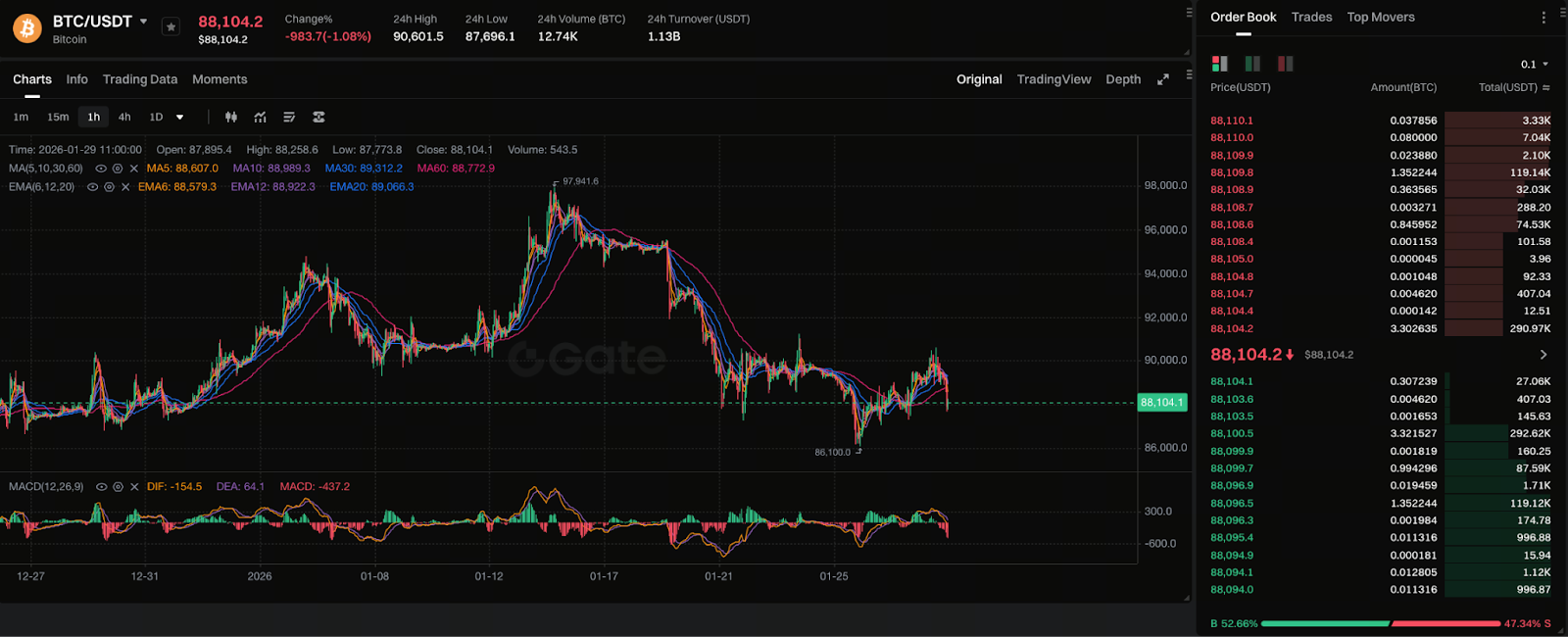
Chart: https://www.gate.com/trade/BTC_USDT
At the start of 2026, Bitcoin’s price has fluctuated around $88,000. Multiple authoritative sources report BTC’s recent trading price at approximately $89,000.
The market has been volatile: Reports indicate Bitcoin reached a record high of about $125,000 in 2025. Afterward, volatility intensified, with prices sometimes dropping to around $90,000 or below. Recent market observations show Bitcoin staged a moderate rebound in early 2026, and several analyst reports suggest prices may continue to recover in the near term.
Keyword optimization: Bitcoin price latest data, BTC 2026 trend
Key Drivers of Bitcoin Price
BTC price is shaped by several major factors:
- Macroeconomic conditions: US dollar trends and interest rate policies affect risk asset allocation. Bitcoin often outperforms when the dollar weakens.
- Regulatory policies and ETF adoption: Regulatory developments in the US and globally directly impact both institutional and retail participation. Stable, transparent regulation typically boosts market sentiment.
- Technological innovation and halving cycles: Bitcoin undergoes a halving roughly every four years, and expectations of reduced supply often drive price appreciation.
- Market sentiment and capital inflows: Traditional financial capital entering the Bitcoin market via ETFs and other channels tends to push prices higher.
Keyword optimization: Bitcoin price factors, macroeconomics and BTC
Bitcoin Outlook for 2026
Market forecasts for BTC’s trajectory in 2026 are mixed. Some institutions and analysts expect Bitcoin could reach higher price ranges, such as $150,000 or above. Others believe price resistance will keep it trading within a range for the short term.
Some price models are even more optimistic with long-term targets, but these projections are based on historical data and indicators and are not investment guarantees.
Keyword optimization: Bitcoin 2026 price forecast, BTC future trends
Bitcoin Investment Risk Advisory
While Bitcoin is the most recognized crypto asset, its price is highly volatile. Investors should be aware of the following risks:
- Extreme market volatility, with sharp price swings in the short term
- Ongoing regulatory uncertainty in the cryptocurrency sector
- Investments should be based on individual risk tolerance and should not rely solely on a single asset
Keyword optimization: Bitcoin investment risk, BTC volatility
Conclusion: Bitcoin’s Value and Future Opportunities
Bitcoin stands as the most influential digital asset in the world, serving both as a store of value and a cornerstone of the emerging financial ecosystem. A comprehensive understanding of Bitcoin requires examining its technical foundations, market dynamics, and macroeconomic context. In the pivotal year of 2026, BTC’s price direction remains closely tied to its long-term value.
Related Articles

AI-Native Settlement Layers: How United Stables Is Building the Next Financial Rail

The ve(3,3) Flywheel Explained: How AERO Tokenomics Powers Aerodrome’s DeFi Economy

How Does PAXG Work? In-Depth Overview of the Physical Gold Tokenization Mechanism

Aerodrome Tokenomics: How ve(3,3) Powers Base's Most Profitable DEX

How is the price of PAXG determined? Pegging mechanism, trading depth, and influencing factors
