What Is AON? Understanding Its Role in Global Risk Management and Insurance Brokerage
As the global business environment becomes more complex, the importance of the risk management industry continues to grow. Natural disasters, supply chain disruptions, cybersecurity threats, interest rate fluctuations, and geopolitical shifts are all driving large companies to increase their demand for risk management and insurance coverage.
Compared with traditional insurance companies, which mainly assume claims liability, AON operates more like a global enterprise services platform. AON’s business spans insurance, consulting, data analytics, and capital markets, which is why it is also regarded as an important part of the global corporate risk management ecosystem.
Source: aon.com
What Is AON?
AON’s core businesses include insurance brokerage, reinsurance, human capital consulting, and enterprise risk management. Large companies often work with AON to design insurance programs, assess operational risks, and build relationships with global insurers.
The central logic of the insurance brokerage industry is to help companies find more suitable insurance structures and risk solutions. AON does not directly assume responsibility for insurance claims. Instead, it generates revenue through service fees, consulting fees, and brokerage commissions.
As the risks facing large global companies become increasingly complex, AON’s business has gradually expanded beyond traditional insurance intermediation into data analytics, cybersecurity, employee benefits, and capital management.
How AON’s Global Risk Management Business Works
AON’s risk management business mainly focuses on corporate operating risks, including property risk, supply chain risk, cybersecurity risk, natural disaster risk, and financial market risk.
Large multinational companies usually have complex supply chains and global operating structures, which means their risk exposure is far greater than that of ordinary companies. Based on industry characteristics, regional risks, and corporate asset structures, AON designs different insurance and risk control solutions for its clients.
In recent years, cybersecurity has become one of the fastest growing areas in the risk management market. As companies become more digital, the risks of data breaches and cyberattacks are driving rapid growth in demand for cyber insurance.
AON also uses data models and risk analytics tools to help companies estimate potential losses. This data driven approach is gradually moving the risk management industry away from traditional insurance intermediation and toward a more integrated enterprise services system.
The Role of Insurance Brokerage in AON’s Business Model
Insurance brokerage is one of AON’s most important sources of revenue.
Companies typically do not buy all their insurance services directly from a single insurer. Instead, they use insurance brokers to compare different products, pricing, and coverage structures. AON’s role is to create that connection between companies and insurance providers.
Compared with the personal insurance market, the corporate insurance market is far more complex. Large companies often need coverage across multiple risk areas, including property, liability, transportation, employee benefits, and cybersecurity, so their insurance programs usually require customized design.
AON has an extensive global insurance partner network, allowing it to integrate insurance resources worldwide for multinational clients.
The insurance brokerage industry also has clear economies of scale. The larger the client base, the more likely a brokerage firm is to gain stronger bargaining power and access to global market resources.
AON’s Corporate Advisory and Human Capital Services System
Beyond insurance brokerage, corporate advisory and human capital services have become important parts of AON’s business.
Modern companies are paying closer attention to employee benefits, pensions, compensation structures, and talent management, all of which are closely tied to long term corporate risk management.
AON helps companies design employee benefit plans, retirement systems, and talent incentive programs, while also providing organizational management and data analytics services.
In the human capital market, data analytics capability is becoming one of the core competitive advantages. AON uses compensation databases, industry talent data, and risk models to help companies optimize their human resources structure.
This business expansion also means AON is no longer just a traditional insurance intermediary. It is gradually becoming an integrated enterprise services platform.
How Reinsurance Became One of AON’s Core Markets
Reinsurance is the “insurance market” within the insurance industry. Insurance companies use the reinsurance market to spread their own risks, and AON plays an important intermediary role in that process.
For example, after a major natural disaster, a single insurer may find it difficult to bear the full claims risk on its own, so it transfers part of that risk to the reinsurance market.
AON helps insurance companies design reinsurance structures and build partnerships with global reinsurers.
The reinsurance market is often affected by natural disasters, climate change, and global risk events, so it tends to be highly volatile.
In recent years, the increase in extreme weather worldwide has also pushed companies and insurers to place greater emphasis on reinsurance arrangements. This trend has further strengthened AON’s importance in the global risk market.
Why Global Companies Rely on Risk Management Firms
Global companies increasingly rely on risk management firms because the types of risks in the modern business environment now go far beyond traditional property insurance.
Supply chain disruptions, cyberattacks, climate risk, workforce changes, and regulatory issues can all have a lasting impact on business operations.
Large multinational companies usually have to deal with legal, tax, and operational risks across multiple countries and regions at the same time. As a result, they often need professional institutions to help integrate their risk control systems.
The importance of the risk management industry continues to rise as the global economy becomes more complex.
Compared with the traditional model of “paying claims after an event,” modern risk management places greater emphasis on “advance assessment” and “long term risk control.”
How Interest Rates, Disasters, and Macro Markets Affect AON
Although AON belongs to the enterprise services industry, its business is still influenced by global macro markets.
When interest rates rise, investment returns in the insurance industry usually improve, which may affect insurance market pricing structures. At the same time, a high interest rate environment may also change corporate risk management budgets.
Natural disasters directly affect global insurance and reinsurance markets. Major catastrophe events usually push insurance premiums higher and increase corporate demand for risk management.
Macroeconomic cycles also influence AON’s business expansion. When global corporate investment activity increases, insurance demand usually rises. During economic slowdowns, however, some companies may reduce their insurance and consulting budgets.
Therefore, AON’s market performance not only reflects changes in the enterprise services industry, but also has a clear connection with the global economic cycle.
How AON Differs from Traditional Insurance Companies
The biggest difference between AON and traditional insurance companies is that AON does not directly assume insurance claims liability.
The core business of traditional insurance companies is to sell insurance products and take on claims risk, while AON is more like a corporate risk management and insurance procurement platform.
AON’s main revenue sources include:
| Business Type | Revenue Source |
|---|---|
| Insurance Brokerage | Brokerage commissions |
| Corporate Advisory | Service fees |
| Reinsurance | Intermediary fees |
| Human Capital Services | Consulting revenue |
This asset light model also creates a clear distinction between AON and traditional insurance companies.
Compared with insurers, which depend more heavily on capital and claims reserves, AON is more oriented toward global enterprise services and risk data platforms.
How to Buy AON and Related U.S. Stock Assets
AON, as a U.S. listed global risk management and insurance brokerage company, can usually be traded through securities platforms that support U.S. stocks. Under the traditional model, users generally need to access the U.S. stock market through an overseas brokerage account.
In recent years, as regulation of global cross border securities businesses has gradually changed, some regions have also begun tightening oversight of overseas securities services, leveraged products, and derivatives trading. As a result, more market participants are paying attention to ways of trading global assets beyond traditional stocks.
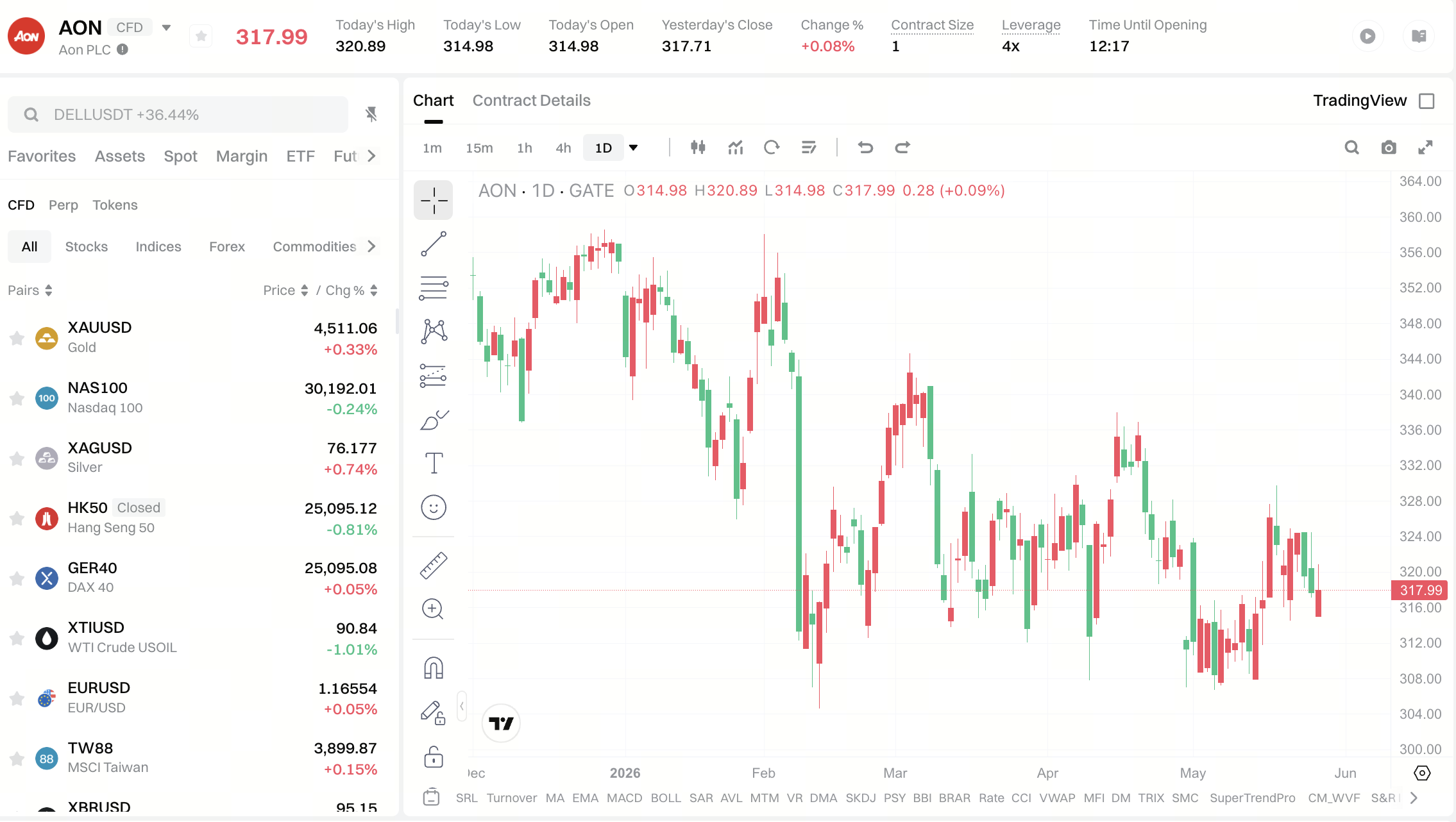
In addition to buying U.S. stocks directly, some platforms have also started offering stock related CFD products. The CFD model usually tracks stock price movements through price contracts and does not involve actual ownership of the underlying shares, so its trading structure differs significantly from that of a traditional securities account.
At the same time, some digital asset platforms have also begun expanding products related to TradFi markets. For example, products such as Gate TradFi CFD have already started covering certain U.S. stocks, ETFs, indexes, and global macro assets, allowing users to follow price movements in both digital assets and traditional financial markets on the same platform.
Because different regions have different regulatory requirements for stocks, CFDs, and cross border financial products, users usually need to pay close attention to the following before trading AON or related U.S. stock assets:
-
Platform coverage
-
Structural differences between stocks and CFDs
-
Leverage mechanisms
-
Market liquidity
-
Regional regulatory restrictions
Compared with traditional stock trading, CFDs place greater emphasis on trading price fluctuations, so their risk structure is also clearly different from that of long term holding assets.
AON’s Position in the Global Financial and Enterprise Services Market
AON has become one of the major representative companies in the global enterprise services and risk management industry. The global insurance brokerage market has long been dominated by a small number of large institutions, and AON and Marsh McLennan are among the industry’s core players.
The risk management industry itself has relatively high barriers to entry, because large multinational companies generally prefer to work with platforms that have global resources, strong data capabilities, and long term service experience. As global corporate risks continue to grow more complex, the risk management industry is also gradually expanding from traditional insurance intermediation into corporate strategy, data analytics, and long term capital management. This shift continues to increase AON’s strategic value in the global enterprise services market.
AON’s Strengths and Limitations
AON’s core strengths lie in its global client network, its ability to integrate insurance resources, and its risk data system. Large multinational companies usually need to cover risk structures across multiple countries and industries, and AON’s global business network can help them manage insurance and risk programs in a unified way.
At the same time, corporate advisory, human capital, and reinsurance businesses make AON’s revenue structure more diversified. Still, AON faces certain limitations. Competition in the risk management industry is intense, while global economic cycles, insurance market volatility, and changes in natural disaster patterns may also affect industry profitability.
In addition, the enterprise services industry is highly dependent on long term client relationships, so customer growth is usually relatively steady rather than explosive.
Summary
AON is a major representative company in the global risk management and insurance brokerage industry. Its core businesses include insurance brokerage, reinsurance, corporate advisory, and human capital services.
As the global business environment becomes more complex, the importance of risk management continues to rise. Cybersecurity, supply chain risk, natural disasters, and global macro volatility are all pushing companies to increase their demand for long term risk management.
Compared with traditional insurance companies, which focus more on claims liability, AON is closer to a global enterprise risk solutions platform. This asset light, highly service oriented business model gives AON an important position in the global enterprise services market.
FAQs
What kind of company is AON?
AON is a large global risk management and insurance brokerage company that mainly provides insurance brokerage, corporate advisory, reinsurance, and risk management services.
How is AON different from an insurance company?
Insurance companies assume claims risk, while AON is more of an enterprise risk management and insurance intermediary platform.
What are AON’s main revenue sources?
AON’s revenue mainly comes from insurance brokerage commissions, corporate advisory services, human capital management, and reinsurance business.
Why do large companies need risk management firms?
Large companies usually need to manage supply chain, cybersecurity, property, and global operational risks at the same time, so they rely on professional risk management institutions.
How can investors buy AON stock?
Investors can usually buy AON stock through platforms that support U.S. stock trading, and some platforms also offer AON CFD products.
Why is AON affected by macro markets?
Interest rates, natural disasters, economic cycles, and changes in the global insurance market can all affect corporate demand for risk management and the structure of the insurance market.
Related Articles

How Does PAXG Work? In-Depth Overview of the Physical Gold Tokenization Mechanism

How is the price of PAXG determined? Pegging mechanism, trading depth, and influencing factors
Perpetual Contract Funding Rate Arbitrage Strategy in 2025

Gate Research: 2024 Cryptocurrency Market Review and 2025 Trend Forecast

Altseason 2025: Narrative Rotation and Capital Restructuring in an Atypical Bull Market