What Is AMZN Stock? Analyzing the Drivers of Amazon's Stock Price and Business Growth Logic
Unlike traditional retail companies, Amazon's valuation logic more closely resembles that of big tech. Beyond merchandise sales volume, capital markets focus on AWS growth, advertising profitability, AI infrastructure spending, and future cash flow potential. So understanding Amazon's business structure matters more than just watching its stock price.
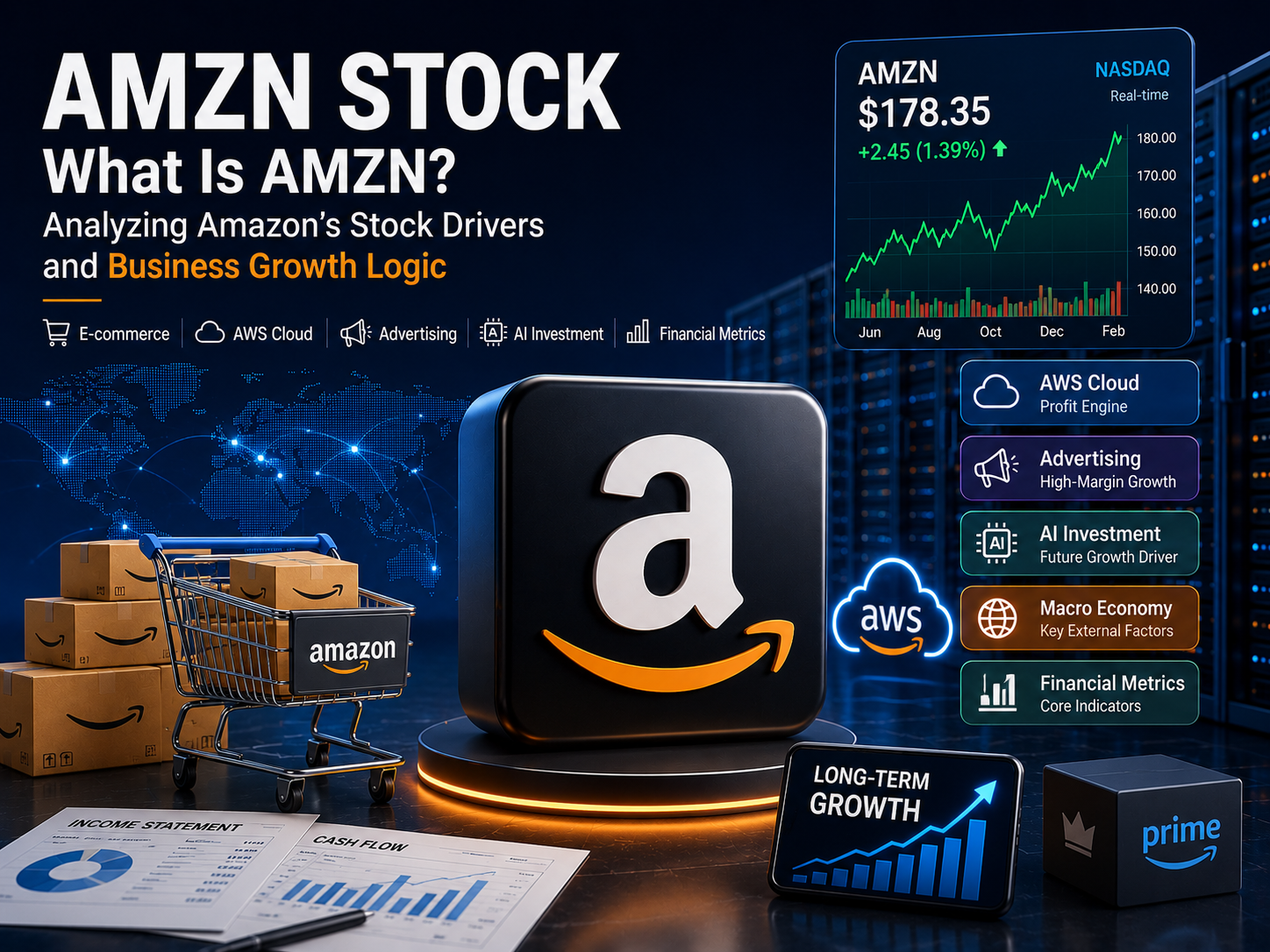
AMZN Stock Basics
As one of the world's most valuable tech firms, Amazon has long been a top focus stock on U.S. capital markets. The company went public on Nasdaq in 1997 and now spans e-commerce, cloud computing, digital advertising, AI, and enterprise services.
Stockwise, AMZN combines consumer internet, cloud, and AI infrastructure themes. So its performance responds not only to retail trends but also to enterprise IT spending, cloud demand, and tech capex cycles.
AMZN is a key component of major U.S. tech indices and a core holding for global institutions. Thanks to its huge user base, mature ecosystem, and expanding tech platform, it's a benchmark for measuring large-cap tech growth.
Unlike single-business firms, Amazon serves both consumer and enterprise markets. This diversification creates multiple growth drivers, so investors must track several segments—not just e-commerce sales—when analyzing the stock.
| Item | Details |
|---|---|
| Company Name | Amazon.com, Inc. |
| Ticker | AMZN |
| Exchange | NASDAQ |
| Industry | Technology & Internet |
| Core Businesses | E-commerce, Cloud, Advertising, AI |
| Main Revenue Sources | Online Retail, AWS, Advertising, Prime |
Because of this broad footprint, AMZN's valuation differs sharply from retail stocks. The market zeroes in on AWS growth, ad profitability, and AI strategy—variables that now drive Amazon's long-term stock performance.
How Amazon's Revenue Mix Impacts Its Stock
Amazon's revenue streams are highly diversified, but each affects the stock differently. E-commerce brings in the most revenue, but the market focuses on high-margin business growth.
Key revenue sources:
| Segment | Primary Revenue |
|---|---|
| Online Retail | Product sales |
| Third-Party Seller Services | Commissions & logistics |
| AWS | Cloud computing |
| Advertising | Platform ads |
| Prime | Subscription fees |
Revenue size alone isn't the story. Investors care about quality—which businesses generate sustainable profit and cash flow. E-commerce runs on thin margins, while AWS and advertising enjoy much higher margins, making them the real value drivers.
That's why earnings reports get scrutinized not just for total revenue, but for the growth rate of high-margin segments.
Why AWS Is Core to AMZN's Valuation
AWS (Amazon Web Services) is Amazon's cloud platform and an important participant in the global cloud market. For most analysts, AWS is a key factor in AMZN's long-term valuation.
AWS offers compute, storage, databases, networking, and AI services. Enterprises, developers, and institutions rely on it for digital infrastructure, giving AWS highly stable, recurring revenue.
Compared to retail, cloud computing has much higher margins. Dollar for dollar, AWS generates far more profit, so the market assigns it a higher valuation multiple.
Many institutions even value AWS as a standalone cloud company, then add retail, advertising, and other businesses to build AMZN's overall valuation. That shows just how critical AWS is to the stock.
How AI Investment Shapes Amazon's Market Outlook
AI has become a top trend in global tech. With generative AI, large models, and enterprise AI accelerating, the market is reassessing big tech's growth potential.
Amazon's AI strategy centers on AWS: the Bedrock generative AI platform, custom AI chips (Trainium, Inferentia), and expanding data center infrastructure.
AI impacts Amazon on two levels. First, AI apps require massive computing power, driving AWS growth. Second, the market rewards AI-competitive companies with higher valuations—an "AI premium."
So even if some AI investments aren't yet profitable, future growth expectations can lift AMZN's valuation. That's why AI news often moves Amazon's stock.
Key Metrics in Amazon's Earnings Reports
For AMZN analysis, earnings reports are vital. The market tracks several metrics to gauge performance and growth trends.
Most-watched indicators:
| Metric | Why It Matters |
|---|---|
| Revenue Growth Rate | Measures business expansion |
| AWS Revenue Growth Rate | Gauges cloud demand |
| Advertising Revenue Growth Rate | Measures monetization |
| Operating Margin | Indicates profitability |
| Free Cash Flow | Reflects financial health |
AWS growth is the headline metric. If it beats expectations, investors see strong enterprise demand, boosting confidence.
Free cash flow is also gaining attention. Better than accounting profit at showing real cash generation, it's a key long-term valuation reference.
Macroeconomic Effects on AMZN
Despite Amazon's strong ecosystem, macroeconomic factors still affect AMZN.
First, Fed rate policy influences tech valuations. Growth companies depend heavily on future cash flows, so high rates reduce those flows' present value, pressuring tech stocks.
Second, consumer spending shifts impact e-commerce. Slower growth or lower confidence weakens buying power, hurting sales.
Third, enterprise IT budgets affect AWS. If companies cut tech spending, cloud demand slows, dampening growth expectations.
So AMZN reflects not just Amazon's performance but also global economic and tech industry cycles.
Trading AMZN with Crypto Assets
Multi-asset trading now lets investors access AMZN beyond traditional stock accounts.
Gate supports spot tokens, CFDs, and derivatives, letting users choose products that match their needs.
| Product Type | Key Features |
|---|---|
| Spot Tokens | Hold underlying asset, no leverage |
| CFDs | Track AMZN price movements |
| Derivatives | Support two-way trading and leverage |
For those wanting to trade Amazon's price moves, CFDs allow long/short positions without owning the stock. Compared to traditional accounts, multi-asset platforms unify digital and traditional assets, boosting capital efficiency.
Note: CFDs and leveraged derivatives carry high risk. Their prices follow the underlying asset, so their risk-return profile differs significantly from spot stocks.
Summary
AMZN is Amazon's ticker on Nasdaq and one of the tech world's most iconic stocks. While e-commerce remains huge, AWS, digital advertising, and AI are now the key growth engines for long-term value.
From a market perspective, AWS growth, AI progress, ad expansion, and free cash flow matter more than merchandise sales for valuation. Understanding these drivers gives a fuller picture of Amazon's business value and stock logic.
FAQ
What stock is AMZN?
AMZN is Amazon's ticker symbol on Nasdaq, representing equity in the company.
Why does AWS affect AMZN's price?
AWS is one of Amazon's highest-margin businesses. Its growth and profitability directly shape market valuation.
Why does AI affect Amazon's valuation?
AI needs massive cloud resources, driving AWS growth. The market also assigns higher valuations to AI-competent firms.
What is Amazon's biggest revenue source?
Revenue comes from online retail, third-party services, AWS, advertising, and Prime subscriptions.
Which financial metrics matter most?
The market focuses on AWS revenue growth, ad revenue growth, operating margin, and free cash flow.
Can I trade AMZN on Gate?
Yes, Gate offers spot tokens, CFDs, and other TradFi products for AMZN exposure.
Related Articles

How Does PAXG Work? In-Depth Overview of the Physical Gold Tokenization Mechanism

How is the price of PAXG determined? Pegging mechanism, trading depth, and influencing factors

What Are the Risks of TSLA? Understanding Tesla’s Competitive Landscape and Investment Challenges

GoldFinger Use Cases in DeFi: How Gold Assets Enter the On-chain Financial System

How Does GoldFinger Work? Gold Asset Tokenization, Proof of Reserve, and on-chain Circulation Explained