What If: I Were the Founder of Kaito?
Key Takeaways
- X’s policy change caused the InfoFi ecosystem to collapse within three days, exposing the structural limits of reliance on centralized platforms.
- InfoFi projects face five options: shutdown, a bounty-based grant platform, a Korea-style sponsored blogging model, multi-platform expansion, or an MCN-style KOL management model.
- InfoFi 2.0 is likely to evolve into a smaller, more controlled model, shifting from permissionless scale to collaboration between vetted KOLs and projects.
- Two fundamental challenges remain: establishing a fair compensation system and justifying the token’s value.
1. InfoFi’s Collapse in Three Days
Source: X(@ nikitabier)
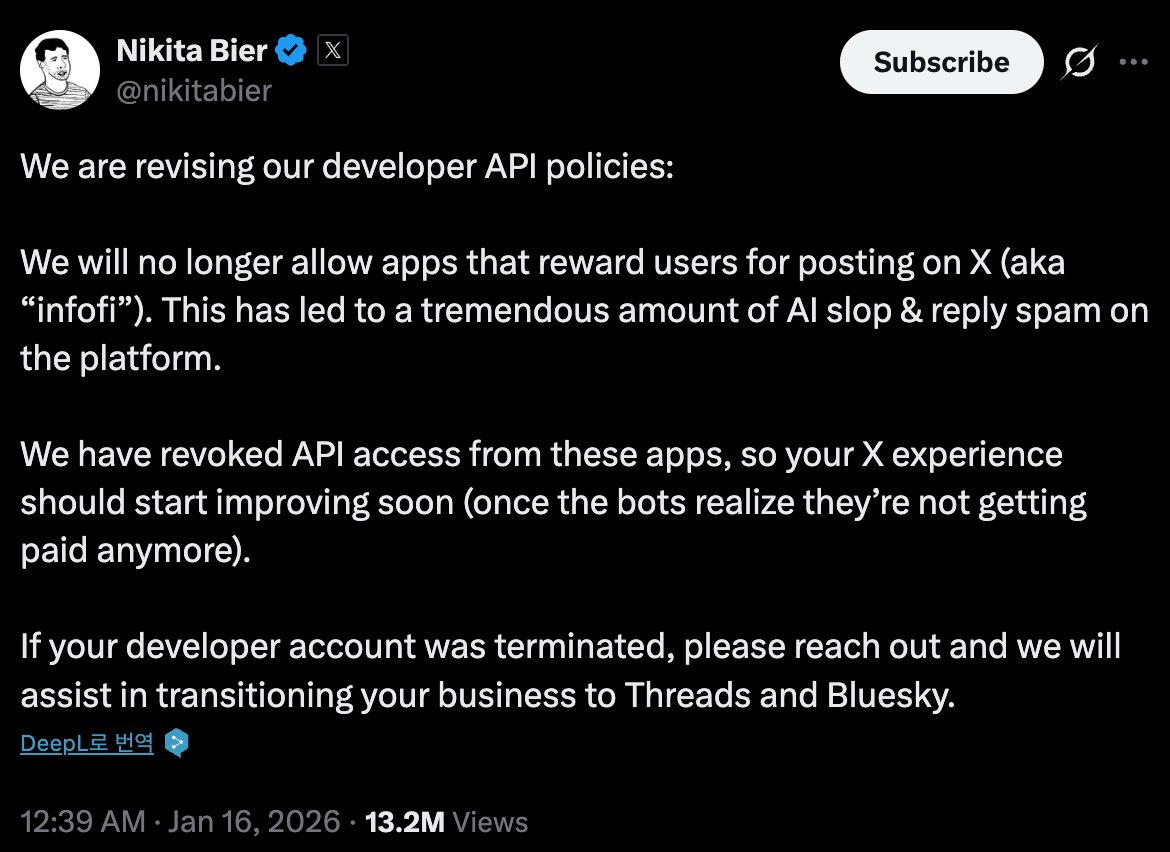
On January 15, Nikita Bier, product lead at X, published a short post stating that apps offering rewards in exchange for posting would no longer be allowed on the platform. For InfoFi projects, this marked the end.
According to Yu Hu, founder of Kaito, events unfolded as follows:
- January 13: Kaito received an email from X indicating a possible review and immediately requested clarification.
- January 14: X sent a formal legal notice, and Kaito submitted a legal response the same day.
- January 15: Nikita Bier’s post went public. Kaito learned of the decision at the same time as everyone else.
The market response was unforgiving.
$KAITO fell sharply, and the community criticized the team for failing to provide advance notice despite claiming it had been preparing for the situation. Kaito issued an emergency statement that evening, explaining that it had previously received legal notices from X that were resolved through new agreements, and that it had therefore waited for further discussion in this case as well.
Regardless of the explanation, a single decision by X brought the InfoFi ecosystem to an end. In just three days, an entire category collapsed, undone by one company’s judgment that it was harming platform quality.
2. If I Were an InfoFi Founder Today
Does this mean InfoFi is over? Projects like Kaito are already preparing for what comes next. However, what is needed now is not a continuation of the past model, but a different version of InfoFi 2.0.
If I were the founder of an InfoFi project like Kaito, what options would realistically be available today? By examining the viable paths forward, we can begin to outline what the next phase of InfoFi might look like.
2.1. Shutting Down
This is the simplest option. Wind down operations before funding runs out. In practice, many small and mid-sized projects are likely to enter a “zombie” phase, largely inactive, with only occasional social posts before disappearing entirely.
With product-market fit built around X now gone, shutting down may be more realistic than burning cash in search of a new direction. If a project holds usable data assets, these can be sold to other companies to recover some value. For this reason, most small and mid-sized InfoFi projects are likely to choose this path.
2.2. Bounty-Based Grant Platform
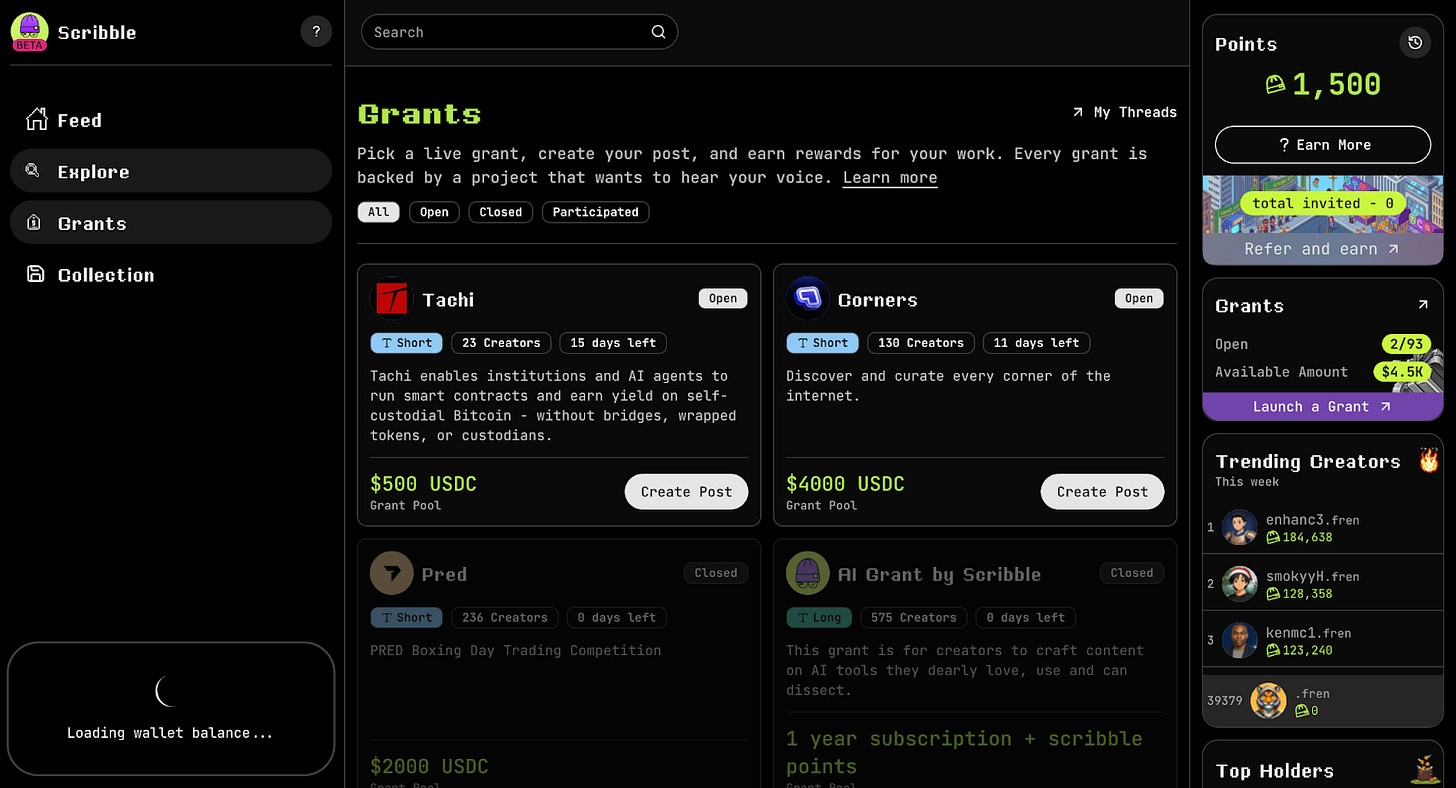
If access to the X API is no longer available, one option is to revert to an older model. KOLs apply directly to campaigns, submissions are reviewed manually, and rewards are paid after approval.
Source: Scribble
Scribble is a representative example. Projects post grants in the form of bounties, and KOLs create and submit content for review before receiving rewards. This is a submit-and-review model rather than real-time tracking.
This structure can scale as an open platform. The platform provides mediation and infrastructure, while individual projects manage their own campaigns. As more projects participate, the KOL pool expands. As the KOL base grows, projects gain more options.
The drawback is uncertainty for KOLs. If submitted content is rejected, the time invested is lost. After repeated failures, KOLs are likely to leave the platform.
2.3. Korea-Style Sponsored Blogging Model

Source: Revu
Korea’s sponsored blogging model follows a “selection first, management later” approach rather than post-submission review. Agencies such as Revu have used this model for more than a decade.
The process is straightforward. A project sets a target number of participants and publishes a campaign. Applicants apply, and the project selects KOLs based on data such as follower count and past performance. Selected KOLs receive clear guidelines. Once content is published, an operator reviews it. If standards are not met, revisions are requested, and penalties apply if deadlines are missed.
Under this model, KOLs avoid wasted effort. Once selected, compensation is effectively guaranteed as long as guidelines are followed. Unlike bounty-based systems, there is no risk of rejection after the work is done. From the project’s perspective, quality control is easier since only pre-vetted participants are selected.
2.4. Multi-Platform Expansion
If X is no longer viable, the next option is to move to YouTube, TikTok, and Instagram. Within Web3, there is already a strong push to expand beyond X. The view is that real growth requires moving away from a platform dominated by crypto-native users toward channels where a broader audience is present.
The main advantage is access to a much larger potential user base than X. Platforms like TikTok and Instagram are especially influential in emerging markets such as Southeast Asia and Latin America. Each platform also runs on different algorithms, allowing operations to continue even if one channel becomes constrained.
The trade-off is operational complexity. With X, only text-based posts needed to be reviewed. On YouTube, content length and production quality matter. On TikTok, the first three seconds determine performance. On Instagram, story execution and format quality must be evaluated. This requires either platform-specific expertise or new internal tooling. API policies and data collection methods also differ by platform. In practice, this is close to rebuilding from scratch.
Policy risk remains. Platforms can change rules abruptly, as X did. However, spreading activity across multiple platforms reduces single-platform dependency. For larger projects, this is the only option that offers meaningful scalability.
2.5. MCN-Style KOL Management
In Web2 MCN models, a KOL’s brand value matters. In Web3, it is even more decisive. Narratives move capital, and opinion leaders carry outsized influence. A single comment can move a token price.
Successful InfoFi projects have already formed active and aligned KOL groups. These KOLs have grown through months of participation on the platform. Instead of sourcing creators from scratch, projects can retain this group and shift to data-driven management, unlike traditional Web2 MCNs that rely on continuous discovery.
An MCN-style structure implies formal contracts rather than loose, opt-in platform participation. With accumulated data and established relationships, the platform can exert stronger influence within the Web3 ecosystem and negotiate better deals.
For InfoFi projects, this requires a robust management system. Data becomes the core asset. If KOLs can be guided through data, and projects can be offered specialized, data-driven GTM strategies, this model can provide a durable competitive edge.
3. InfoFi 2.0
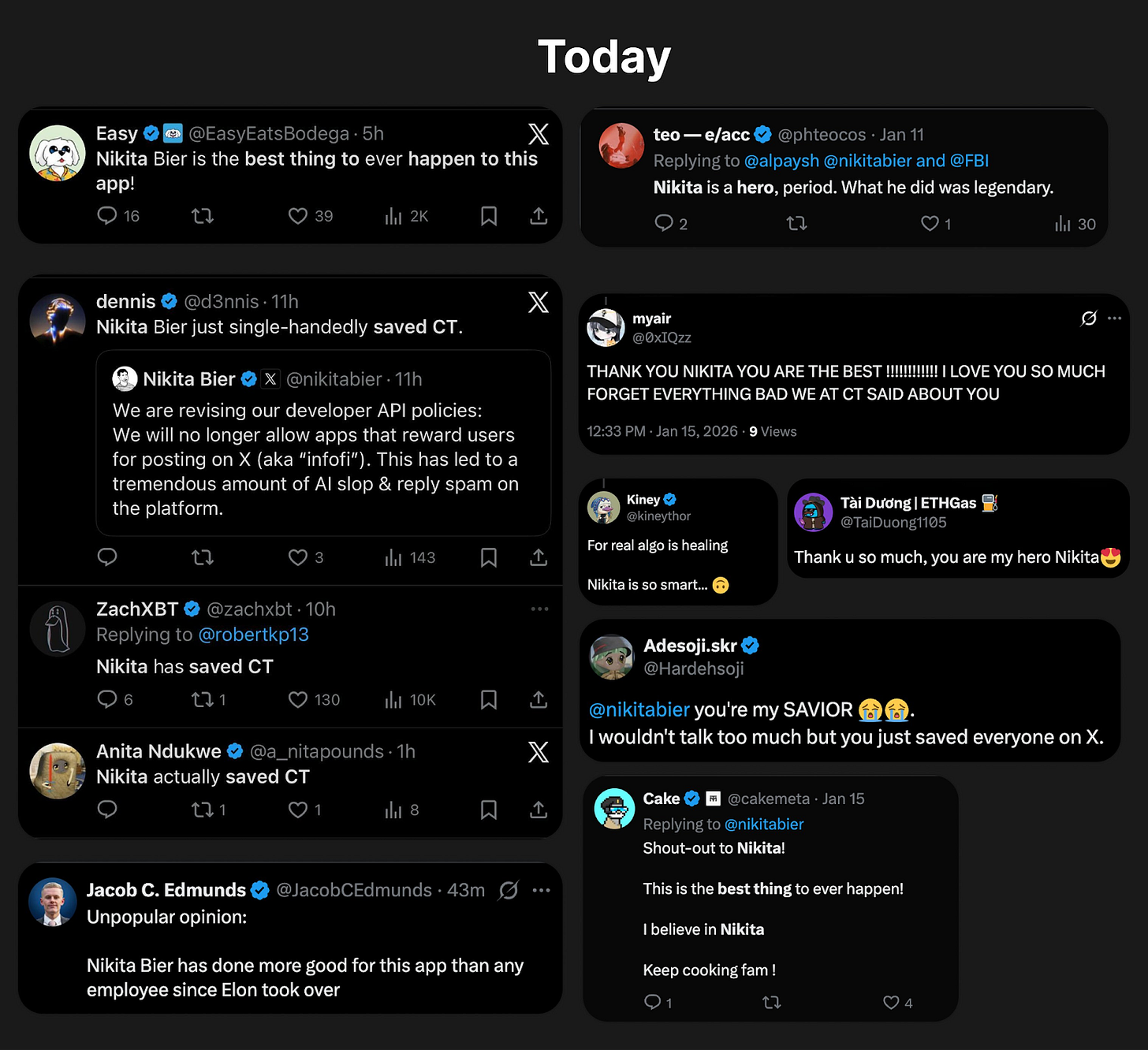
The collapse of InfoFi leaves two lessons for the Web3 ecosystem.
- The irony of decentralization: Web3 projects relied on the centralized platform X, and a single decision by X was enough to bring the system down.
- The limits of incentive design: Rewards succeeded in attracting participants, but there was no effective way to control quality. Spam increased, giving X a clear justification to intervene.
Source: X(@ nikitabier)
Does this mean InfoFi is over?
Not entirely. A small number of projects that found product-market fit are likely to survive by changing form. They can pivot toward multi-platform expansion, curated campaigns, or MCN-style management.
InfoFi 2.0 is likely to be smaller, more controlled, and more focused on quality. It will shift from an open, permissionless platform to a vetted network, closer to an integrated marketing platform that combines local GTM efforts with components such as offline advertising.
However, the fundamental issues remain.
Joel Mun from Tiger Research House noted that once rewards are introduced, participants inevitably look for ways to game the system, making fair structures difficult to design. This behavior leads to low-quality content and creates a negative feedback loop that can undermine the platform, making it a critical issue for InfoFi projects.
David raised a more fundamental question. He argued that the value of InfoFi tokens was sustained less by platform performance and more by staking airdrops and belief in the narrative. Both have now lost relevance. This leads to a direct question: why should investors buy InfoFi tokens?
For InfoFi 2.0 to survive, these questions require clear answers. A project cannot remain sustainable if it is disconnected from its token holders.
Disclaimer:
- This article is reprinted from [Tiger Research Reports]. All copyrights belong to the original author [Ryan Yoon]. If there are objections to this reprint, please contact the Gate Learn team, and they will handle it promptly.
- Liability Disclaimer: The views and opinions expressed in this article are solely those of the author and do not constitute any investment advice.
- Translations of the article into other languages are done by the Gate Learn team. Unless mentioned, copying, distributing, or plagiarizing the translated articles is prohibited.
Related Articles

The Future of Cross-Chain Bridges: Full-Chain Interoperability Becomes Inevitable, Liquidity Bridges Will Decline

Solana Need L2s And Appchains?

Sui: How are users leveraging its speed, security, & scalability?

Navigating the Zero Knowledge Landscape

What is Tronscan and How Can You Use it in 2025?
