What Are the Risks of Allora Network? Data Integrity, Incentives, and Game Theory in Decentralized AI
Allora Network coordinates multiple AI models through a decentralized architecture, allowing them to participate together in prediction and inference tasks. Its goal is to use collective intelligence to improve information efficiency and prediction accuracy. Yet, as with any open network, decentralization does not mean risk disappears. Data sources, participant behavior, and incentive mechanisms can all affect the reliability of the final results.
In the field of decentralized AI infrastructure, Allora Network represents the development direction of AI inference markets. Compared with traditional centralized AI services, Allora offers more transparent model evaluation and reward mechanisms, but it also introduces new layers of complexity involving on-chain governance, reputation systems, and economic incentives.
Why Does Data Quality Determine Prediction Results?
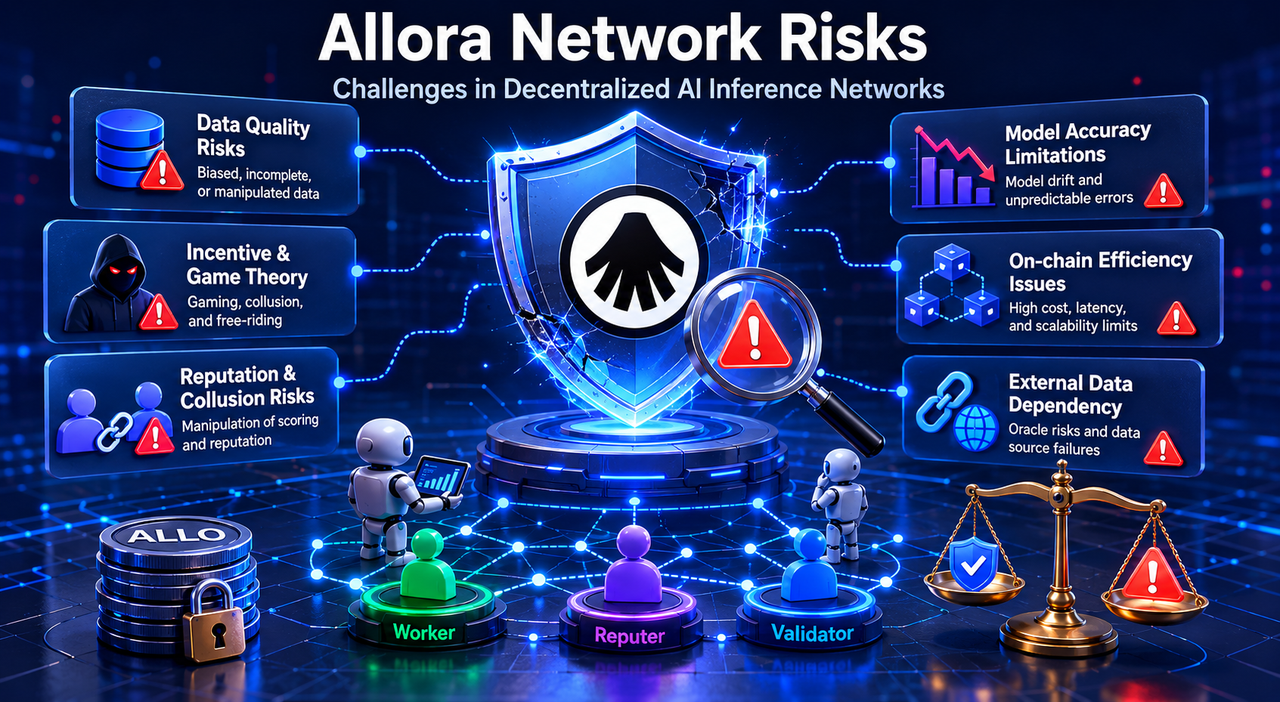
Allora Network’s predictive capability is built on data. No matter how advanced a model is, biased input data can still lead to flawed outputs.
Data problems mainly appear in three forms: missing data, delayed data, and distorted data. Some on-chain data may contain noise, while some off-chain data may be affected by collection methods and source quality.
Because multiple models in the network may rely on similar data sources at the same time, incorrect data may even be amplified collectively rather than automatically eliminated.
Can Model Accuracy Be Manipulated?
One of Allora’s core mechanisms is distributing rewards based on prediction accuracy, but accuracy evaluation itself can also become a target for strategic behavior.
If some participants can obtain special information in advance, or exploit loopholes in the scoring rules to adjust their prediction strategies, the network may produce unfair advantages.
For example, some models may be optimized specifically for the scoring mechanism rather than for genuinely better predictive ability. In machine learning, this is known as “objective gaming.”
That is why keeping rewards aligned with real prediction quality is a challenge faced by all prediction markets.
What Potential Risks Exist in the Reputer System?
Reputers are responsible for evaluating Workers’ prediction performance and determining reputation weight.
If Reputers themselves are manipulated, the entire scoring system may lose credibility. In theory, multiple Reputer nodes could form interest-based alliances and artificially raise the reputation scores of specific models.
Although Validators verify the scoring process, coordinated attacks in complex networks remain a long-term concern.
For this reason, Reputer reputation management and anti-collusion design are important to network security.
Why Can Incentive Mechanisms Lead to Game-Theoretic Behavior?
Any network based on token rewards faces incentive-related game theory problems.
Allora’s goal is to reward the most accurate predictors, but participants are ultimately seeking economic returns. When the reward structure diverges from the prediction objective, nodes may prioritize maximizing income rather than maximizing prediction quality.
For example, some participants may choose to imitate high-reputation models instead of investing resources into developing new prediction methods. This can reduce the network’s overall capacity for innovation.
If a “free-rider effect” persists over time, the advantage of collective intelligence may gradually weaken.
Can the Reputation System Create Centralization Risks?
Allora uses a reputation mechanism to increase the influence of high-quality models, but relying too heavily on historical performance can also create new problems.
When a small number of models maintain high reputations over a long period, their prediction results may become dominant in the network. Over time, it may become harder for new models to enter the market.
This phenomenon is known as “reputation centralization.”
If reputation becomes too concentrated, the network may gradually move away from the principle of open competition, weakening the diversity that a decentralized network should have.
What Efficiency Issues Can On-Chain Verification Create?
Allora emphasizes the verifiability of prediction results, so some processes need to be recorded and verified through blockchain.
Compared with centralized AI services, on-chain verification usually requires additional time and resource costs.
When the number of inference requests increases sharply, the network may face several challenges:
-
Increased data processing latency
-
Higher costs
-
Weaker user experience
-
Limited network throughput
As a result, finding the right balance between transparency and efficiency is an important issue for Allora’s future development.
What Risks Come from Dependence on External Data?
Many prediction tasks require real-world data.
For example, financial market prices, macroeconomic indicators, and social media sentiment analysis largely come from off-chain sources.
If external data sources are attacked, tampered with, or stop updating, the quality of prediction models will be directly affected.
These issues are similar to the challenges faced by oracles and are an unavoidable risk when connecting blockchains with the real world.
Do AI Models Themselves Have Limitations?
Allora can optimize model performance, but it cannot remove the inherent limitations of AI itself.
Machine learning models rely on historical data for training, while real-world conditions are always changing.
When market structures shift, models that once worked well may quickly become ineffective.
In finance, this is often called “model drift.”
Even if the network continuously updates reputation scores, it cannot guarantee that future predictions will always be accurate.
How Does Allora Reduce These Risks?
One of Allora’s design goals is to reduce single points of failure through collective intelligence.
When multiple models participate in prediction at the same time, the impact of a single model failure can be reduced. The two-layer verification structure of Reputers and Validators can also lower the risk of scoring manipulation.
At the same time, the network uses a dynamic reputation system, allowing model influence to adjust as performance changes.
Although these mechanisms cannot completely eliminate risk, they can improve the network’s overall resistance to disruption and its long-term stability.
Conclusion
Allora Network builds an open AI inference market through collective intelligence and on-chain incentives, but that openness also introduces risks involving data quality, scoring credibility, incentive games, and network efficiency. As an important experiment in decentralized AI infrastructure, Allora is not trying to remove every risk. Instead, it uses protocol design and economic incentives to reduce the impact of those risks on prediction results.
As AI and blockchain become more deeply integrated, finding the right balance among openness, accuracy, and security will remain an important challenge for Allora Network and the broader decentralized AI industry.
FAQs
What Is the Biggest Risk of Allora Network?
The main risks of Allora Network include data quality problems, manipulation of model scoring, incentive mechanism imbalance, and efficiency limitations caused by on-chain verification.
Why Does Data Quality Affect Allora’s Prediction Results?
Allora Network’s AI models rely on input data for inference. If the data is biased, delayed, or incorrect, prediction results may deviate even when the model itself is effective.
Can Reputers Be Manipulated?
In theory, yes. If multiple participants coordinate to influence the scoring process, the network’s reputation system may be disrupted. That is why Reputers need continuous oversight from Validators.
What Is an Incentive Game Problem?
An incentive game problem refers to participants changing their behavior to obtain more rewards, creating a gap between the intended goal and the reward mechanism, which can affect the network’s overall efficiency.
Can Allora Completely Avoid Incorrect Predictions?
No. Allora can improve prediction quality through collective intelligence, but it cannot eliminate uncertainty caused by data errors, market changes, and model limitations.
How Are Allora’s Risks Different from Those of Traditional AI Platforms?
Traditional AI platforms mainly face technical risks. Allora Network, in addition to technical risks, also needs to address on-chain governance, token economics, and participant game theory in an open network.
Related Articles

Arweave: Capturing Market Opportunity with AO Computer

The Upcoming AO Token: Potentially the Ultimate Solution for On-Chain AI Agents

AI+Crypto Landscape Explained: 7 Major Tracks & Over 60+ Projects
0G vs Bittensor: Key Differences Between AI Infrastructure Layer and Decentralized AI Model Network

What is AIXBT by Virtuals? All You Need to Know About AIXBT