Vitalik Buterin’s Deep Dive into Creator Token Design: From Incentives to Non-Tokenized DAOs and Prediction Tools
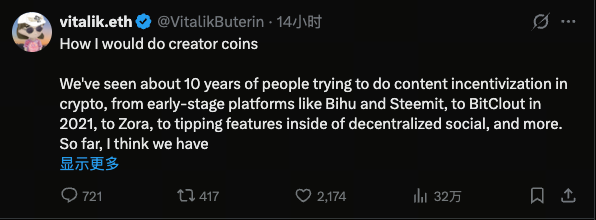
Image: https://x.com/VitalikButerin/status/2017956762347835488
1. Background: The Creator Economy and the Challenge of Crypto Incentive Mechanisms
In the Web3 era, the creator economy has emerged as a key driver of growth in the blockchain ecosystem. Issuing creator tokens theoretically enables creators to be rewarded for producing high-quality content, while allowing fans to directly participate in support and ecosystem governance. In practice, however, most token projects fail to deliver these intended results. The market is typically driven by traffic and speculation, not by the intrinsic value of quality content.
This issue is also present on traditional Web2 platforms, but crypto token mechanisms should offer more transparent and robust channels for economic incentives. Recently, Vitalik Buterin shared insightful commentary on this topic, sparking widespread industry discussion.
2. Vitalik’s Core Perspective: Incentives Do Not Equal Outcomes
Vitalik notes that the crypto industry has seen limited success in content incentivization over the past decade. The problem is not a lack of content supply, but the inability to effectively filter and amplify high-quality content. He observes that technology—especially AI—has driven down the cost of content creation, making it easier to produce large volumes of material. Without effective filtering, incentive mechanisms risk generating more noise than signal.
Traditional creator token markets are often dominated by celebrities or socially influential users. This structural flaw channels resources to a select few rather than genuine quality creators. Vitalik argues that the failure lies not in the token mechanism itself, but in the ecosystem’s lack of robust content quality filtering and governance structures.
3. Non-Tokenized DAO: A New Governance Model
To address these challenges, Vitalik proposes a significant strategy—creating a non-tokenized creator DAO. This DAO does not rely solely on tokens as the exclusive means of governance. Instead, it uses member voting to select creators, ensuring clear content focus and controlled scale.
This approach resembles Protocol Guild-type DAOs, which prioritize quality content governance over token proliferation. The central idea is to make the DAO the primary filter for high-quality creators, thereby establishing stable brand effects and commercial leverage.
4. Creator Tokens as Predictive Tools: The Rationale
In Vitalik’s framework, creator tokens evolve from simple incentives to predictive tools. When a creator is recognized and admitted to a DAO, the DAO’s revenue can be used to buy back and burn that creator’s tokens. This shifts the token’s value to reflect participants’ expectations of the creator’s future impact, rather than pure speculation.
This design reduces “recursive speculation cycles” and ties token prices more closely to DAO recognition of outstanding creators. Under this model, speculators effectively become “forecasters of quality creators,” enhancing the efficiency of content selection.
5. Potential Impact on the Creator Ecosystem and Market
If widely adopted, this design could shift the creator token market from hype-driven speculation toward a more rational, value-driven ecosystem. High-quality creators and teams would gain access to stable resources through DAO selection, while speculators would increasingly focus on forecasting and supporting top-tier content.
This mechanism could deliver several benefits:
- Improve the discovery of high-quality content
- Build a healthier creator economic cycle
- Mitigate negative feedback from price volatility and speculation
However, successful implementation depends on effective DAO governance and strong curation skills among members; otherwise, the model could still become unstable.
6. Risks and Challenges
Despite its innovative potential, this approach faces several practical challenges, including:
- How should DAO member selection criteria be defined?
- How can governance be protected from manipulation by a minority?
- How can predictive markets be effectively integrated with traditional mechanisms?
These issues require ongoing iteration and optimization by ecosystem designers, developers, and community participants during implementation.
7. Conclusion: The Future of Web3 Content Ecosystems
Vitalik’s perspective highlights that the true value of creator tokens lies not in simple incentives, but in building effective filtering and prediction mechanisms. Rethinking token functions and governance structures may pave the way for a healthier, higher-quality Web3 ecosystem.
As the market’s understanding of content quality and governance matures, the creator economy could be poised for a genuine transformation.
Related Articles

AI-Native Settlement Layers: How United Stables Is Building the Next Financial Rail

The ve(3,3) Flywheel Explained: How AERO Tokenomics Powers Aerodrome’s DeFi Economy

How Does PAXG Work? In-Depth Overview of the Physical Gold Tokenization Mechanism

Aerodrome Tokenomics: How ve(3,3) Powers Base's Most Profitable DEX

How is the price of PAXG determined? Pegging mechanism, trading depth, and influencing factors
