TradFi vs DeFi: Key Distinctions, Risk Analysis, and the Future of Finance
TradFi and DeFi represent the two main structures in today’s financial landscape, each relying on distinct trust frameworks and asset custody models, with pronounced differences in risk profiles and return characteristics. As technology and market dynamics progress, the boundary between TradFi and DeFi is gradually narrowing, driving a trend toward integration.
TradFi and DeFi: Fundamental Definitions and Boundaries
The fundamental difference between TradFi and DeFi centers on financial trust and execution mechanisms: TradFi relies on centralized intermediaries—banks, brokerages, exchanges, and clearinghouses—supported by legal, regulatory, and credit systems, prioritizing stability, compliance, and scalable operations. DeFi, however, operates through blockchain and smart contracts, replacing intermediaries with code-driven rules to enable permissionless asset trading, lending, and yield distribution. Whereas TradFi establishes trust via institutions and regulatory frameworks, DeFi leverages transparent, verifiable technology for global, highly composable financial services. This distinction drives their structural, risk, and efficiency differences.
At their core, TradFi is built for stability and order; DeFi for efficiency and innovation.
In terms of scale, TradFi remains the dominant global financial system. According to major international institutions, TradFi’s total assets exceed $400 trillion, spanning stocks, bonds, forex, commodities, and derivatives. DeFi, by contrast, is still emerging. Even at bull market peaks, DeFi’s total value locked (TVL) remains under several hundred billion dollars, underscoring a significant magnitude gap.
This scale disparity means TradFi “carries global capital,” while DeFi is primarily a platform for “innovation and experimentation.”
Core Structural Differences Between TradFi and DeFi
Structurally, TradFi and DeFi differ mainly in trust sources, asset custody, and operational logic.
TradFi is built on institutional trust, with account systems linked to personal identities. Assets are mainly institutionally custodied, and transactions follow regulated timelines and procedures. DeFi relies on code-based trust; wallets serve as accounts, assets are self-custodied, systems operate 24/7, and rules execute automatically on-chain.
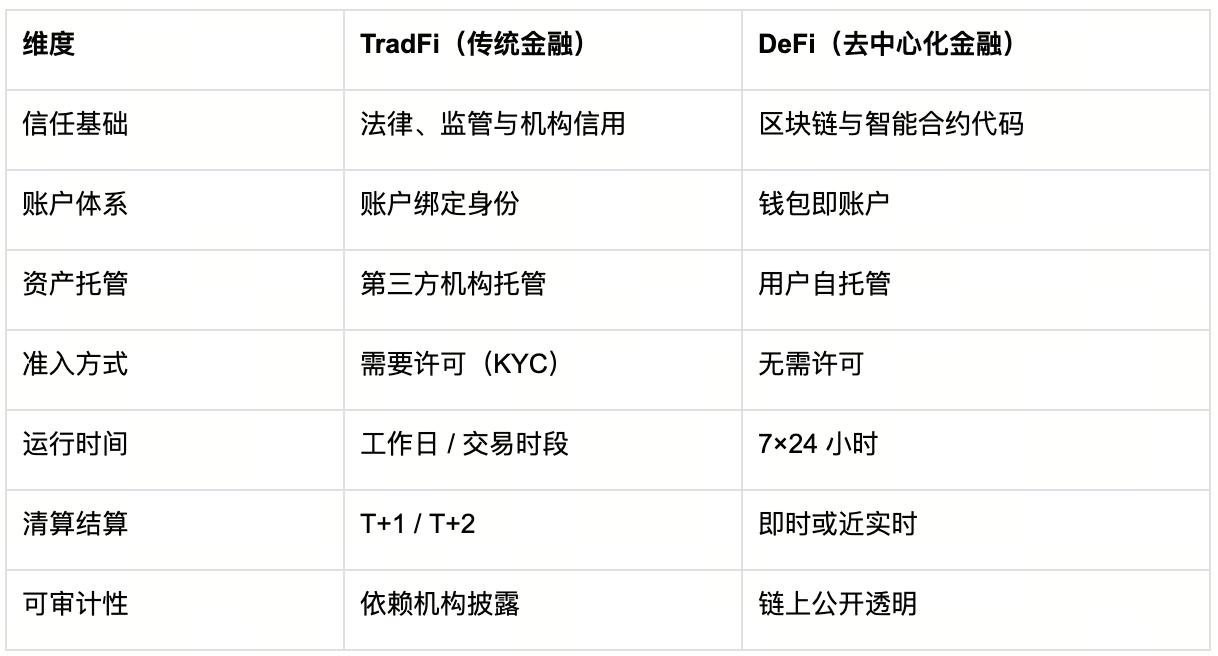
These differences fundamentally impact risk distribution, operational efficiency, and user experience.
Comparing Risk Structures: Institutional vs. Technological Risk
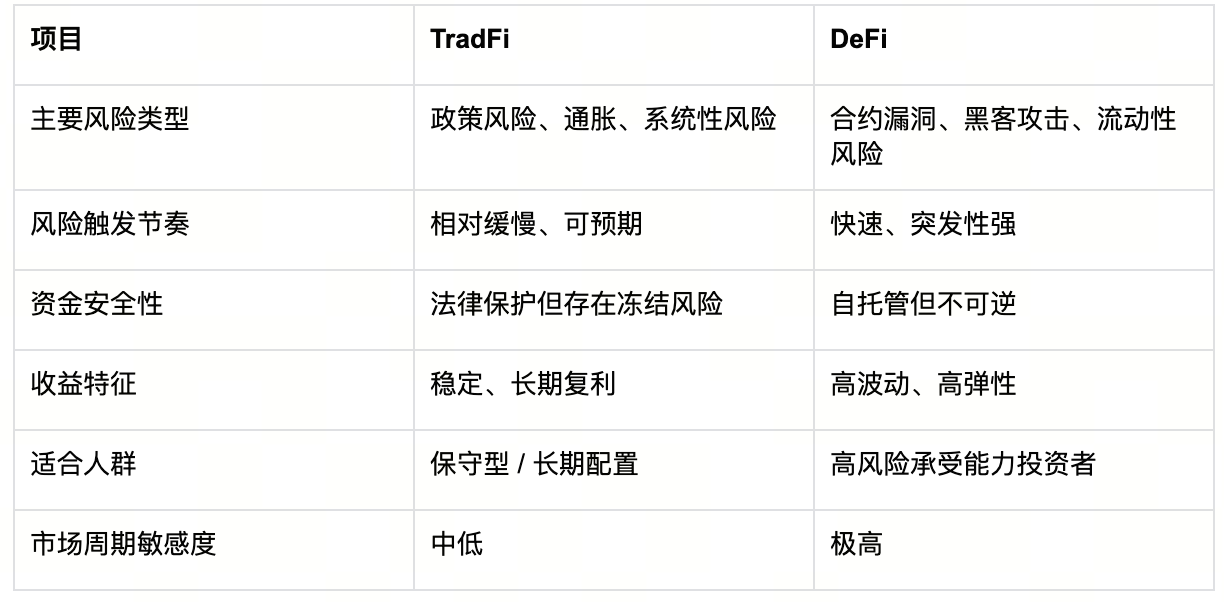
TradFi risks are primarily macro and institutional—monetary policy shifts, inflation, interest rate volatility, systemic financial risk, and restricted account access. These risks have broad impact but relatively predictable evolution.
DeFi risks are rooted in technology and market structure—smart contract vulnerabilities, hacks, liquidity crises, and flawed mechanism design. Risk events are often sudden but their impact is typically concentrated. Historically, DeFi has seen protocol exploits inflict hundreds of millions in losses within short windows, but effects are generally limited to specific protocols or sectors.
TradFi risks are “slow-moving variables”; DeFi risks are “fast-moving variables.”
Yield Sources and Capital Efficiency Analysis
TradFi returns are driven by economic growth, corporate profits, interest spreads, and cycles—marked by low volatility, predictability, and long-term compounding.
DeFi returns arise from protocol incentives, risk premiums, and improved capital efficiency, offering higher short-term upside but depending heavily on market sentiment, liquidity, and technical safety.
Capital allocation between TradFi and DeFi shifts significantly across market phases.
TradFi and DeFi Are Not Opposites: Integration Is Underway
TradFi and DeFi integration is accelerating. For example, Bitcoin and Ethereum ETFs have reached asset scales in the tens of billions—becoming a key entry point for TradFi capital into crypto.
Meanwhile, RWA (Real World Asset tokenization) is expanding DeFi’s scope. Today, on-chain RWAs include government bonds, credit assets, and commodities, with total value now at several tens of billions and rising.
This integration shows blockchain is fast becoming a core infrastructure for TradFi, not just an alternative.
How Should Individual Investors Choose Between TradFi and DeFi?
For retail investors, TradFi and DeFi are not “either/or” propositions, but asset allocation and risk management challenges. Participation depends on three factors: market cycle, capital scale, and risk appetite.
1. Choice Logic Across Market Cycles
The relative appeal of TradFi versus DeFi shifts with macro and market cycles.
Liquidity expansion / rising risk appetite
- In environments with rate-cut optimism and abundant liquidity, capital chases high-volatility assets. DeFi often shows stronger upside and return elasticity, but higher volatility.
Contraction cycle / declining risk appetite
- When rates rise, liquidity tightens, or uncertainty increases, TradFi cash, commodities, bonds, and derivatives become more attractive for defense and preservation.
Historically, DeFi suits bull cycles; TradFi is preferred for downturns and defensive periods.
2. Optimal Choices by Capital Scale
Capital scale directly affects investment strategy in TradFi and DeFi.
Small-scale investors
- For those with smaller capital, DeFi’s low barriers, permissionless access, and high efficiency are appealing. On-chain products allow participation with modest funds, provided technical and operational risks are manageable.
Mid-scale investors
- The focus here is “drawdown control.” Solely betting on either DeFi or TradFi can add risk—combining both helps balance volatility and returns.
Large-scale or high-net-worth investors
- With greater capital, liquidity, compliance, and security are paramount. TradFi offers clear advantages, while DeFi serves as a strategic and supplementary component.
The larger the capital, the more stability is needed; the smaller the capital, the more flexibility is possible.
3. Allocation by Risk Appetite
Risk appetite determines TradFi and DeFi allocation.
Low-risk investors
- TradFi assets are best, focusing on interest rates, inflation hedging, and long-term allocation, while cautiously exploring low-risk DeFi products.
Moderate-risk investors
- Dynamically balance TradFi and DeFi, adjusting based on market conditions, avoiding concentration risk.
High-risk investors
- Seek high-beta opportunities in DeFi, but must actively manage risk and accept volatility and drawdowns.
The higher the risk appetite, the more hands-on management is needed; the lower the risk appetite, the more rules and stability matter.
4. The Key Is “Combination”—Not Picking Sides
In essence, retail investors should focus on:
- Which asset class to target in each cycle
- How much volatility to accept based on capital
- What level of returns to pursue given risk preference
TradFi delivers stability and certainty; DeFi provides flexibility and innovation. Smart allocation means dynamically adjusting weights, not rigidly choosing sides.
How Will TradFi and DeFi Coexist and Evolve?
With the crypto user base expanding, TradFi and DeFi are evolving from standalone systems to integrated coexistence. The future isn’t a traditional-vs-decentralized binary, but a composite model shaped by regulatory frameworks, traditional assets, and blockchain. Investor needs are the main driver for this convergence.
On one hand, investors increasingly want unified platforms for multi-asset allocation, rather than hopping between banks, brokerages, and crypto platforms. On the other, blockchain’s advantages in settlement efficiency, transparency, and programmability offer traditional finance a practical upgrade path. As on-chain identity, custody, and compliance mature, tokenizing TradFi assets is moving from concept to reality.
Integration will change investor participation. In the future, investors may access crypto and traditional assets within a single ecosystem, enabling efficient cross-market allocation. Faster settlement and improved capital flows boost capital utilization, making position and risk management more agile.
DeFi is also maturing, shifting from incentive-driven growth to risk management and sustainability—making it more attractive to mainstream capital and traditional finance. Financial institutions are actively adopting blockchain to enhance clearing, settlement, and asset management.
Conclusion
In summary, TradFi and DeFi will not replace each other, but are gradually integrating and evolving together. Investors will benefit from broader asset choices, higher trading efficiency, and greater flexibility. The real long-term opportunity is not about betting on one system, but adapting to the ongoing structural transformation.
FAQs
1.What is the fundamental difference between TradFi and DeFi, and how should individual investors interpret it?
TradFi relies on centralized institutions and established regulation for stability, compliance, and risk control; DeFi runs on blockchain and smart contracts, emphasizing openness, transparency, and disintermediation. For retail investors, these are not mutually exclusive but distinct financial tools with different risk profiles and participation modes.
2.Is TradFi safer than DeFi in the current market?
TradFi offers clearer safety boundaries due to institutional protections, but limited return elasticity; DeFi provides greater transparency and efficiency, but faces technical and market volatility risks. Safety depends on individual risk tolerance, not the system itself.
3.Why are more TradFi assets entering the crypto market?
As crypto adoption grows, traditional institutions see blockchain as a way to improve settlement efficiency and asset liquidity. Tokenization reduces cross-border friction, enabling TradFi to reach new investors more efficiently—this trend is accelerating.
5.Should retail investors allocate to both TradFi and DeFi?
Allocation depends on investment horizon, capital, and risk preference. Conservative investors should use TradFi as a core, with DeFi as a supplement; higher risk-tolerance investors can increase DeFi exposure within prudent limits for potential excess returns.
6.What’s the biggest change for investors after TradFi and DeFi converge?
Greater choice and efficiency. Investors may soon allocate multi-asset portfolios on a single platform, achieving lower costs and higher capital management efficiency.
Further Reading
Related Articles

AI-Native Settlement Layers: How United Stables Is Building the Next Financial Rail

The ve(3,3) Flywheel Explained: How AERO Tokenomics Powers Aerodrome’s DeFi Economy

How Does PAXG Work? In-Depth Overview of the Physical Gold Tokenization Mechanism

Aerodrome Tokenomics: How ve(3,3) Powers Base's Most Profitable DEX

How is the price of PAXG determined? Pegging mechanism, trading depth, and influencing factors
