TradFi Accounts Explained: How Traditional Financial Accounts Work
Every payment, investment, and market transaction is mediated through institution-managed accounts that define ownership, access rights, settlement processes, and regulatory compliance.
Unlike blockchain-based systems where users interact directly with assets, TradFi accounts are account-based structures operated by banks and brokerages. Assets are custodied by institutions, transactions are processed through clearing and settlement networks, and access is governed by identity verification, jurisdiction, and regulatory oversight. This architecture has supported global financial stability for decades, but it also introduces structural friction.
This article explains what TradFi accounts are, how they operate in practice, why they create friction for modern users, and how crypto-native platforms are rethinking account-based access to traditional financial markets.
What Is a TradFi Account?
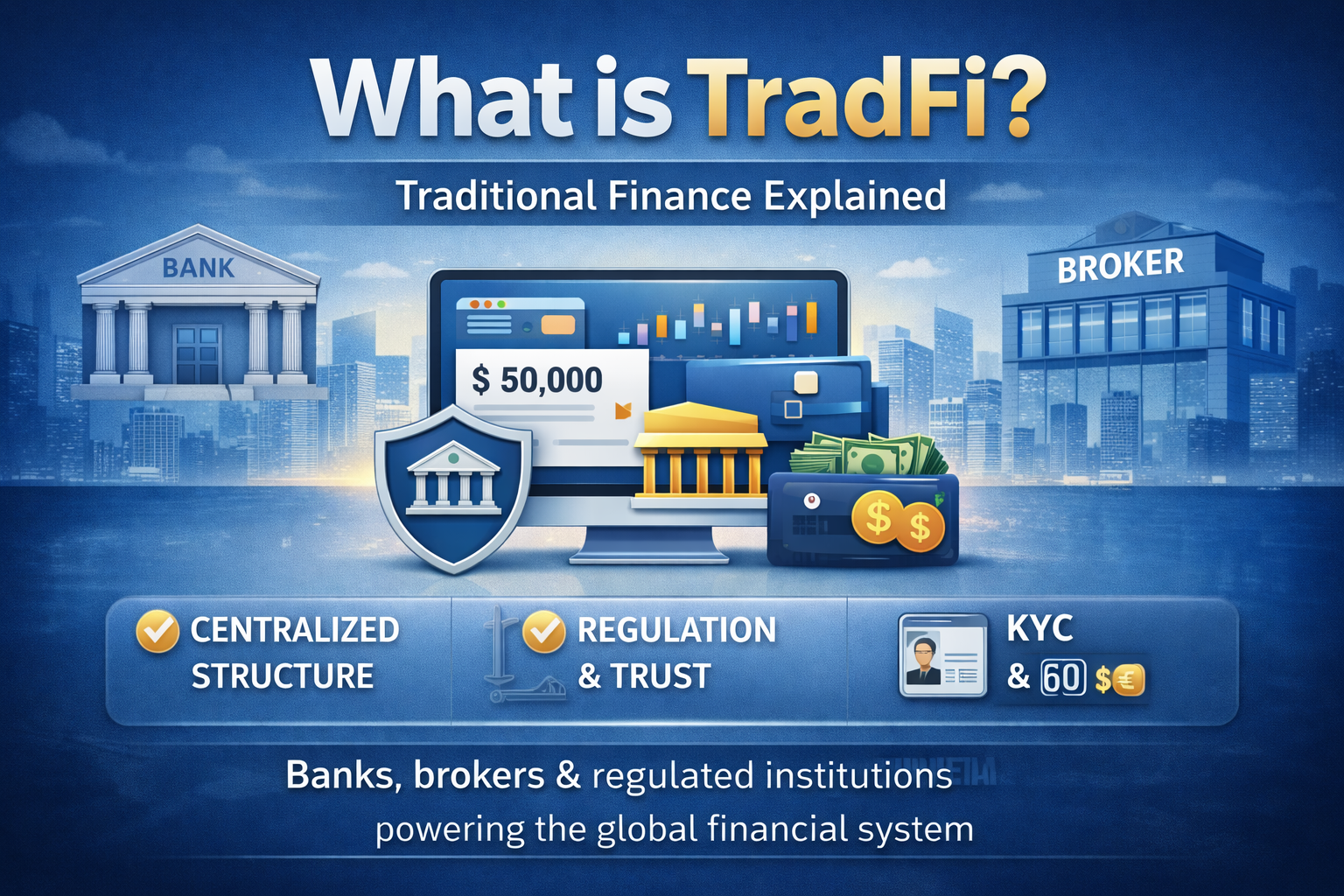
A TradFi account is a regulated financial account provided by banks or brokerages that enables custody, transactions, and market participation. These accounts are used to store funds, make payments, invest, and conduct financial transactions.
TradFi accounts share several defining characteristics:
- Assets are custodied by centralized institutions
- Account operations are strictly regulated by financial authorities
- Accounts are linked to verified real-world identities (KYC) and closely tied to fiat currencies
At their core, TradFi accounts represent the gateway through which individuals and organizations participate in modern financial activity.
Types of Traditional Financial Accounts
Within the TradFi system, different account types serve different financial purposes:
- Bank Deposit Accounts Checking and savings accounts used for fund storage, transfers, and daily payments. These prioritize security and liquidity but typically offer limited returns.
- Investment and Trading Accounts Brokerage, securities, futures, and forex accounts used to trade stocks, bonds, funds, commodities, and derivatives. These accounts focus on investment access and are subject to stricter compliance requirements.
- Credit and Derivative Accounts Margin and leveraged accounts that allow users to amplify trading exposure under specific conditions, introducing higher risk alongside greater capital efficiency.
Together, these accounts form the structural backbone of traditional financial markets.
How TradFi Accounts Operate
TradFi accounts function through three core mechanisms: custody, settlement, and compliance.
First, funds and assets are held in custody by financial institutions. Users do not directly control private keys or underlying ownership structures; instead, ownership is reflected through account records.
Second, transactions rely on clearing and settlement systems such as interbank networks and securities clearing houses. While stable and reliable, these systems often operate with fixed schedules and delayed settlement cycles.
Finally, all account activity is subject to regulatory oversight, including KYC, AML checks, and transaction monitoring. These controls enhance system stability but limit flexibility and speed.
Common Frictions in Traditional Financial Accounts
Despite their maturity, TradFi accounts present several challenges for everyday users:
- High entry barriers Account opening often requires extensive documentation, residency verification, and jurisdiction-specific eligibility.
- Ongoing costs Maintenance fees, transaction charges, and cross-border transfer costs can significantly reduce net returns over time.
- Time and geographic constraints Fixed trading hours, holiday closures, and slow cross-border settlement reduce efficiency for global and digital-native users.
These frictions make traditional accounts less accessible for users seeking flexible, global financial participation.
How Crypto Platforms Improve Access to TradFi Accounts
Gate TradFi accounts are designed around an integrated access model, removing many of the frictions associated with traditional financial participation.
Unified Account and Pricing Structure
Gate introduces USDx as the margin and pricing unit for TradFi accounts. USDx is an internal accounting unit pegged 1:1 to USDT.
Users simply transfer USDT into a TradFi account, where balances are automatically displayed as USDx, without manual conversion, hidden fees, or asset custody complexity.
Expanded Asset Coverage and Professional Infrastructure
Gate TradFi provides access to:
- Forex markets
- Precious metals such as gold and silver
- Major global indices
- Stock CFDs, including popular equities like NVDA and TSLA
The platform integrates the MT5 trading engine, combining professional-grade tools with the simplicity of the Gate App. Account data and risk controls remain synchronized across systems.
How Gate TradFi Accounts Operate in Practice
Gate TradFi follows established CFD market rules while applying crypto-native efficiency:
- Fixed trading hours aligned with traditional markets
- Preset leverage levels by asset class
- Cross-margin model for position management
- Overnight holding fees applied during market closures
At the same time, users benefit from:
- A single account for crypto and TradFi assets
- No repeated KYC across platforms
- Highly competitive fees, with forex trading costs as low as $0.018 per lot
- Leverage up to 500x for major forex and indices, and up to 5x for stock CFDs
This hybrid structure lowers the learning curve for traditional traders while improving capital efficiency for crypto-native users.
How To Open and Use Gate TradFi Accounts
To get started:
- Update the Gate app to version V8.4.0 or later
- Log in and select the TradFi tab
- Complete KYC and TradFi permission activation
- Transfer USDT into the TradFi account
- Select an asset and begin trading
For crypto users, this process is significantly simpler than opening accounts with traditional brokers and closely mirrors standard crypto trading workflows.
Summary
TradFi accounts remain the foundation of the global financial system, offering stability, regulatory protection, and deep liquidity. However, their structural complexity, cost, and limited flexibility increasingly conflict with the needs of digital-native users.
As crypto adoption grows, the integration of TradFi accounts into crypto platforms represents a natural evolution. Gate TradFi demonstrates how traditional financial access can be simplified, expanded, and modernized within a unified trading environment.
Further Reading
Related Articles

AI-Native Settlement Layers: How United Stables Is Building the Next Financial Rail

The ve(3,3) Flywheel Explained: How AERO Tokenomics Powers Aerodrome’s DeFi Economy

How Does PAXG Work? In-Depth Overview of the Physical Gold Tokenization Mechanism

Aerodrome Tokenomics: How ve(3,3) Powers Base's Most Profitable DEX

How is the price of PAXG determined? Pegging mechanism, trading depth, and influencing factors
