The First Year Tokenomics Was Proven Wrong
When the Bitcoin ETF was approved in early 2024, many crypto professionals jokingly called each other “distinguished U.S. stock traders.” Yet, as the New York Stock Exchange moved to develop on-chain equities and 24/7 trading, and tokens became part of the traditional finance agenda, it became clear to the crypto community that the industry had not, in fact, taken over Wall Street.
On the contrary, Wall Street has been betting on integration from the start. Today, the market is shifting toward two-way acquisitions: crypto companies seek traditional finance licenses, clients, and compliance expertise, while legacy institutions acquire blockchain technology, distribution channels, and innovation capabilities.
Both sectors are increasingly intertwined, and the boundaries are fading. In three to five years, the distinction between crypto firms and traditional financial institutions may disappear altogether—leaving only financial companies.
This process of consolidation and integration is unfolding under the legal framework of the Digital Asset Market Structure Clarity Act (CLARITY Act), which is reshaping the unruly crypto sector into a form familiar to Wall Street. The first target of reform is token equity—a concept unique to crypto, and far less popular than stablecoins.
The Era of Binary Choices
For years, crypto professionals and investors have operated under a cloud of ambiguity, frequently subject to regulatory enforcement from governments worldwide.
This constant tension has stifled innovation and put token investors in a difficult position: they hold tokens but lack any real equity. Unlike shareholders in traditional markets, token holders have neither legal rights to information nor recourse against insider trading by project teams.
So when the CLARITY Act passed the U.S. House of Representatives with overwhelming support last July, the industry pinned high hopes on it. The market’s core demand was clear: to define whether tokens are digital commodities or securities, and to end the protracted jurisdictional battle between the SEC and the CFTC.
The Act stipulates that only assets that are fully decentralized and lack a controlling party qualify as digital commodities, placing them under CFTC oversight—similar to gold or soybeans. Any asset showing signs of centralized control or raising funds by promising returns is classified as a restricted digital asset or security, subject to the SEC’s stringent regulation.
This benefits networks like Bitcoin and Ethereum, which no longer have a central authority. But for most DeFi projects and DAOs, it’s nearly existential.
The Act requires all intermediaries involved in digital asset transactions to register and implement strict AML and KYC procedures. For DeFi protocols running on smart contracts, this is virtually impossible.
The Act’s summary notes that some decentralized financial activities related to blockchain network maintenance may be exempt, but anti-fraud and anti-manipulation enforcement powers remain in place.
This represents a classic regulatory compromise: coding and frontend development are permitted, but once activities touch trading, profit distribution, or intermediary services, they fall under stricter oversight.
Because of this compromise, the CLARITY Act has not provided true peace of mind for the industry after the summer of 2025. It forces every project to confront a difficult question: What exactly are you?
If you claim to be a decentralized protocol and comply with the CLARITY Act, your token cannot have real value. If you want to reward token holders, you must embrace an equity structure and subject your token to securities law scrutiny.
Talent Over Tokens
This dilemma will play out repeatedly in 2025.
In December 2025, a merger announcement sparked dramatically different reactions on Wall Street and in the crypto community.
Circle, the world’s second-largest stablecoin issuer, announced its acquisition of Interop Labs, the core development team behind cross-chain protocol Axelar. Traditional financial media saw this as a textbook talent acquisition: Circle gained a top-tier cross-chain technology team to strengthen USDC’s multi-chain circulation.
Circle’s valuation was reinforced, and Interop Labs’ founders and early equity investors exited with cash or Circle shares.
But in the crypto secondary market, the news triggered panic selling.
Investors reviewing the deal terms discovered that Circle’s acquisition targeted only the development team, explicitly excluding the AXL token, the Axelar network, and the Axelar Foundation.
This discovery instantly shattered previous bullish sentiment. Within hours of the announcement, AXL erased all gains made on acquisition rumors and plunged even further.
For years, crypto project investors assumed that buying tokens was equivalent to investing in a startup. As the development team drove adoption, protocol usage would rise, and token value would follow.
Circle’s acquisition shattered this illusion, legally and practically declaring that the development company (Labs) and the protocol network are entirely separate entities.
“This is legalized robbery,” wrote an investor who had held AXL for over two years on social media. But he had no grounds to sue, since the prospectus and whitepaper’s legal disclaimers never promised token holders any residual claim against the development company.
Looking back at 2025’s token-backed crypto acquisitions, these deals typically involved the transfer of technical teams and core infrastructure, but excluded token rights—leaving investors exposed.
In July, Kraken’s Layer 2 network Ink acquired Vertex Protocol’s engineering team and trading architecture. Vertex Protocol subsequently announced its shutdown, and the VRTX token was abandoned.
In October, Pump.fun acquired the trading terminal Padre. Upon announcement, the project team declared the PADRE token void with no future plans.
In November, Coinbase acquired trading terminal technology from Tensor Labs, with the deal similarly excluding TNSR token rights.
Throughout 2025’s wave of mergers and acquisitions, deals increasingly focused on acquiring teams and technology, while disregarding tokens. This has fueled investor outrage: “Either give tokens the same value as stocks, or don’t issue them at all.”
DeFi’s Dividend Dilemma
If Circle’s case is an external acquisition tragedy, Uniswap and Aave showcase long-standing internal conflicts at different stages of the crypto market’s evolution.
Aave, long considered the king of DeFi lending, was engulfed in a fierce internal battle over revenue distribution at the end of 2025, centered on frontend income.
Most users don’t interact directly with blockchain smart contracts—they use the web interface developed by Aave Labs.
In December 2025, the community noticed that Aave Labs had quietly altered the frontend code, redirecting high transaction fees from token swaps to Labs’ company account, rather than the decentralized autonomous organization Aave DAO’s treasury.
Aave Labs justified the move with standard business logic: they built the website, paid for servers, bore compliance risk, and should monetize the traffic. But token holders saw it as betrayal.
“Users come for the decentralized Aave protocol, not your HTML website.” The controversy wiped $500 million from Aave’s token market value in a short time.
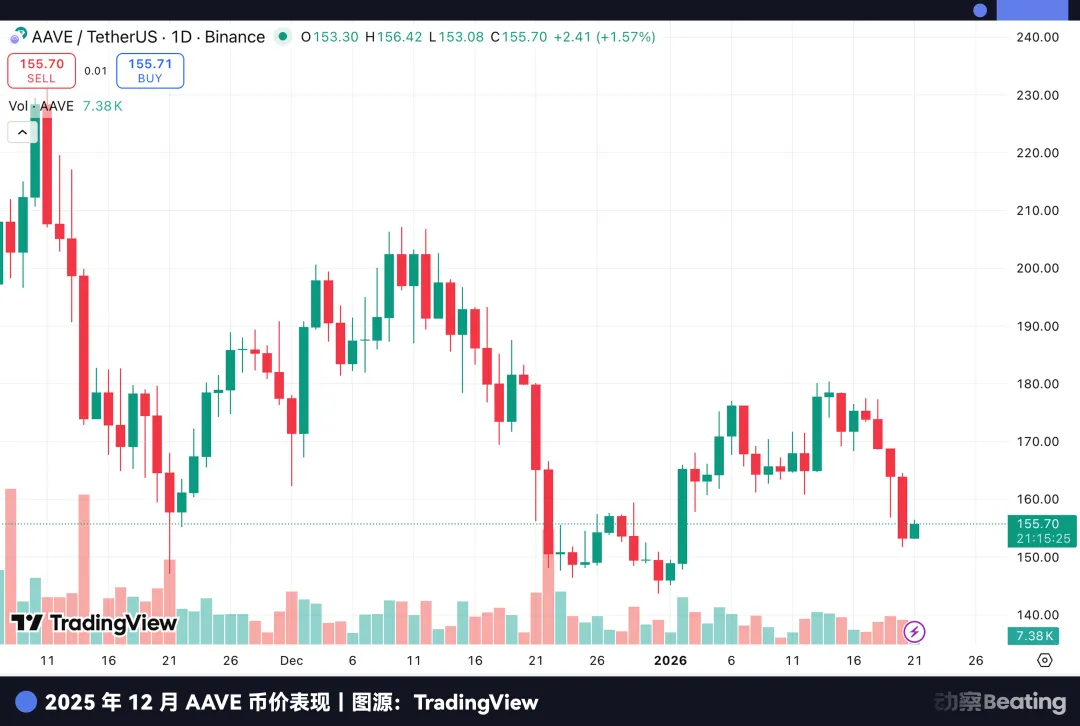
Though both sides ultimately reached a compromise under intense public pressure—with Labs promising to propose sharing non-protocol revenue with token holders—the rift remains.
The protocol may be decentralized, but the traffic gateway is centralized. Whoever controls the gateway controls the protocol’s economic taxation power.
Meanwhile, Uniswap, the leading decentralized exchange, had to self-censor to comply with regulations.
From 2024 to 2025, Uniswap advanced its long-awaited fee switch proposal, aiming to use part of protocol trading fees to repurchase and burn UNI tokens—turning them from mere governance votes into deflationary, yield-bearing assets.
Yet, to avoid SEC securities classification, Uniswap adopted a highly complex structure, physically separating the dividend-paying entity from the development team. They even registered a new entity in Wyoming—DUNA, a decentralized unincorporated nonprofit association—seeking a legal haven at the edge of compliance.
On December 26, Uniswap’s fee switch proposal passed the final governance vote, including burning 100 million UNI and Uniswap Labs shutting down frontend fees to focus on protocol-level development.
The struggles of Uniswap and Aave’s internal conflict highlight an uncomfortable reality: the dividends investors want are precisely what regulators use to define securities.
Granting tokens real value invites SEC penalties; avoiding regulation means keeping tokens valueless.
Empty Rights Mapping—What’s Next?
To understand the 2025 token equity crisis, it’s helpful to look at mature capital markets, such as the American Depositary Shares (ADS) and Variable Interest Entity (VIE) structures for Chinese companies.
If you buy Alibaba (BABA) shares on Nasdaq, experienced traders will tell you you’re not buying direct equity in the operating company in Hangzhou, China.
Due to legal restrictions, you hold equity in a Cayman Islands holding company, which controls the Chinese operating entity through complex agreements.
This resembles some altcoins—what you buy is a mapped right, not the underlying asset itself.
But 2025 taught us that there are key differences between ADS and tokens: legal recourse.
The ADS structure may be convoluted, but it’s built on decades of international commercial law, robust auditing, and the tacit understanding between Wall Street and regulators.
Most importantly, ADS holders have legal residual claim rights. If Alibaba is acquired or privatized, the acquirer must legally exchange your ADS for cash or an equivalent asset.
By contrast, tokens—especially governance tokens once full of promise—were exposed in the 2025 acquisition wave: they don’t appear as liabilities or equity on balance sheets.
Before the CLARITY Act, this fragile relationship relied on community consensus and bull market optimism. Developers implied tokens were like stocks; investors pretended to be venture capitalists.
But when regulatory clarity arrived in 2025, the truth became unavoidable: under traditional corporate law, token holders are neither creditors nor shareholders. They’re more like fans who bought expensive membership cards.
When assets are tradable, rights can be split. When rights are split, value flows to what law recognizes, what can carry cash flow, and what can be enforced.
In this sense, crypto in 2025 didn’t fail—it became part of financial history, subject to the same scrutiny of capital structure, legal documentation, and regulatory boundaries as mature markets.
As crypto’s convergence with traditional finance becomes irreversible, a sharper question arises: Where will industry value flow next?
Many believe integration means victory, but history often shows the opposite. When new technology is absorbed by old systems, it gains scale but may lose its original distribution model. The legacy system excels at taming innovation into forms that can be regulated, accounted for, and placed on balance sheets, locking residual claim rights into established structures.
Crypto’s compliance may not return value to token holders; it’s more likely to revert value to entities familiar to the law—companies, equity, licenses, regulated accounts, and contracts enforceable in court.
Token equity will persist, just as ADS does, as tradable rights mapping in financial engineering. But the real question is: Which layer of mapping are you actually buying?
Statement:
- This article is republished from [动察Beatinng], with copyright belonging to the original author [Kaori]. If you have any objections to this reprint, please contact the Gate Learn team, and we will respond promptly according to relevant procedures.
- Disclaimer: The views and opinions expressed in this article are solely those of the author and do not constitute investment advice.
- Other language versions of this article are translated by the Gate Learn team. Do not copy, distribute, or plagiarize translated articles without mentioning Gate.
Related Articles

The Future of Cross-Chain Bridges: Full-Chain Interoperability Becomes Inevitable, Liquidity Bridges Will Decline

Solana Need L2s And Appchains?

Sui: How are users leveraging its speed, security, & scalability?

Navigating the Zero Knowledge Landscape

What is Tronscan and How Can You Use it in 2025?
