The Evolution of Leveraged ETFs: Why Traders Are Turning to Gate Leveraged ETFs
ETFs: No Longer Just Passive Allocation Tools
For most investors, ETFs have long been seen as stable, diversified, and low-cost vehicles, primarily used to track indices and reduce the risk of holding a single asset. These qualities make them ideal for long-term portfolio strategies.
As market dynamics accelerate, traders now demand greater capital efficiency and heightened sensitivity to price movements. Traditional index-tracking ETFs are no longer sufficient for short-term or swing trading needs. The market now requires a tool that sits between spot and derivatives—one that can amplify trends without the complexity of futures contracts. This is where leveraged ETFs come in as the new solution.
Gate Leveraged ETF: Product Positioning
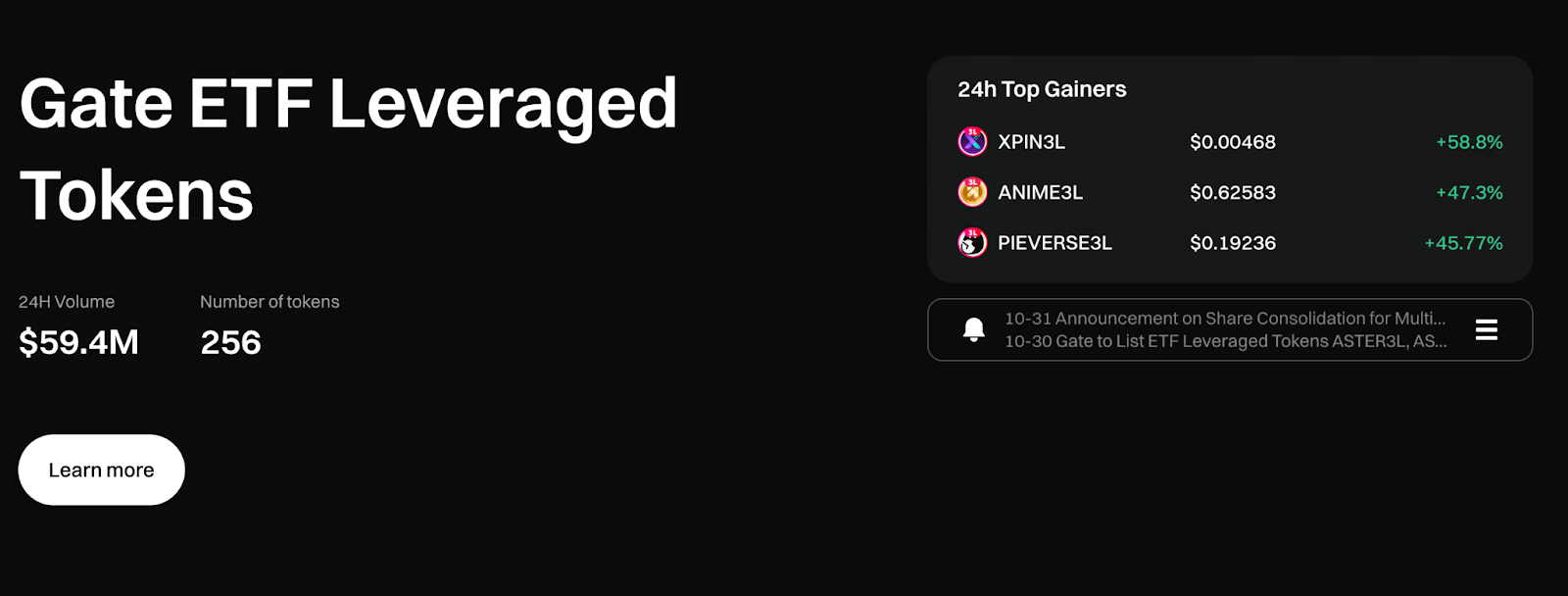
Gate’s leveraged ETFs are not conventional index funds. Instead, they are trading tokens backed by perpetual contract positions, with the system automatically maintaining a fixed leverage ratio. Common leverage options include 3x and 5x, designed specifically for trending markets.
The main difference for users lies in the trading experience. There’s no need to access the derivatives market or manage leverage risk manually. Simply buy or sell these tokens through the spot trading interface to deploy a leveraged trading strategy and amplify market trends.
Start trading Gate leveraged ETF tokens now: https://www.gate.com/leveraged-etf
Execute Leveraged Trades via Spot Trading
Gate’s leveraged ETFs package the complexity of derivatives into a simple product, so users never need to:
- Calculate or maintain margin requirements
- Take on borrowing or forced liquidation risks
- Manage positions or adjust leverage ratios
The system automatically handles all underlying position adjustments. This eliminates the risk of forced liquidation found in traditional derivatives trading, resulting in lower psychological stress for users.
How Is Fixed Leverage Maintained?
Leveraged ETFs maintain stability through ongoing risk management and adjustment mechanisms:
- Dynamic Perpetual Contract Allocation
Each leveraged ETF is linked to a separate perpetual contract position. The system dynamically adjusts position size in response to market fluctuations to keep leverage within the target range. - Daily Automatic Rebalancing
To prevent leverage from drifting due to rapid market moves, the system rebalances positions at set times, ensuring product performance aligns with its design. - Full System Custody
Users only need to focus on entry and exit timing. There’s no need to understand contract details or manually adjust strategies.
Why Are Traders Focusing on Leveraged ETFs?
Leveraged ETFs are attractive for several reasons:
- Amplified Returns in Trending Markets
When the market shows a clear direction, leverage magnifies price movements, allowing capital to capture larger swings in less time. - System-Managed Risk
Because there’s no margin system, users are not exposed to forced liquidation from adverse price moves. This results in a more stable trading rhythm. - Cumulative Gains in Trending Markets
During sustained uptrends or downtrends, the rebalancing mechanism can further amplify positions, creating a compounding effect. - Low Entry Barriers
For those new to derivatives trading, leveraged ETFs offer a more accessible way to implement leveraged strategies.
Leveraged ETFs Come with Risks
While easy to use, leveraged ETFs are inherently high-volatility instruments. Users must understand these features before trading:
- Price swings are much greater than in spot markets
- Frequent rebalancing in sideways markets can erode performance
- Actual returns may differ from the stated leverage multiple
- Management fees and hedging costs are reflected in the token price over time
As a result, leveraged ETFs are best suited for strategic trading, not long-term passive holding.
The Role and Necessity of Management Fees
To ensure the stable operation of leveraged ETFs, the platform must cover several ongoing costs, including:
- Contract opening and closing fees
- Perpetual contract funding rate expenses
- Hedging and liquidity management costs
- Slippage losses during rebalancing
The daily management fee of 0.1% covers these essential expenses and is a standard rate in the leveraged ETF market.
How to Use Leveraged ETFs Correctly
Once again, leveraged ETFs are not for passive buy-and-hold strategies. They are market amplators that require careful planning. Only with clear trend direction, reasonable stop-loss strategies, and effective risk control can they maximize their potential.
Summary
Gate’s leveraged ETFs provide a trading option that closely resembles spot trading but with the advantage of increased efficiency. They enable broader access to leveraged trading and redefine how leverage is used. The risk is also magnified, not just the return. Only with a clear understanding of the product and one’s own risk tolerance will leveraged ETFs empower your trading—rather than expose you to losses.
Related Articles

AI-Native Settlement Layers: How United Stables Is Building the Next Financial Rail

The ve(3,3) Flywheel Explained: How AERO Tokenomics Powers Aerodrome’s DeFi Economy

How Does PAXG Work? In-Depth Overview of the Physical Gold Tokenization Mechanism

Aerodrome Tokenomics: How ve(3,3) Powers Base's Most Profitable DEX

How is the price of PAXG determined? Pegging mechanism, trading depth, and influencing factors
