Tether Freezes $182 Million in USDT as Iran-Linked Market Activity Surges: A Deep Dive into the Current Stablecoin Landscape
What Are Tether and USDT?
USDT, issued by Tether, is a stablecoin pegged to the US dollar and holds a leading position in the cryptocurrency market. USDT is designed to offer investors a price-stable digital alternative to the dollar through a 1:1 peg with the US dollar. As of 2025–2026, USDT represents more than 60% of the total global stablecoin market capitalization, boasting substantial market size and high liquidity.
Tether Freezes $182 Million in USDT: Event Overview
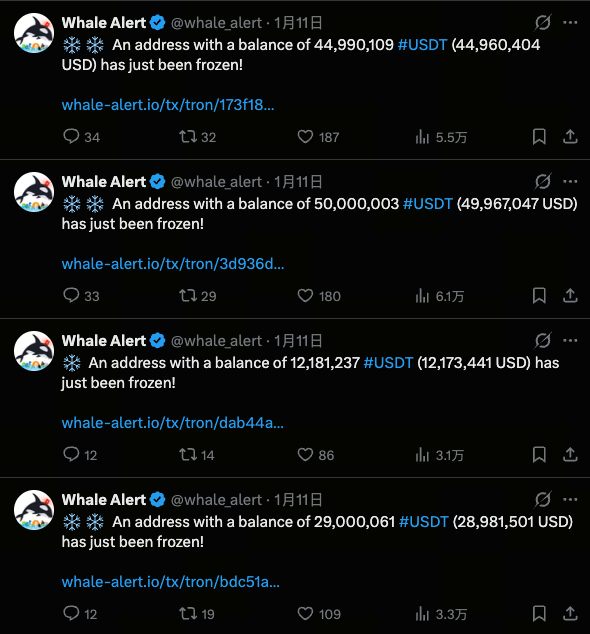
Image: https://x.com/whale_alert
On January 11, 2026, Tether froze approximately $182 million in USDT across five wallet addresses on the Tron blockchain. On-chain data shows that these addresses each held between $12 million and $50 million. Tether reportedly took this action in response to a formal request from law enforcement, making it one of the largest stablecoin freezes in recent history.
This incident underscores Tether’s active role in regulatory compliance and cooperation with law enforcement. Since 2023, Tether has helped authorities freeze over $3 billion in USDT and has collaborated with regulators in more than 60 countries and regions. Compared to its main competitor USDC (issued by Circle), Tether’s total frozen assets are significantly higher, highlighting differences in compliance strategies among stablecoin issuers.
Trends in Stablecoin Compliance and Enforcement
Although stablecoins were initially designed to promote decentralization and payment neutrality, Tether’s ability to freeze funds introduces a centralized element that allows it to block assets quickly when required by law. This mechanism is both a compliance necessity and a source of market debate. For regulators, the power to freeze suspicious funds provides greater control over illicit activities such as money laundering and sanctions evasion.
Globally, stablecoin regulation is shifting from rulemaking to active enforcement. Major economies—including the US and EU—are strengthening anti-money laundering (AML) and sanctions regulations, pushing stablecoin issuers to take on greater compliance responsibilities. This trend is reshaping the role of crypto assets in mainstream finance and may influence investor behavior.
Why Is USDT in Demand in Iran?
Despite the risks of compliance actions and asset freezes, USDT continues to gain traction in Iran. For many Iranians, USDT serves as an alternative to the depreciating rial and as a workaround for restrictions on international payments. With US sanctions impeding traditional cross-border financial channels, stablecoins have become essential tools for international transactions and preserving value.
Reports show that in Iran, Tether’s digital assets have at times traded above the local price of hard currency dollars, reflecting strong demand for stablecoins among users seeking stable value storage amid inflation and currency depreciation.
The Dual Impact of Crypto in the Iranian Market
However, Iran’s reliance on cryptocurrency also brings risks. While stablecoins help the public manage economic uncertainty, regulatory actions, exchange security incidents (such as the Nobitex hack), and enforcement targeting addresses suspected of sanctions violations all undermine market liquidity and user confidence.
The Iranian government is also seeking to shape the market through taxation and regulation, highlighting the ongoing tension and interplay between traditional finance and digital assets.
Potential Lessons for Investors and the Market
For crypto asset investors, stablecoins like USDT provide the benefits of decentralized payments, but the compliance risks tied to centralized issuers must not be ignored. Recent freeze events serve as reminders for investors to monitor:
- The compliance policies and law enforcement cooperation frameworks of stablecoin issuers
- Regulatory developments affecting crypto trading and holding in specific jurisdictions
- How macroeconomic factors—such as inflation and exchange rates—impact demand for stablecoins
Conclusion
Tether’s $182 million USDT freeze signals a new phase of compliance enforcement in the global stablecoin market, while USDT’s ongoing popularity in Iran shows the critical role stablecoins play as digital dollar alternatives in unique economic conditions. Understanding these trends can help investors better navigate the risks and opportunities within the stablecoin ecosystem.
Related Articles

AI-Native Settlement Layers: How United Stables Is Building the Next Financial Rail

The ve(3,3) Flywheel Explained: How AERO Tokenomics Powers Aerodrome’s DeFi Economy

How Does PAXG Work? In-Depth Overview of the Physical Gold Tokenization Mechanism

Aerodrome Tokenomics: How ve(3,3) Powers Base's Most Profitable DEX

How is the price of PAXG determined? Pegging mechanism, trading depth, and influencing factors
