Stablecoins Reshaping Financial Gateways in 2026: Why the Boundaries Between Payments and Investment Are Rapidly Converging
Why Payments and Investments Have Historically Been Separate
In traditional finance, both payments and investments revolve around “money,” but they serve two fundamentally different needs.
Payments are designed for immediacy, stability, low friction, and high accessibility. They’re used for payroll, bill payments, merchant settlements, cross-border remittances, and everyday spending. Investments, by contrast, focus on generating returns, managing duration, accepting risk, and building wealth. These include funds, bonds, stocks, pensions, and various asset management products.
Because of these differences, payments and investments have always operated under separate institutional frameworks:
- Payments rely on bank accounts, card networks, clearing systems, and payment processors.
- Investments depend on brokerages, fund managers, custodians, and wealth management platforms.
- Payment accounts emphasize real-time availability.
- Investment accounts focus on yield and asset allocation.
- Payment regulation centers on anti-money laundering, settlement security, and consumer protection.
- Investment regulation prioritizes disclosure, suitability, and risk warnings.
This division has brought maturity but created a clear disconnect. For users to earn a return on idle funds, they typically must go through a cumbersome process:
- Funds start in a bank or payment account.
- They are then transferred to an investment account.
- Users purchase earn products, funds, or other assets.
- When spending, assets must be sold, redeemed, and settled.
- Finally, funds are returned to the payment account.
The problem: liquidity and returns have long been mutually exclusive. Money is either “easy to spend” or “able to earn”—it’s rarely both in the same account experience.
How Stablecoins Enable a Single Balance for Both Payments and Yield
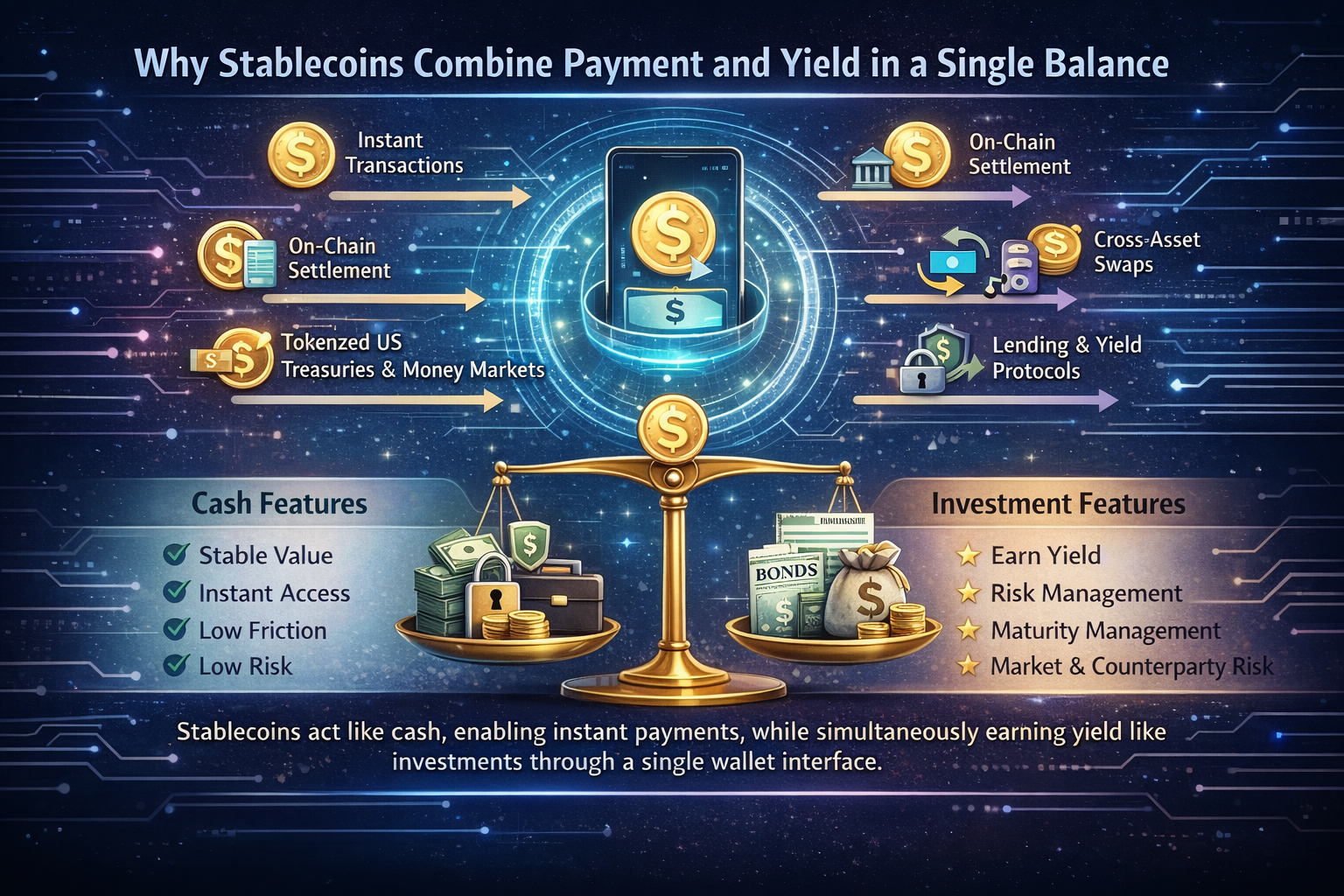
The true value of stablecoins isn’t just that they’re “on-chain dollars” or a “faster transfer tool.” Their core value is integrating payments, settlement, swap, collateral, and yield access into a single account interface.
When a USD balance exists as a stablecoin, it inherently has multiple composable features:
- It can be transferred and spent like cash.
- It can settle transactions in real time on-chain.
- It can swap for other assets within the same wallet.
- It can access lending protocols, tokenized US Treasuries, or money market products to earn yield.
- It can be embedded in exchanges, wallets, cross-border payment systems, and enterprise finance platforms.
This means the old switching between “payment accounts” and “investment accounts” is being replaced by asset orchestration within a single wallet. Users no longer need to exit the payment system and enter the investment system—they can manage parking, transferring, settling, and earning—all in one account.
However, it’s critical to note: compressed boundaries don’t mean risk is eliminated. The core differences between payments and investments remain.
Payment products emphasize:
- Value stability
- Instant availability
- Low learning curve
- Low risk expectations
Investment products emphasize:
- Sources of return
- Risk-taking
- Duration management
- Counterparty and market volatility
So, a more precise statement isn’t “payments and investments have fully merged,” but “cash is becoming an asset, and assets are becoming cash-like.” On-chain infrastructure lowers switching costs but doesn’t remove the fundamental risk trade-offs of finance.
Key Signals from the Latest 2026 Developments
As we enter 2026, the convergence of payments and investments is no longer just industry narrative—multiple landmark industry moves have occurred.
-
Major Payment Networks Are Publicly Backing Stablecoins
On March 3, 2026, Visa announced an expanded partnership with Stripe’s Bridge. According to official disclosures, Bridge’s stablecoin-linked cards are live in 18 countries, with plans to expand to over 100 countries across Europe, Asia-Pacific, Africa, and the Middle East by the end of 2026.
This signals two things:
- Stablecoins are moving from crypto trading to real-world payments.
- Traditional payment giants aren’t avoiding on-chain assets—they’re positioning themselves as the connective layer between on-chain and card networks.
-
Mastercard Is Strengthening On-Chain and Fiat Connectivity
On March 17, 2026, Mastercard announced the acquisition of stablecoin infrastructure provider BVNK. The company stated its goal is to connect on-chain payments with fiat rails and drive interoperability among stablecoins, tokenized deposits, and tokenized assets.
This move shows that traditional card networks now realize future competition isn’t just about card swipes—it’s about who controls the conversion and settlement gateways between different forms of money.
-
Tokenized Short-Term Debt Products Are Powering Yield-Bearing Balances
If stablecoins solve “how money moves,” tokenized short-term debt solves “how balances earn yield.”
Products like BlackRock’s BUIDL and Circle’s USYC now allow institutions to access short-term yield assets with minimal friction. For corporate treasuries, institutional users, and large wallet platforms, this means idle USD no longer needs to be parked in traditional banks—it can earn yield while remaining liquid.
These products are important because they provide “payable balances” with yield foundations similar to traditional low-risk assets, further blurring the line between payment and investment accounts.
-
Regulatory Frameworks Are Converging
The EU’s MiCA regulation is now fully implemented. On January 17, 2025, ESMA issued guidance for stablecoins not meeting MiCA requirements, requiring market participants to comply by the end of Q1 2025, with some transitional mechanisms extended until July 1, 2026.
The biggest impact of regulatory progress isn’t limiting innovation—it’s giving institutions clear participation boundaries. Only as stablecoins and yield products become auditable, transparent, and regulated will banks, payment providers, and public companies scale up their involvement.
Commercial Opportunities and Real-World Constraints of Boundary Convergence
If you see this shift as just “wallets adding an earn tab,” you’re underestimating its impact. What’s really being rewritten is the source of account value.
Historically, payment accounts generated revenue from:
- Trading fees
- Interchange fees
- Yield on idle balances
- Merchant services
Investment accounts relied on:
- Management fees
- Custodian fees
- Trading commissions
- Performance shares
- Distribution and advisory fees
In the future, a single on-chain account may combine several of these capabilities. It can handle payments, distribute yield, and connect to swap, lending, collateral, and cross-border settlement. The entry value of a user’s main balance will rise significantly.
From a business standpoint, the first beneficiaries are likely not high-volatility crypto assets, but stablecoin accounts. The reason is simple: a main balance must meet three conditions:
- Stable valuation.
- Low payment friction.
- Seamless access to yield.
High-volatility assets are better suited for trading or investing—not daily fund storage. The true disruptor for financial gateways is the “payable, yield-bearing, globally transferable” stablecoin balance.
But real-world constraints are clear, including at least four key points:
- Yield sources must be transparent. If the underlying assets are short-term US Treasuries, money markets, or high-grade short-term assets, risk is easier to assess; if they rely on high-leverage on-chain strategies, payment risks are magnified.
- Consumer protection must be robust. Real-world payments need not just fast settlement, but also refunds, dispute resolution, anti-fraud, and identity verification.
- Regulatory classification is still complex. Once a product promises yield, it may trigger payment, deposit substitute, fund share, or securities regulation.
- User experience must be simplified. Mainstream users won’t tolerate higher learning costs just because something is “Web3”—they care about usability, safety, and direct spending.
As a result, winning platforms won’t simply put “wallet” and “investment” on the same screen—they’ll systematically solve:
- How to keep balances highly liquid.
- How to ensure yield structures are transparent.
- How to manage redemption, custody, and counterparty risk.
- How to enable global distribution within compliance frameworks.
The Top 3 Competitive Frontiers for the Next Three Years
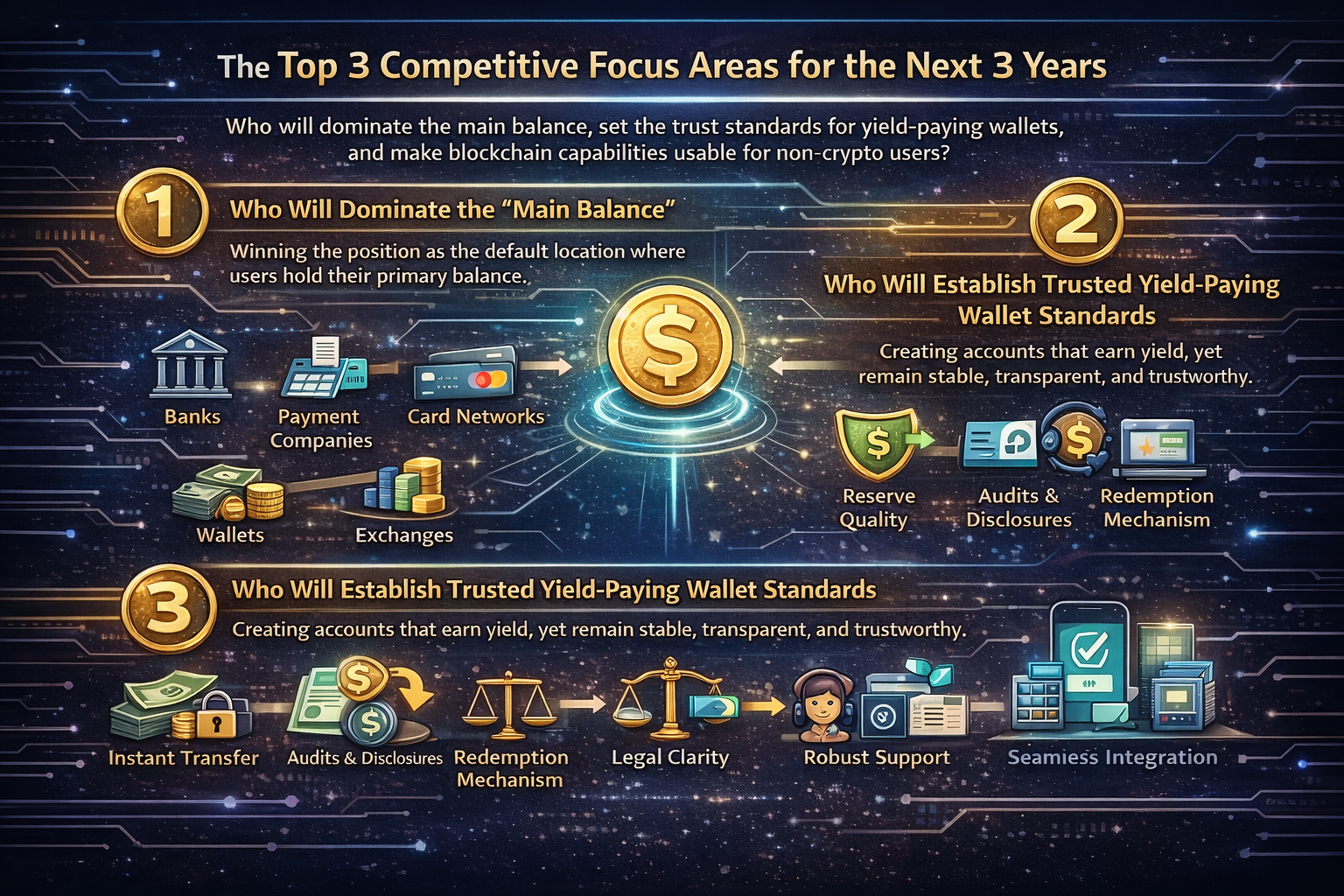
In the next three years, I believe the industry will compete over three core questions:
-
Who Will Capture Users’ “Main Balance”?
The most valuable asset isn’t a single transaction—it’s the default balance users are willing to park with you over the long term. Whether it’s payroll, business collections, or cross-border settlement, any platform that becomes the first destination for funds gains a natural advantage for payments, lending, investment, and distribution.
That’s why future competitors won’t just be crypto-native—they’ll include:
- Banks
- Payment companies
- Card networks
- Wallet platforms
- Exchanges
- Major tech firms
-
Who Will Set the Trust Standard for Yield-Bearing Payment Accounts?
The market doesn’t lack wallets that can earn yield—what’s scarce is an account model that delivers yield, remains stable, and is accepted by regulators and institutions.
The trust standard of the future will likely focus on:
- Reserve asset quality
- Audit and disclosure frequency
- Redemption mechanisms
- Legal clarity of ownership
- Risk isolation design
Whoever productizes these standards first will be best positioned as next-generation financial infrastructure.
-
Who Will Deliver On-Chain Capabilities in User Experiences Acceptable to Non-Crypto Users?
Most users don’t care if the backend is a public chain, sidechain, or tokenized protocol—they care about:
- Fast settlement
- Low cost
- Safety of funds
- Seamlessness compared to existing payment tools
Widespread adoption won’t come from “educating users about on-chain finance”—it’ll come from “hiding blockchain complexity behind great products.”
Conclusion
The idea that “the boundary between payments and investments is disappearing” is directionally correct—but to be precise, in 2026, payments and investments are shifting from two separate account systems to a layered capability system within a single account.
The boundary hasn’t vanished; it’s shifted from “separation between accounts” to “layering of underlying assets, risk management, and regulatory responsibility.” The most powerful financial products of the future may not be traditional payment or investment apps, but settlement accounts with built-in yield.
Whoever can deliver liquidity, security, yield, and compliance in a single balance is best positioned to become the next-generation financial gateway.
Related Articles

In-depth Explanation of Yala: Building a Modular DeFi Yield Aggregator with $YU Stablecoin as a Medium

The Future of Cross-Chain Bridges: Full-Chain Interoperability Becomes Inevitable, Liquidity Bridges Will Decline

Solana Need L2s And Appchains?

Sui: How are users leveraging its speed, security, & scalability?

Navigating the Zero Knowledge Landscape
