Square Introduces Automatic Bitcoin Payments for Millions of U.S. Merchants
Square Rolls Out Automated Bitcoin Payments
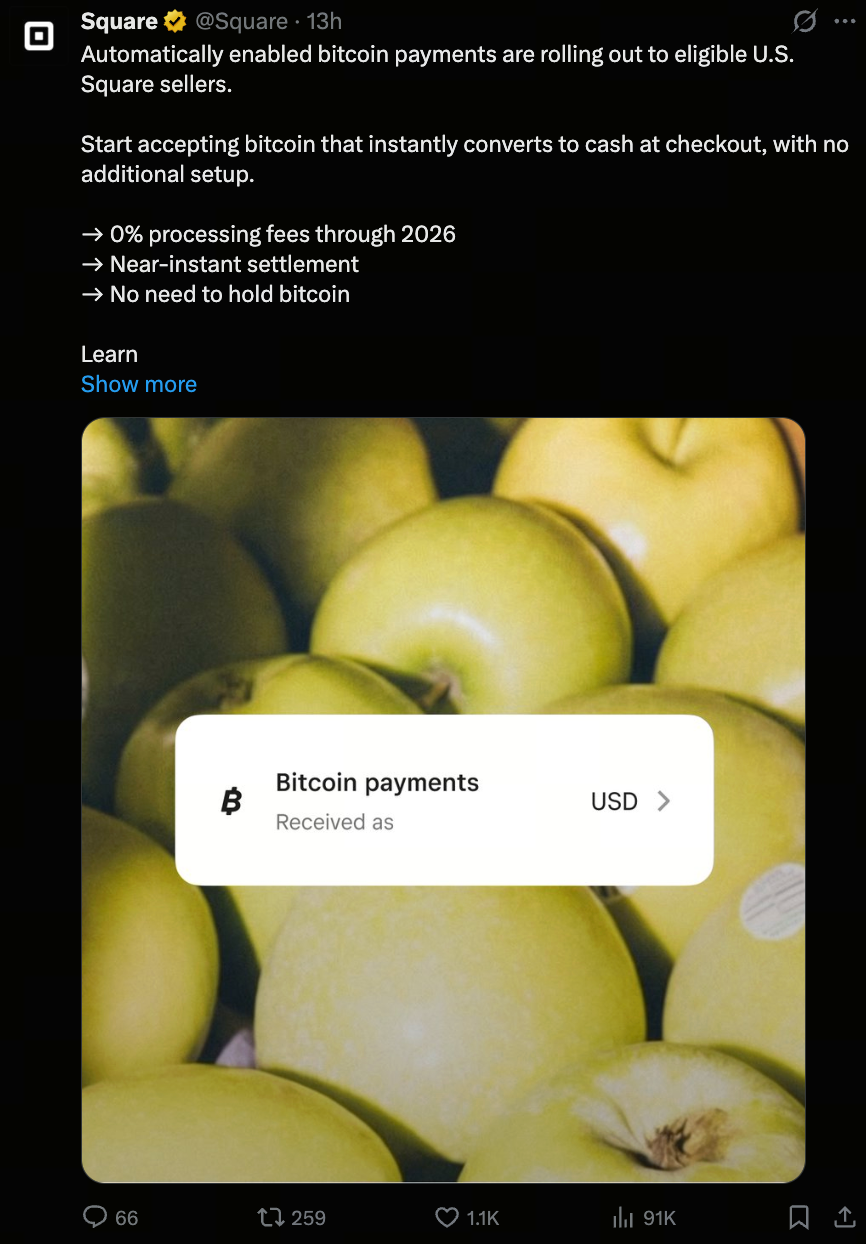
Square, the payment services company founded by Jack Dorsey, has announced the introduction of Bitcoin payment capabilities for eligible small businesses in the United States.
 (Source: Square)
A standout feature of this solution is that merchants do not need to configure anything extra—the system automatically enables BTC payments, instantly converting each transaction to US dollars upon completion. Merchants continue to receive funds in USD, rather than holding Bitcoin directly. The company also notes that settlement is nearly instantaneous and that no processing fees will be charged until 2026, making it easy for merchants unfamiliar with cryptocurrency to accept Bitcoin payments.
Merchants Shielded from Price Volatility
Historically, many businesses have been hesitant to accept cryptocurrency due to price fluctuations and asset management challenges.
Square’s new model employs automatic conversion:
-
Customers pay in BTC
-
The system immediately swaps it for USD
-
Merchants receive fiat currency directly
As a result, merchants do not need to manage crypto holdings, worry about price volatility, or alter their accounting or financial workflows.
This design significantly lowers the barrier for merchants to adopt crypto payments.
A Major Milestone for Square Bitcoin
This new feature is part of a broader initiative called Square Bitcoin. Unlike previous iterations, Bitcoin payments are now directly integrated into Square’s existing payment infrastructure, requiring no manual activation from merchants.
 (Source: Square)
Miles Suter, Head of Bitcoin Products at Block, stated that this initiative is designed to make it easier for millions of businesses to accept Bitcoin payments and to advance BTC as a mainstream payment tool. Jack Dorsey also confirmed the official launch of this feature on social media.
Competing with Other Payment Providers
Square’s move highlights the payment industry’s growing interest in digital assets. For instance, PayPal recently launched its USD stablecoin, PYUSD, and is promoting it across 70 global markets. However, Dorsey has consistently favored Bitcoin over stablecoins and remains cautious about the latter. Nevertheless, he acknowledged that due to rising market demand, the company will support USD stablecoins.
Square’s Merchant Ecosystem
According to investor materials, Square’s merchant base is currently distributed as follows:
-
78% in the United States
-
22% from other countries
Once the BTC payment feature is fully deployed, it could impact the payment methods of millions of businesses.
Simplifying Crypto’s Technical Complexity
Square’s payment model also reflects a new philosophy in crypto product design: concealing technical complexity within the system backend.
In this approach:
-
Users do not need to understand blockchain technology
-
The system automatically handles conversion and settlement
-
The transaction process is nearly identical to traditional payments
This approach further lowers the adoption barrier for merchants considering crypto payments.
Bitcoin as a Foundational Layer for Finance
Lightspark CEO and former PayPal president David Marcus has also commented on this trend. He believes that the large-scale adoption of Bitcoin payments could parallel the standardization of the TCP/IP protocol in the early days of the Internet.
TCP/IP is the backbone technology for internet data transmission, and Marcus suggests that Bitcoin could similarly become the foundational infrastructure for value transfer—enabling capital flows between platforms through a unified blockchain base layer.
Expanding Bitcoin’s Practical Use Cases
Square’s strategy goes beyond serving crypto users, integrating Bitcoin payments directly into existing business systems.
These systems are already widely used for in-store payments, inventory management, and payroll. By embedding BTC payment capabilities, Square could further expand Bitcoin’s role in the real economy.
Summary
Square’s automated Bitcoin payment feature marks a significant step in integrating cryptocurrency into mainstream payment systems. With instant USD conversion and zero processing fees, merchants can accept BTC payments without market risk. If successful, this model could see Bitcoin evolve from a speculative asset to a vital tool for everyday business transactions.
Related Articles

In-depth Explanation of Yala: Building a Modular DeFi Yield Aggregator with $YU Stablecoin as a Medium

The Future of Cross-Chain Bridges: Full-Chain Interoperability Becomes Inevitable, Liquidity Bridges Will Decline

Solana Need L2s And Appchains?

Sui: How are users leveraging its speed, security, & scalability?

Navigating the Zero Knowledge Landscape
