Solana’s Strategic Shift: From Hype to Financial Infrastructure
A Return to Financial Infrastructure
Over the past year, the Solana ecosystem has quietly shifted its development strategy. Moving beyond the initial wave of NFTs, blockchain gaming, and social tokens, the focus has steadily transitioned toward building financial applications and transactional infrastructure. This strategic realignment reflects a more pragmatic core vision within the Solana community: blockchain is not just a speculative vehicle, but a fundamentally new layer of financial architecture.
Practically, this means the ecosystem is channeling resources into decentralized finance (DeFi), on-chain trading systems, and payment and settlement solutions with tangible real-world potential. Armani Ferrante, CEO of Backpack Exchange and a key figure in the Solana ecosystem, describes Solana as creating an environment capable of supporting high-throughput trading and real-time settlement—a prototype, in some respects, of an internet-native capital market.
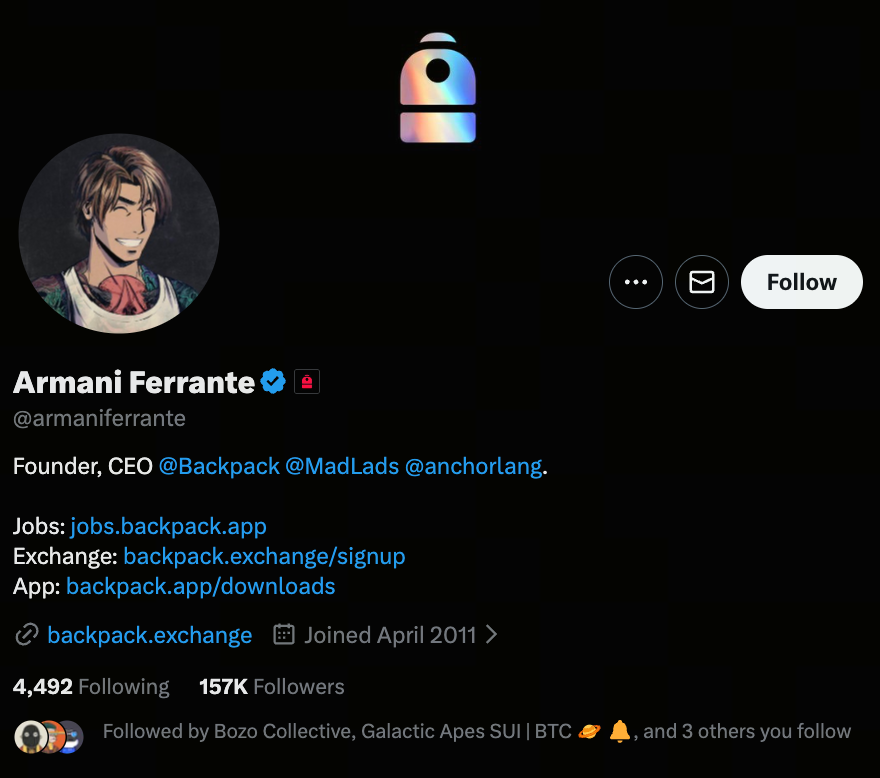
(Source: armaniferrante)
Signs of Maturity
For some outside observers, Solana today may seem less sensational and hype-driven than in its early days. Yet this cooling period is, in fact, a key indicator of the ecosystem’s growing maturity.
The focus is shifting away from entertainment-driven apps and short-term narratives, toward the development of robust financial modules. The value proposition is evolving from rapid user acquisition to prioritizing efficient transactions, standardized settlement, and system reliability. Ferrante notes that this strategic direction signals Solana’s willingness to forgo short-term market excitement in favor of a sustainable, long-term financial position. For any public chain aspiring to serve as foundational infrastructure, this is an essential journey.
Where Traditional Finance Meets Crypto Markets
Despite the overall crypto market remaining in a relatively subdued price range, traditional financial institutions continue to show growing interest in blockchain technology. From Wall Street’s perspective, stablecoins, on-chain settlement, and programmable assets are increasingly viewed as tools to enhance financial efficiency. Blockchain’s future role may not be to replace existing financial systems, but to function as a neutral, verifiable settlement layer—enabling assets like stocks, bonds, and derivatives to move seamlessly across platforms, rather than being siloed within isolated databases.
Ferrante emphasizes: “The essence of a token is simply a consensus record of ownership.” This principle applies not only to crypto assets, but to all financial instruments.
Regulatory Integration: The True Test of Real-World Adoption
According to Ferrante, Solana’s long-term success hinges not on regulatory avoidance, but on seamless integration with existing legal and compliance frameworks. Any large-scale financial application must ultimately satisfy real-world regulatory standards. Genuine maturity is achieved not when technology works flawlessly in a controlled environment, but when it strikes a balance among regulatory demands, market realities, and user needs. Solana’s current approach is not about evading these realities, but proactively preparing for global financial on-chain adoption—even if that means sacrificing some short-term speculative gains.
To learn more about Web3, click to register: https://www.gate.com/
Summary
Solana is undergoing a structural shift from hype-driven momentum to utility-focused development:
- Investment and development priorities: DeFi, on-chain trading, payment and settlement infrastructure
- Ecosystem impact: Enhanced system stability and long-term sustainability
- Future role: Serving as a neutral settlement layer within the global financial system
For Ferrante, this approach may be understated, but it aligns more closely with blockchain’s original promise—as financial infrastructure, not merely a short-term narrative device.
Related Articles

AI-Native Settlement Layers: How United Stables Is Building the Next Financial Rail

The ve(3,3) Flywheel Explained: How AERO Tokenomics Powers Aerodrome’s DeFi Economy

How Does PAXG Work? In-Depth Overview of the Physical Gold Tokenization Mechanism

Aerodrome Tokenomics: How ve(3,3) Powers Base's Most Profitable DEX

How is the price of PAXG determined? Pegging mechanism, trading depth, and influencing factors
