Solana Mocks Starknet: Market Cap Controversy Explodes as Solana Questions Starknet Valuation Using Outdated Data
Background: Solana Publicly Mocks Starknet’s Market Cap Structure
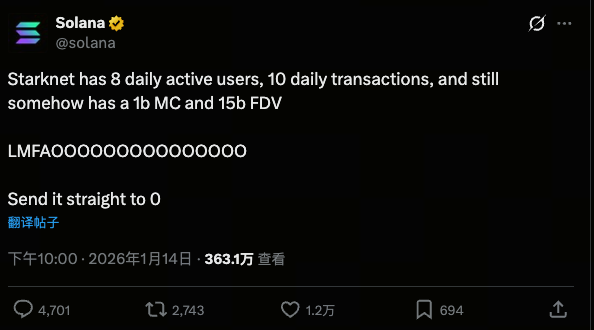
Image: https://x.com/solana/status/2011438153199223135
In mid-January 2026, the crypto community rapidly intensified its focus on an “official spat” between major blockchain platforms. Solana’s official X account (formerly Twitter) posted a message with a distinctly mocking tone, directly calling out Starknet for its extremely low on-chain activity despite a market capitalization exceeding $1 billion. The post used a stark contrast to suggest that Starknet’s valuation was significantly inflated, sparking a viral debate.
The statement quickly spread across social media, sparking heated debate between Layer 1 and Layer 2 supporters. Many market participants viewed it as evidence of intensifying competition within the public blockchain ecosystem.
Details of Solana’s Accusations and Data Disputes
Solana’s official post presented the following core arguments to dismantle the Starknet bull case:
- Starknet reportedly has around 8 daily active users, a shockingly low figure that implies the network is a “ghost chain” despite its massive funding.
- Processes approximately 10 daily transactions, suggesting that the Starknet blockchain has virtually no real-world utility or adoption.
- Maintains a circulating market cap of over $1 billion, raising serious questions about the rationality of current STRK token prices.
- Holds a fully diluted valuation (FDV) of about $15 billion, which Solana implied was a sign of massive market overvaluation.
Solana used this stark disparity to challenge the logic and reasonableness of Starknet’s current valuation.
However, as the discussion evolved, several industry experts pointed out that these figures did not reflect Starknet’s real-time on-chain status, but were instead taken from an outdated snapshot or specific filtering criteria. At that time, Starknet was potentially experiencing a post-airdrop lull or the data was misinterpreted. Therefore, these numbers do not accurately represent Starknet’s current ecosystem. As a result, some market commentators criticized Solana for selectively citing outdated data to create dramatic conflict and gain a narrative advantage.
Responses from Starknet Officials and Industry Participants
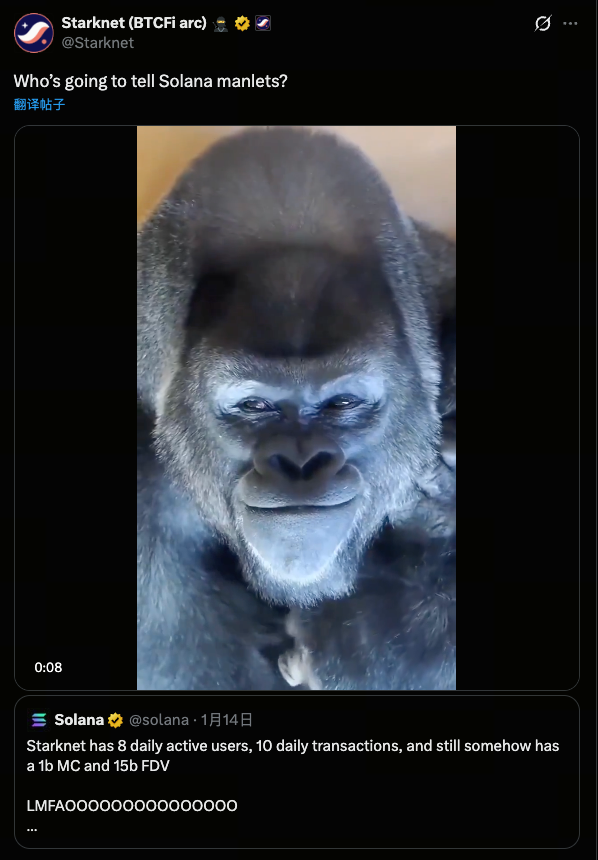
Image: https://x.com/Starknet/status/2011456290258907480
In response to Solana’s public mockery, Starknet’s official account did not directly refute the data. Instead, it opted for a more viral, lighthearted approach. Starknet posted an image featuring a gorilla emoji and jokingly asked, “Who told them these numbers?”. Shortly afterward, StarkWare CEO Eli Ben-Sasson joined the conversation, humorously responding on social media:
“Solana might have 8 marketing interns, keeping the market cap up by tweeting every day.”
Some industry thought leaders, including Binance co-founder He Yi, also called for moderation, arguing that mutual attacks over on-chain data are largely emotional and offer little benefit to ecosystem development.
This exchange added an obvious entertainment element to the heated discussion, while highlighting the real pressure blockchain projects face in the battle for attention.
Comparing Actual Market Data and On-Chain Conditions
Objectively, the state of the Starknet ecosystem described by Solana diverges significantly from current realities.
According to leading on-chain data platforms such as DeFiLlama and Dune Analytics:
- Starknet’s current TVL (Total Value Locked) has surpassed $300 million, indicating strong retention of capital within its DeFi protocols.
- Daily active users number around 65,000, proving that the network has a healthy, active user base far exceeding single digits.
- On-chain transaction frequency remains stable with roughly 759,000 daily operations, supported by lower fees and faster finality.
These figures indicate that while Starknet’s ecosystem scale and activity still do not match top Layer 1s like Solana, it is far from being the “single-digit user” ghost network depicted in the viral tweets.
Meanwhile, Starknet has recently advanced its ecosystem on several fronts, including exploring BTCFi (Bitcoin Finance) expansion and integrating Bitcoin assets.
- Significantly reducing gas costs
- Promoting staking and refining its tokenomics model
- Exploring BTCFi and cross-ecosystem expansion
These developments further weaken the rationale behind accusations of an “empty shell” valuation.
Analysis: Ecosystem Competition and Market Impact
From a broader perspective, this incident reveals several key points about the current crypto market cycle:
1. Risk of Narrative-Driven On-Chain Data
In a social media-driven information landscape, outdated or selective data is easily used to construct emotional narratives. Crypto investors must pay close attention to data sources, timeframes, and context when interpreting on-chain metrics to avoid being manipulated.
2. Public Blockchain Competition Shifts to Narrative Warfare
Solana and Starknet represent distinct technical paths—high-performance Layer 1 and Ethereum-based Layer 2, respectively. As market growth slows, competition has expanded from technology and development to narrative, attention, and brand strategy.
3. Emotional Volatility May Affect Short-Term Price Expectations
Controversial incidents like this often impact market sentiment and investor expectations in the short term. For example, STRK’s price and trading volume saw heightened attention during the event, though long-term trends will ultimately revert to fundamentals.
The Verdict: Separating Fact from Fiction
The public debate between Solana and Starknet over market capitalization and on-chain activity is a classic example of information games in crypto ecosystem competition.
In a decentralized world, data should be the most persuasive language. Yet when data is taken out of its temporal context or selectively used, its conclusions require careful re-examination. For investors, the ability to rationally distinguish among facts, narratives, and emotions remains essential for understanding the crypto market.
Related Articles

AI-Native Settlement Layers: How United Stables Is Building the Next Financial Rail

The ve(3,3) Flywheel Explained: How AERO Tokenomics Powers Aerodrome’s DeFi Economy

How Does PAXG Work? In-Depth Overview of the Physical Gold Tokenization Mechanism

Aerodrome Tokenomics: How ve(3,3) Powers Base's Most Profitable DEX

How is the price of PAXG determined? Pegging mechanism, trading depth, and influencing factors
