Solana Launches STRIDE and SIRN: From Reactive Fixes to Continuous Defense in an Institutional-Grade Security Upgrade
On April 6, the Solana Foundation officially unveiled two new ecosystem security mechanisms: STRIDE and SIRN. While this announcement may seem like a routine update about security tools and emergency networks, it is better understood as a fundamental overhaul of Solana’s infrastructure-level security—especially in light of the ecosystem’s current expansion, growing institutional DeFi activity, rising on-chain AUM, and the ongoing evolution of industry security governance.
The message is clear: Solana is moving away from the outdated model of “projects conducting their own audits and coordinating after issues arise.” Instead, it’s building a systematic security framework encompassing evaluation, monitoring, early warning, verification, and response. In essence, Solana is elevating security from a single-point service to an ecosystem-wide capability.
1. Solana’s Ecosystem Governance Reaches a New Level
According to Solana’s official announcement on April 6, 2026, the Foundation is funding a new security initiative led by Asymmetric Research, consisting of four main components:
-
STRIDE: A comprehensive security program for Solana DeFi
-
24/7 proactive threat monitoring: Covering protocols that have passed evaluation and whose TVL exceeds $10 million
-
SIRN: Solana Incident Response Network
-
Formal verification support: Targeting leading protocols with TVL over $100 million
Individually, these measures—auditing, monitoring, emergency response, and formal verification—are well-established in the industry. What’s truly significant is Solana Foundation’s effort to integrate these capabilities into a scalable, tiered ecosystem security system.
Historically, blockchain security governance has suffered from three main issues:
- Fragmented security responsibilities.
Each protocol independently selects audit partners, sets up monitoring, and responds to incidents. Security standards depend on team resources and connections, not on ecosystem-wide minimums.
- Misaligned security investment and risk exposure.
Many protocols manage tens or hundreds of millions of dollars, yet rely mainly on one-off audit reports rather than ongoing monitoring and adaptive defenses.
- Ad hoc incident response.
When attacks occur, teams scramble to contact auditors, security researchers, exchanges, and infrastructure providers. In major incidents, even a few minutes’ delay can mean greater asset losses.
Solana’s new approach aims to address all three structural challenges at once.
2. STRIDE: More Than an Audit Program—A Security Admission Framework
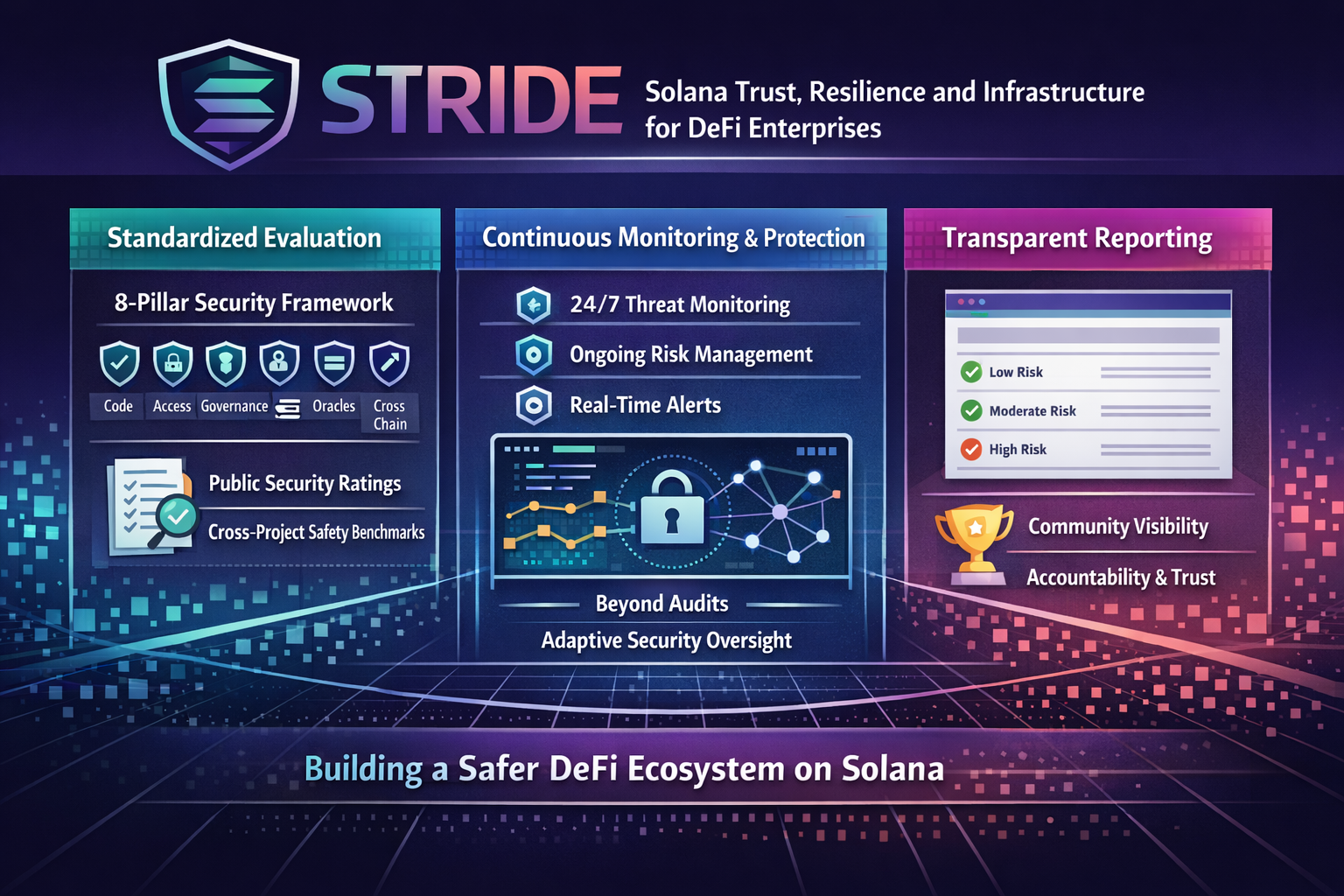
STRIDE stands for Solana Trust, Resilience and Infrastructure for DeFi Enterprises. Officially, it’s a “structured security program for evaluating, monitoring, and upgrading Solana projects.”
Many initially see STRIDE as just another ecosystem audit program, but this underestimates its strategic role.
According to the Foundation, STRIDE is not simply about “reviewing code.” It establishes a cross-project, cross-risk-level, publicly verifiable security standard framework, with three core layers:
1. Standardized Evaluation
Asymmetric Research designed STRIDE’s framework around eight security pillars, conducting independent evaluations of ecosystem protocols. Solana is not just offering a service—it’s defining what qualifies as a protocol meeting the ecosystem’s recognized security baseline.
Unlike traditional audits—where reports are private between project and auditor—STRIDE introduces a public, graded security standard.
This means users, investors, and institutions will increasingly focus on “STRIDE evaluation status,” “security tier,” and “continuous monitoring coverage,” not just “audit history.” As STRIDE gains acceptance, it will become a new ecosystem trust badge.
2. Continuous Monitoring, Not One-Time Delivery
Protocols passing evaluation with TVL above $10 million receive ongoing operational security support and 24/7 proactive threat monitoring. Monitoring intensity is tailored to each protocol’s risk profile: the greater the AUM, the stronger the protection.
This matters because DeFi’s most critical risks aren’t just “bugs in the code.” They include:
-
Permission abuse
-
Weaknesses in multisig and operational processes
-
Risks in upgrade procedures
-
Early detection of on-chain anomalies
-
Timely alerts before attack chains form
STRIDE expands Solana’s security focus from “Smart Contract correctness” to “protocol-wide secure operations.”
This aligns with today’s DeFi landscape. As protocols grow more complex, major incidents often stem from the interplay of code, permissions, governance, oracles, cross-chain dependencies, and operational flows. One-off audits can’t cover dynamic risks; continuous monitoring is the real defense.
3. Public and Transparent Discovery
STRIDE evaluation results will be published openly, boosting transparency for users and investors and creating new external accountability for protocol teams. Security becomes a public reputation issue, not just internal engineering quality.
Going forward, top Solana protocols will compete not only on TVL, trading volume, and revenue, but also on their level of security maturity.
3. SIRN: Addressing Blockchain’s Weakest Link—Incident Response
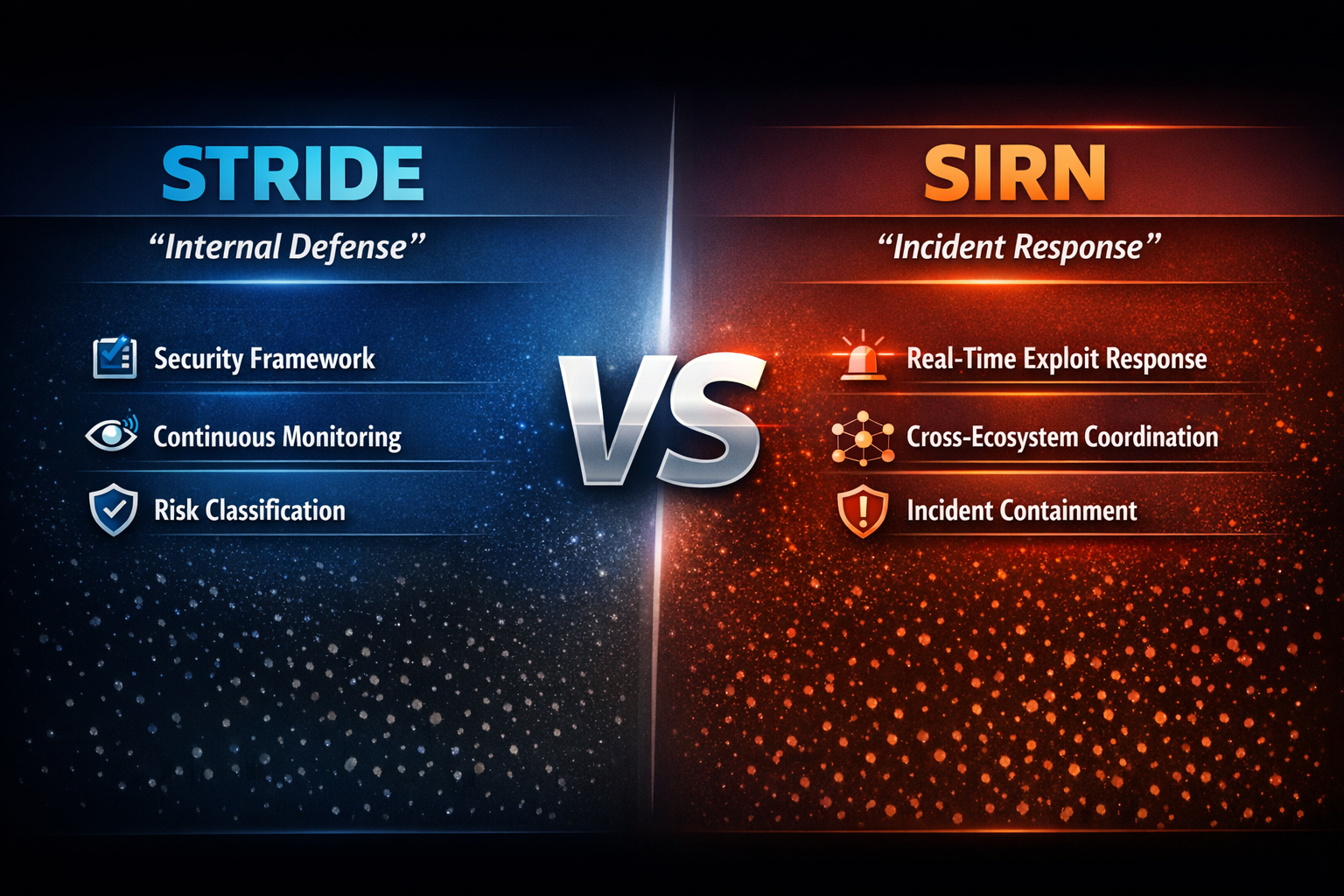
If STRIDE is about “building strength,” SIRN is about “fighting fires.”
SIRN stands for Solana Incident Response Network: A member-based security response network for the entire Solana ecosystem, designed for real-time collaborative response during security incidents. It’s open to all protocols, with resource allocation prioritized by TVL.
Founding members include:
-
Asymmetric Research
-
OtterSec
-
Neodyme
-
Squads
-
ZeroShadow
These aren’t just audit firms—they cover security research, infrastructure, incident response, multisig, and asset control. SIRN is not a “consulting group,” but a rapidly deployable emergency collaboration network.
On-chain security incidents differ from traditional internet attacks in one key way: Funds are lost extremely quickly and are often irreversible.
In Web2, companies can isolate servers, shut interfaces, and roll back databases after an incident. In DeFi, a single permission leak, malicious transaction, or rogue cross-chain message can see assets bridged, mixed, and moved across jurisdictions in minutes.
What determines loss magnitude is not “audit history,” but:
-
Immediate attack detection
-
Rapid confirmation of attack paths and affected contracts
-
Coordination across multisig, frontend, RPC, analytics, and exchanges
-
Quick freezing of flows or prevention of secondary losses
-
Fast, unified, credible external communications
SIRN organizes these tasks proactively, raising Solana’s “average response capability” during attacks.
It does not guarantee zero losses, but reduces the risk of losses being amplified by slow coordination or information gaps.
4. Why Strengthen Security Now?
Timing matters.
In early-stage ecosystems, launching a tiered, institutionalized security system can seem like overkill. But for mature ecosystems with significant funds, leading protocols, complex strategies, and institutional involvement, lacking such a system is increasingly dangerous.
Solana now fits the latter category.
1. Solana Moves from “High-Performance Chain” to “High-Value Financial Infrastructure”
Solana’s narrative has centered on performance, cost, and user experience. But with stablecoin payments, RWA, on-chain trading, lending, Derivatives, and institutional products, Solana now carries real financial flows—not just high-frequency trading and retail activity.
As AUM and financial complexity rise, security becomes exponentially more important.
Performance drives growth; security determines sustainability.
2. DeFi Security Competition Shifts from “Audit” to “System”
The industry recognizes that a single audit does not equal security.
Many attacked projects had audits but lacked:
-
Continuous on-chain monitoring
-
Permission and operational process controls
-
Rapid upgrade paths for vulnerabilities
-
Mature incident response networks
-
Advanced formal verification
Solana combines these elements, signaling a more mature security logic:
Security is not a PDF—it’s a continuously running system.
3. For Institutions, Security Must Be “Explainable, Verifiable, and Governable”
Institutions care about mechanisms for incident response—not just yield. The “backstop” is governance and risk control, not financial compensation.
STRIDE and SIRN signal to institutions that Solana is institutionalizing ecosystem security, not relying on project self-discipline.
This improves Solana DeFi’s transparency and evaluability for large funds—just as important as TPS.
5. Why Formal Verification? Leading Protocols Have Outgrown “Experience Alone”
Solana Foundation will fund formal verification for protocols with TVL above $100 million.
This isn’t a luxury—it’s a necessary response to changing risk thresholds.
At the $100 million scale, a protocol is not just a startup, but a system managing massive financial risk. Code review, testing, and audit experience aren’t enough. Complex systems face issues from state space, boundary conditions, and combinatorial logic that can’t be exhaustively checked manually.
Formal verification attempts mathematical proofs of contract properties across all possible states—not just limited test samples.
It’s not a cure-all: costly, complex, limited in scope, and dependent on correctly defined properties. But for leading DeFi protocols, it’s increasingly a necessary investment.
Solana Foundation’s support for high TVL protocols reflects a shift from “universal ecosystem support” to “tiered systemic assurance.”
6. Practical Impacts on Solana’s Ecosystem
1. Higher Security Thresholds for Leading Protocols
Success on Solana will require not just rapid business growth, but upgraded security capabilities.
Audit history alone won’t suffice—protocols must enter advanced monitoring and verification systems.
This drives professional security governance and makes “security budget” a natural operating expense.
2. Raising the Bar for Small and Medium Projects
While 24/7 monitoring and formal verification are tiered by TVL, Solana offers free security resources to all projects, including Hypernative, Range, Riverguard, Sec3, AuditWare Radar, etc.
New projects can access systematic security tools from Day 1, reducing the recurrence of basic security mistakes.
3. New Evaluation Criteria for Users and Capital
Users will start evaluating protocols based on:
-
STRIDE evaluation status
-
Continuous security monitoring
-
Inclusion in SIRN
-
Formal verification
Security becomes an explicit competitive dimension—not just a hidden factor remembered during incidents.
4. Solana Foundation as “Ecosystem Security Coordinator”
The Foundation emphasizes that these resources do not shift responsibility away from project teams. Over-endorsement could lead to false expectations of ecosystem backstops. Solana’s role is to build a public security foundation—not assume project liability.
This boundary improves overall ecosystem security while avoiding misaligned incentives.
7. Limitations—Don’t Overidealize the Model
STRIDE and SIRN are positive steps, but they don’t guarantee Solana will never face security incidents.
Three key limitations:
-
No system can eliminate unknown risks in complex environments. DeFi’s attack surface evolves—protocol combinations, cross-chain interactions, governance attacks, social engineering, and operational errors can bypass traditional defenses.
-
Tiered resource allocation means priorities aren’t equal. SIRN and advanced support are prioritized by TVL, so small protocols may not receive the same response speed as leading projects in extreme events.
-
Public evaluation frameworks require time to build credibility. STRIDE’s value depends on its adoption and recognition by users, capital, and Developers—not just its launch.
8. Conclusion: Solana Aims to Prove “Speed with Reliability”
Solana has been known for speed, low fees, and high throughput.
But long-term financial value depends not just on performance, but on trust structures that attract capital, Developers, and institutions. STRIDE and SIRN fill this critical gap, upgrading security from fragmented project responsibility to a system engineering approach with public infrastructure attributes. Security evolves from outsourced audits to a comprehensive framework of continuous monitoring, tiered governance, rapid response, and high-standard verification.
Solana has proven “the chain can run.” Now, it’s proving that as high-value assets, complex protocols, and institutional funds enter the network, Solana has matching security governance capabilities.
STRIDE and SIRN are not just security products—they represent Solana’s institutionalized upgrade toward mature financial infrastructure.
Related Articles

The Future of Cross-Chain Bridges: Full-Chain Interoperability Becomes Inevitable, Liquidity Bridges Will Decline

Solana Need L2s And Appchains?

Sui: How are users leveraging its speed, security, & scalability?

Navigating the Zero Knowledge Landscape

What is Tronscan and How Can You Use it in 2025?
