Best Use Cases and Trading Strategies for Smart Leverage
In the crypto market, leverage tools are essentially amplifiers. They can magnify both profits and losses. Unlike traditional leverage trading, Smart Leverage introduces dynamic leverage and automated risk control, fundamentally changing how returns and risks behave. As a result, its performance varies significantly across different market environments.
In this context, simply understanding the tool itself is not enough to achieve consistent returns. The real key lies in how it is used. As a tool built on automation and adaptability, Smart Leverage depends heavily on selecting the right market scenario and matching it with the appropriate strategy. This is where its true value emerges in practical trading.
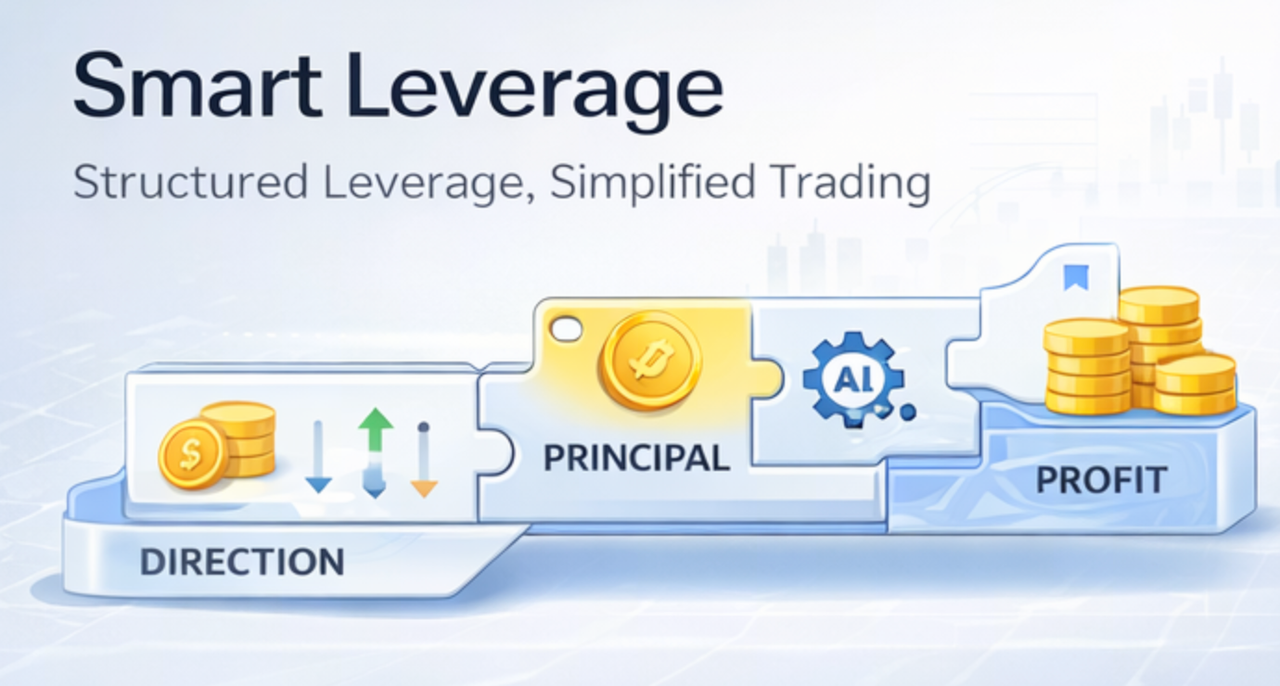
Why Market Scenarios Matter for Smart Leverage
Unlike fixed leverage tools, Smart Leverage automatically adjusts its leverage level as market conditions change. This means returns are not just a simple multiple of price movement. Instead, they depend on the structure and path of market trends.
Because of this, its performance can differ dramatically across market environments. When used in the right scenario, it can significantly enhance returns. In the wrong setting, however, results may fall short of expectations or even lead to losses. In other words, the market scenario defines the upper limit of strategy performance.
Four Key Use Cases for Smart Leverage
In practice, Smart Leverage is best suited for the following four types of market environments:
Use Case 1: Trending Markets
In strong upward or downward trends, Smart Leverage performs at its best. Traders only need to align with the market direction and open positions accordingly. The system will gradually adjust leverage as the trend develops, amplifying returns.
Compared to fixed leverage tools, it offers greater flexibility in trending conditions and does not require constant manual adjustments. This makes it well suited for short- to medium-term holding strategies.
Use Case 2: Ranging Markets
In sideways or range-bound markets, fixed leverage tools often suffer from volatility decay. Smart Leverage, however, can partially mitigate this through its dynamic adjustment mechanism.
Traders can adopt a range trading approach, buying low and selling high within the price band. By controlling holding time, they can improve capital efficiency. That said, returns in ranging markets are less stable and require more precise execution.
Use Case 3: Short-Term Trading and Volatility Capture
For intraday or short-term trades, Smart Leverage offers enhanced flexibility. Traders can quickly enter and exit positions to capitalize on short-term price movements, boosting potential returns.
Because there is no need to manage margin manually, the process becomes much simpler. This allows traders to focus more on market analysis, although it still demands strong timing and discipline.
Use Case 4: Hedging and Portfolio Strategies
Smart Leverage can also be used to build hedging strategies. For example, when holding spot assets, traders can open positions in the opposite direction to reduce overall portfolio risk.
This approach enables hedging without relying on traditional derivatives. It is particularly suitable for investors looking to reduce volatility while maintaining flexibility in their asset allocation.
When Not to Use Smart Leverage: Long-Term Holding and Extreme Uncertainty
Despite its advantages, Smart Leverage is not designed for long-term holding. Since leverage is continuously adjusted, long-term performance can become unpredictable and may deviate from expectations.
It is also less effective in highly uncertain or directionless markets with extreme volatility. In such conditions, the system may struggle to optimize leverage efficiently, leading to unstable returns or losses. Caution is advised in these environments.
Three Core Strategies for Smart Leverage
In practice, Smart Leverage can be combined with the following core strategies:
First is the trend-following strategy. When a clear trend is present, traders open positions in the direction of the trend and hold them. This is the most fundamental and often the most effective approach.
Second is the swing trading strategy. Traders operate within a price range, buying low and selling high multiple times to accumulate gains. This approach is better suited for more experienced users.
Third is the event-driven strategy. Traders enter and exit positions quickly when major market events or breakouts occur, aiming to capture short-term volatility. Timing is critical in this approach.
Differences from Other Leverage Tools
Compared to leveraged ETF tokens, Smart Leverage is better suited for complex market environments. Its dynamic leverage mechanism allows it to adapt as conditions change, whereas leveraged ETFs perform best in clear trends.
Compared to contract trading, Smart Leverage emphasizes automation and simplicity. It is ideal for users who prefer not to manage positions actively. Contract trading, on the other hand, is better suited for professional traders who require precise control over their strategies.
Conclusion
The true advantage of Smart Leverage lies not in leverage itself, but in its ability to adapt to different market conditions. Only by using it in the right scenarios and pairing it with appropriate strategies can its full potential be realized.
From trending markets to ranging conditions, and from short-term trading to hedging strategies, Smart Leverage offers a wide range of applications. At the same time, avoiding unsuitable scenarios is just as important for achieving consistent returns.
FAQs
What market conditions are best for Smart Leverage
Trending markets and those with clear price structures are most suitable.
Can Smart Leverage positions be held long term?
Generally not recommended. It is better suited for short-term or strategic trading.
How should Smart Leverage be used in ranging markets?
A range trading strategy can be applied, but holding periods should be carefully managed.
Can Smart Leverage be used for hedging?
Yes, it can reduce portfolio risk through opposing positions.
Which strategy is best for beginners?
Starting with a trend-following strategy is recommended, then gradually building experience.
Related Articles

Exploring 8 Major DEX Aggregators: Engines Driving Efficiency and Liquidity in the Crypto Market

What Is Copy Trading And How To Use It?

What Is Technical Analysis?

How to Do Your Own Research (DYOR)?

What Is Fundamental Analysis?
