Silicon Valley’s Ultimate Scenario Planning: What Should We Go All-In on in 2026?
As 2026 opens, the world stands at a sharply divided crossroads.
On one side, inflation is easing, AI is accelerating its reach, and capital markets are stirring with anticipation. On the other, geopolitical tensions are rising, institutional uncertainty is mounting, and skepticism abounds over whether the next growth cycle is real. In this environment, the globally influential All-In Podcast released its annual ultimate forecasts:
Hosted by renowned Silicon Valley angel investor Jason Calacanis (early investor in Uber and Robinhood), the episode convened three heavyweight guests: “SPAC King” Chamath Palihapitiya, “Science Sultan” David Friedberg, and David Sacks, widely known as the White House’s inaugural “AI and Crypto Czar.”
These leading minds—each commanding tens of billions of dollars and deeply versed in the mechanics of power and capital—engaged in a high-stakes debate across politics, technology, investment, and global dynamics. Topics ranged from California’s wealth tax crisis to the prospect of 6% GDP growth, from bullish calls on Huawei and prediction markets to the provocative idea that SpaceX could merge into Tesla.
The MSX Research Institute distilled the core takeaways from this intellectual exchange for its readers.
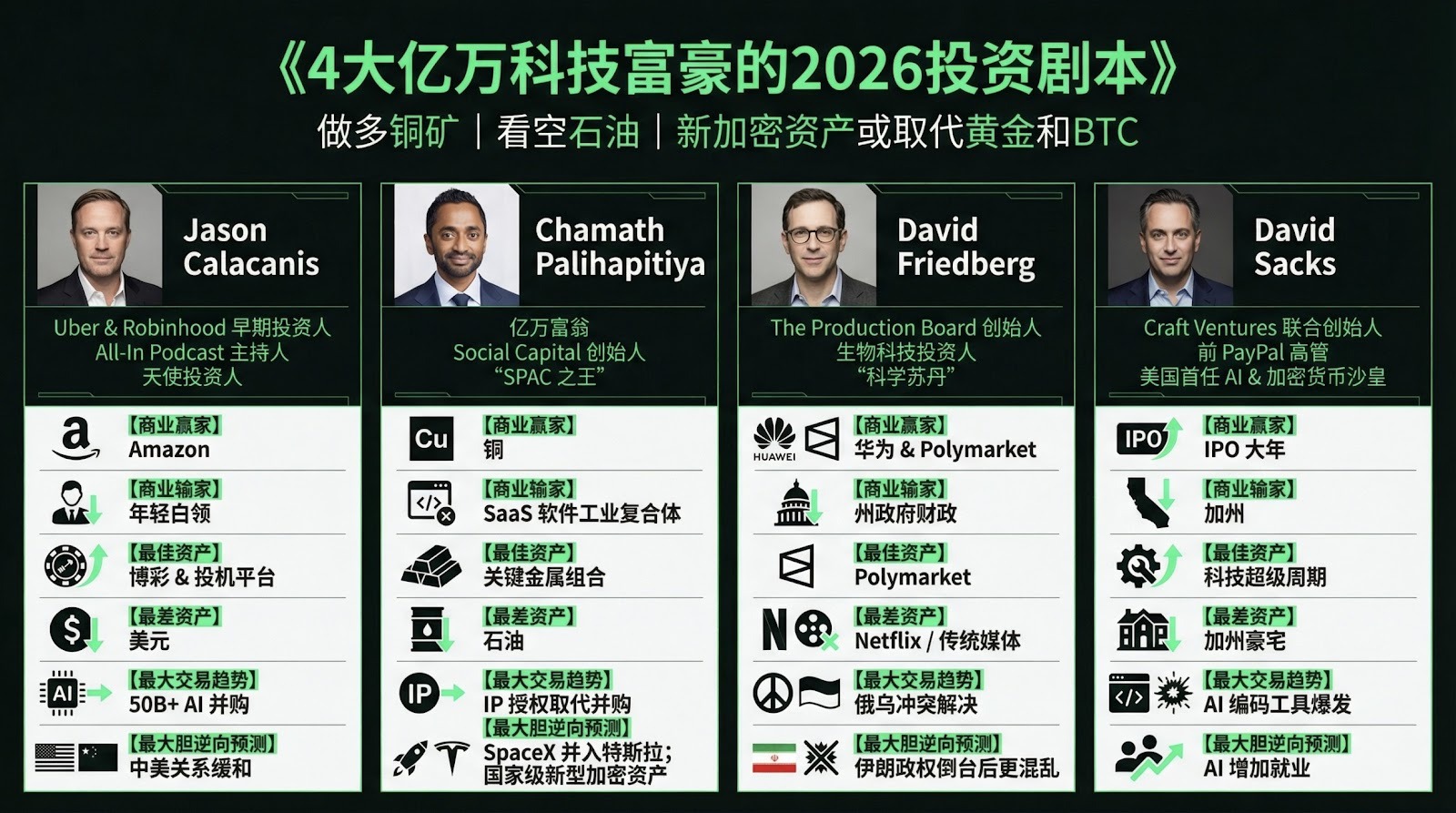
11 Key Predictions from Four Industry Titans
Source: AI-generated image
On California’s wealth tax and capital flight risk, their perspectives:
- Chamath Palihapitiya: Groups that have definitively left California now hold a combined net worth in the hundreds of billions, delivering a significant long-term fiscal blow to the state.
- David Friedberg: The proposal is unlikely to be enacted, but it has already exposed deep structural fiscal pressures for local governments.
- David Sacks: The wealth tax was my direct reason for leaving California. Even if it doesn’t pass in 2026, most expect some version to return by 2028.
On the biggest business winners of 2026:
- Jason Calacanis: Bullish on Amazon, predicting it will reach the “corporate singularity”—the first company where profits from robots surpass those from humans. Its automated warehouses and logistics network form a formidable moat.
- Chamath Palihapitiya: Picks copper, forecasting that geopolitics and supply chain security will drive a persistent supply-demand imbalance. At current trends, the world could face a 70% copper supply gap by 2040.
- David Friedberg: Optimistic about Huawei and prediction markets. Huawei continues to make technical breakthroughs, while prediction markets are evolving from niche products into new infrastructure for information and price discovery, with a breakout year likely ahead.
- David Sacks: 2026 will be a blockbuster year for IPOs—the “Trump boom” will reignite the capital market expansion cycle, with a wave of successful listings creating trillions in new market value. He also agrees with Calacanis on Amazon, but for different (unspecified) reasons.
On the biggest business losers of 2026:
- Jason Calacanis: Young white-collar Americans will be hit hardest, as new positions are the first to be replaced by AI and automation.
- Chamath Palihapitiya: The enterprise SaaS “maintenance and migration” revenue model will be systematically squeezed by AI disruption.
- David Friedberg: State government finances, with pension liabilities and solvency problems coming to the forefront.
- David Sacks: California—regulatory and tax uncertainty will continue to drive out capital and business.
On the most significant deal structures of 2026:
- Jason Calacanis: Expects a mega-acquisition in the AI sector exceeding $50 billion.
- Chamath Palihapitiya: Traditional M&A will give way to large-scale IP licensing partnerships, which will become more prevalent and mature in 2026.
- David Friedberg: The largest “deal” will be geopolitical conflict resolution, with the Russia-Ukraine conflict possibly being settled this year.
- David Sacks: Bullish on the explosion of coding assistant and tool-use sectors.
On the boldest contrarian predictions for 2026:
- Jason Calacanis: US-China relations will see real easing, with both sides forging a win-win working relationship.
- Chamath Palihapitiya: Two contrarian calls—first, SpaceX won’t IPO but may merge into Tesla; second, central banks will build a new paradigm for sovereign cryptocurrencies (distinct from BTC).
- David Friedberg: If the crisis in Iran escalates, it could intensify instability across the Middle East.
- David Sacks: AI will drive job expansion, not job loss—we’re likely to see employment growth.
On the best-performing assets for 2026:
- Jason Calacanis: Favors speculative and platform assets, as a takeoff economy, possible rate cuts, and more disposable income will fuel greater risk-taking and speculation.
- Chamath Palihapitiya: Continues to bet on a basket of key metals, including copper.
- David Friedberg: Prediction markets, which are poised to replace traditional media and markets, have massive potential.
- David Sacks: Picks the technology expansion supercycle.
On the worst-performing assets for 2026:
- Jason Calacanis: The dollar will remain under pressure.
- Chamath Palihapitiya: Sees oil entering a long-term downtrend, possibly falling to $45 per barrel.
- David Friedberg: Bearish on Netflix and traditional media stocks.
- David Sacks: Bearish on California luxury real estate.
On the most anticipated trends for 2026:
- Jason Calacanis: The IPO market makes a comeback, with at least two giants—SpaceX, Anthropic, or OpenAI—expected to file for public offerings this year.
- Chamath Palihapitiya: Expects the expansion of “Trumpism”—unilateralism and economic resilience—a powerful trend that could drive strong GDP growth.
- David Friedberg: The deepening Iran situation will reshape the Middle East order.
- David Sacks: Calls for routine audits of government spending at all levels, institutionalizing a “decentralized DOGE (Department of Government Efficiency)” to make public expenditures transparent.
On the biggest political winners of 2026:
- Jason Calacanis: Young left-wing politicians.
- Chamath Palihapitiya: Anti-waste, anti-bureaucracy political movements.
- David Friedberg: Democratic Socialists of America (DSA), who are gaining ground within the Democratic Party—a trend set to solidify in 2026.
- David Sacks: The “Trump boom,” with a forecast of a 75–100 basis point rate cut in June.
On the biggest political losers of 2026:
- Jason Calacanis: Centrist Democrats.
- Chamath Palihapitiya: The Monroe Doctrine—supplanted by Trumpism.
- David Friedberg: The tech sector, increasingly targeted by populists on both the left and right.
- David Sacks: Centrist Democrats.
US GDP growth forecasts for 2026:
- Chamath Palihapitiya: 5% floor, 6.2% ceiling.
- David Friedberg: 4.6%.
- David Sacks: 5%.
In Closing
Today, China released its 2025 national economic report, posting GDP of 140.19 trillion yuan—a 5.0% year-over-year increase, meeting its target as planned.
From a global perspective, factoring in exchange rates over the next one to two years, the US-China GDP gap (in dollar terms)—which had widened in recent years—now appears to be narrowing markedly at this point.
This contrast is thought-provoking: China is pursuing high-quality growth through structural adjustment, while the US, as described on the All-In Podcast, is striving to leap out of a period of mediocre growth through the “Trump boom + AI singularity.”
Both of the world’s economic giants are entering a new phase of competition focused on productivity and structural efficiency. In this context, Chamath Palihapitiya’s remark on the show is especially provocative: “Don’t short the US economy—it’s ready to soar. 6% GDP growth is not a fantasy.”
The caveat: In this year of accelerated reshuffling, you must align with productivity, not obsolescence.
That may be the most crucial question of this cycle.
Let’s move forward together.
Disclaimer:
- This article is reprinted from [ForesightNews], with copyright held by the original author [Frank, MSX Research Institute]. If you have concerns regarding this reprint, please contact the Gate Learn team for resolution according to established procedures.
- Disclaimer: The views and opinions expressed in this article are solely those of the author and do not constitute investment advice.
- Other language versions of this article are translated by the Gate Learn team. Without reference to Gate, copying, distribution, or plagiarism of the translated article is prohibited.
Related Articles

Arweave: Capturing Market Opportunity with AO Computer

The Upcoming AO Token: Potentially the Ultimate Solution for On-Chain AI Agents

AI+Crypto Landscape Explained: 7 Major Tracks & Over 60+ Projects

0G vs Bittensor: Key Differences Between AI Infrastructure Layer and Decentralized AI Model Network

What is AIXBT by Virtuals? All You Need to Know About AIXBT