Security Concerns Emerge Around Clawdbot AI Assistant
Why Did Clawdbot Gain Traction So Quickly?
Clawdbot is an open-source AI assistant designed to run continuously on server-side environments. Unlike basic chatbots, it acts as a digital work assistant capable of actually executing tasks. Users simply issue commands via instant messaging platforms, allowing the system to automatically handle complex daily operations. This actionable AI approach positions Clawdbot as a key milestone in personal assistant development, fueling its rapid rise in attention.
Supported Platforms and Use Cases
Clawdbot integrates directly with WhatsApp and Telegram, enabling users to manage tasks through chat, including but not limited to:
- Automatically organizing and cleaning emails
- Scheduling and managing meetings
- Gathering company background and business intelligence
- Tracking potential client activity
- Drafting content and updating calendars
Its low learning curve and instant usability have been key drivers behind its rapid user growth.
Imagination Fueled by Self-Improvement Capabilities
In addition to its robust feature set, Clawdbot stands out for its self-optimization design. This capability has led many developers and users to see it as a prototype for future personal AI assistants, further raising market expectations for such tools. As its functions integrate deeper into core workflows, however, the associated security risks become increasingly significant.
Critical Security Risks Unveiled by SlowMist
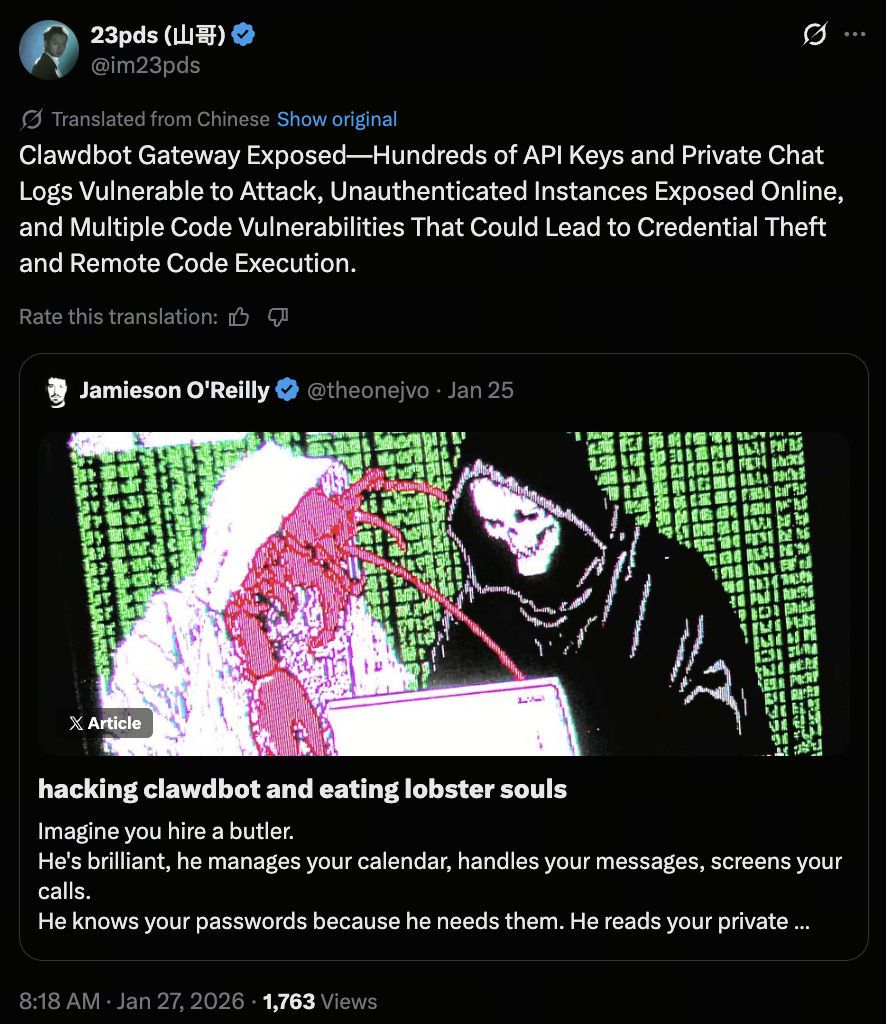
(Source: im23pds)
im23pds, Chief Information Security Officer at SlowMist, recently reported that Clawdbot exposes multiple security vulnerabilities in real-world deployments. These issues go beyond configuration and extend to the codebase itself.
The main risks identified include:
- Many Clawdbot gateway instances lack authentication, allowing direct public internet access
- Hundreds of API keys and private chat logs are potentially accessible externally
- Numerous code defects that could be exploited for credential theft
- Potential for remote code execution under certain conditions
If exploited, these vulnerabilities could affect far more than just individual users.
AI Assistants Become Practical—Security Is the Key Barrier
The Clawdbot case highlights that as AI tools shift from supporting conversations to executing real tasks, security design becomes paramount. When assistants can access communication records, calendars, and account permissions, any configuration oversight can serve as an attack vector. For open-source projects, functional innovation is important, but balancing usability with robust security protection will be essential for long-term market acceptance.
Summary
Clawdbot demonstrates what the future of personal AI assistants might look like, while also reminding the market that as AI begins to perform tasks for users, security is a baseline requirement—not a luxury. This security alert may prove to be a pivotal test in the evolution of AI tools from rapid popularity to maturity.
Related Articles

AI-Native Settlement Layers: How United Stables Is Building the Next Financial Rail

The ve(3,3) Flywheel Explained: How AERO Tokenomics Powers Aerodrome’s DeFi Economy

How Does PAXG Work? In-Depth Overview of the Physical Gold Tokenization Mechanism

Aerodrome Tokenomics: How ve(3,3) Powers Base's Most Profitable DEX

How is the price of PAXG determined? Pegging mechanism, trading depth, and influencing factors
