Redefining ETH Staking: How GTETH Turns Locked Capital into Flexible Allocation
Reasons Behind Low Staking Participation
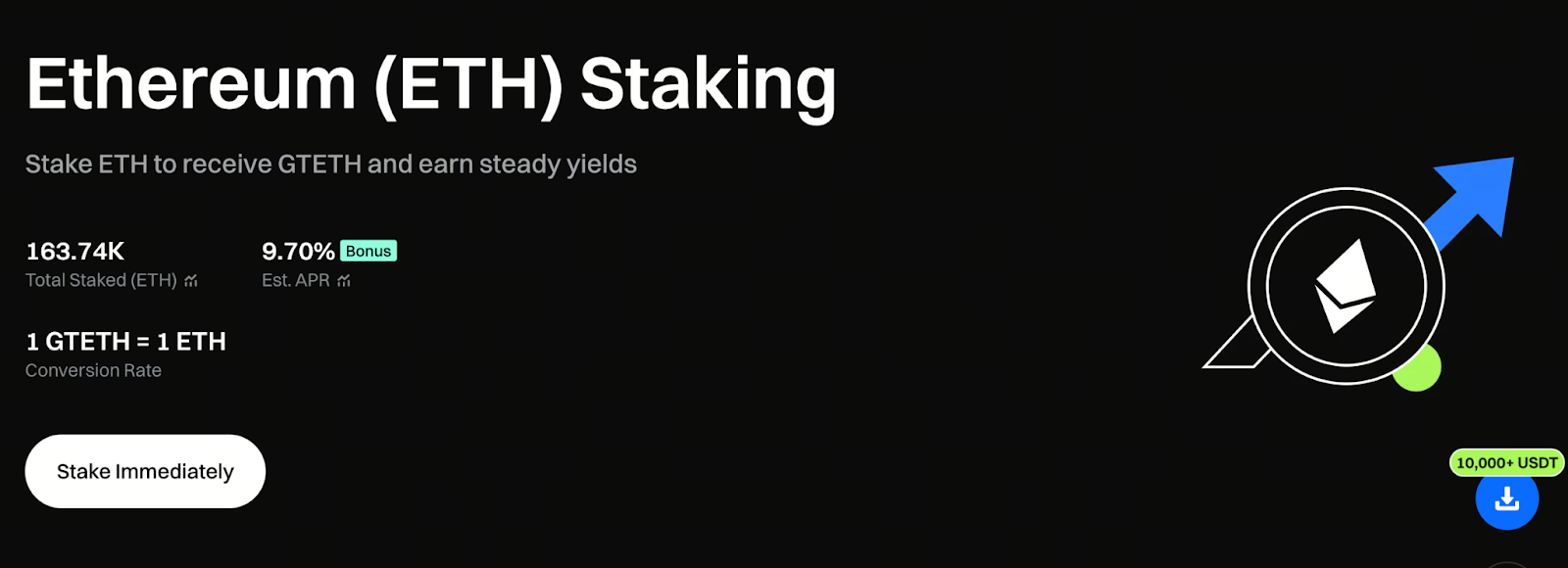
Since Ethereum transitioned to Proof of Stake (PoS), staking should theoretically be the natural choice for ETH holders. Yet, data shows that most users remain on the sidelines and have not incorporated staking into their regular asset allocation. The issue is not an unappealing yield, but rather a mismatch between staking’s operational model and the pace of modern trading.
For most investors, the ability to adjust assets instantly often outweighs the importance of annualized returns. When staking means long-term capital lock-up and reduced liquidity, even stable yields tend to be excluded from core allocation strategies.
Liquidity Constraints Are the Hidden Cost of ETH Staking
Traditional ETH staking—whether self-hosted or through third-party services—faces several common challenges:
Uncertain lock-up periods, non-transparent yield settlement, and limited flexibility during market volatility. These factors make staking a passive waiting game rather than a dynamic asset management tool. Over time, ETH staking primarily attracts long-term holders willing to sacrifice flexibility, making it difficult to fit into more agile investment portfolios.
GTETH Turns Staking Participation into an Asset Class
GTETH doesn’t focus on educating users about PoS architecture or node details—it reimagines the participation process. Users simply convert ETH to GTETH to instantly join Ethereum staking, with all node operations, yield calculations, and distributions handled automatically by the system.
With this approach, staking becomes an asset-type choice rather than a long-term operational burden. The entry barrier drops to a single conversion, allowing staking to blend seamlessly into everyday asset management.
Yields Directly Reflected in Asset Price
GTETH uses an accumulative return model—staking rewards from Ethereum PoS, plus Gate’s additional GT incentives, are built into GTETH’s value over time. Holders don’t need to claim rewards or perform extra actions; simply holding GTETH allows ETH value to grow naturally, while on-chain transparency ensures all returns are traceable.
Liquidity Is a Built-In Feature, Not a Trade-Off
GTETH fundamentally changes the game by removing the architectural link between lock-up and lost flexibility. While holding GTETH, users can redeem ETH or trade freely at any time—no fixed unlock periods required. Yield and liquidity coexist in a single asset, enabling ETH staking to adjust in real time with market conditions.
From Passive Yield Tool to Strategic ETH Allocation
When liquidity constraints are lifted, GTETH evolves from a staking alternative to a flexible ETH allocation node. Whether it’s reducing exposure during market risk or reallocating capital to new opportunities, GTETH allows adjustments without sacrificing staking rewards—bringing staking into the heart of portfolio strategy.
Transparent Return Breakdown and Quantifiable Long-Term Efficiency
GTETH yields come from two main sources:
- Ethereum PoS staking rewards: approximately 2.7% annualized
- Gate’s additional GT incentives: approximately 7% annualized
All accumulated returns are reflected at the point of ETH redemption, with a streamlined and transparent process.
Join Gate ETH staking now to start your on-chain mining rewards journey: https://www.gate.com/staking/ETH?ch=ann46659
VIP Level Determines Long-Term Compound Efficiency
GTETH’s fee structure is directly linked to Gate VIP levels. The base fee rate is 6%, with discounts as follows:
- VIP 5–7: 20% discount
- VIP 8–11: 40% discount
- VIP 12–14: 60% discount
While short-term differences may be minor, over time and with compounding, the fee structure becomes a key factor in overall returns.
A Different Approach from Mainstream LSTs
Most liquid staking tokens essentially serve as certificates for locked positions, offering limited flexibility. GTETH, however, functions as a daily asset management tool—its value changes naturally with returns and allows unrestricted market access. This architecture transforms staking from a static allocation into a dynamic ETH management strategy.
Summary
GTETH’s core value lies in redefining staking’s role in investment portfolios—not in technical complexity. It preserves PoS yield potential while eliminating the psychological and capital pressures of lock-up, enabling ETH staking to operate in sync with market dynamics. Now that PoS is the Ethereum standard, staking no longer needs to be a rigid, long-term commitment. Instead, it becomes a flexible allocation choice that balances liquidity and yield, fitting modern Web3 asset management logic.
Related Articles

AI-Native Settlement Layers: How United Stables Is Building the Next Financial Rail

The ve(3,3) Flywheel Explained: How AERO Tokenomics Powers Aerodrome’s DeFi Economy

How Does PAXG Work? In-Depth Overview of the Physical Gold Tokenization Mechanism

Aerodrome Tokenomics: How ve(3,3) Powers Base's Most Profitable DEX

How is the price of PAXG determined? Pegging mechanism, trading depth, and influencing factors
