How o1.exchange Minimizes MEV Risk: Private Routing and Trader Protection Mechanisms Explained
MEV (Maximal Extractable Value) is the additional value generated during the ordering of blockchain transactions. Typical forms include front-running, sandwich attacks, and back-running. These activities may cause users' actual order execution prices to worsen and increase transaction costs.Stage 2 Translation:
As DeFi trading volume grows, MEV has become a critical factor shaping the on-chain trading experience. Transaction information in the public mempool is visible to network participants before being included in a block, and certain bots leverage this data to front-run trades and extract additional profits.
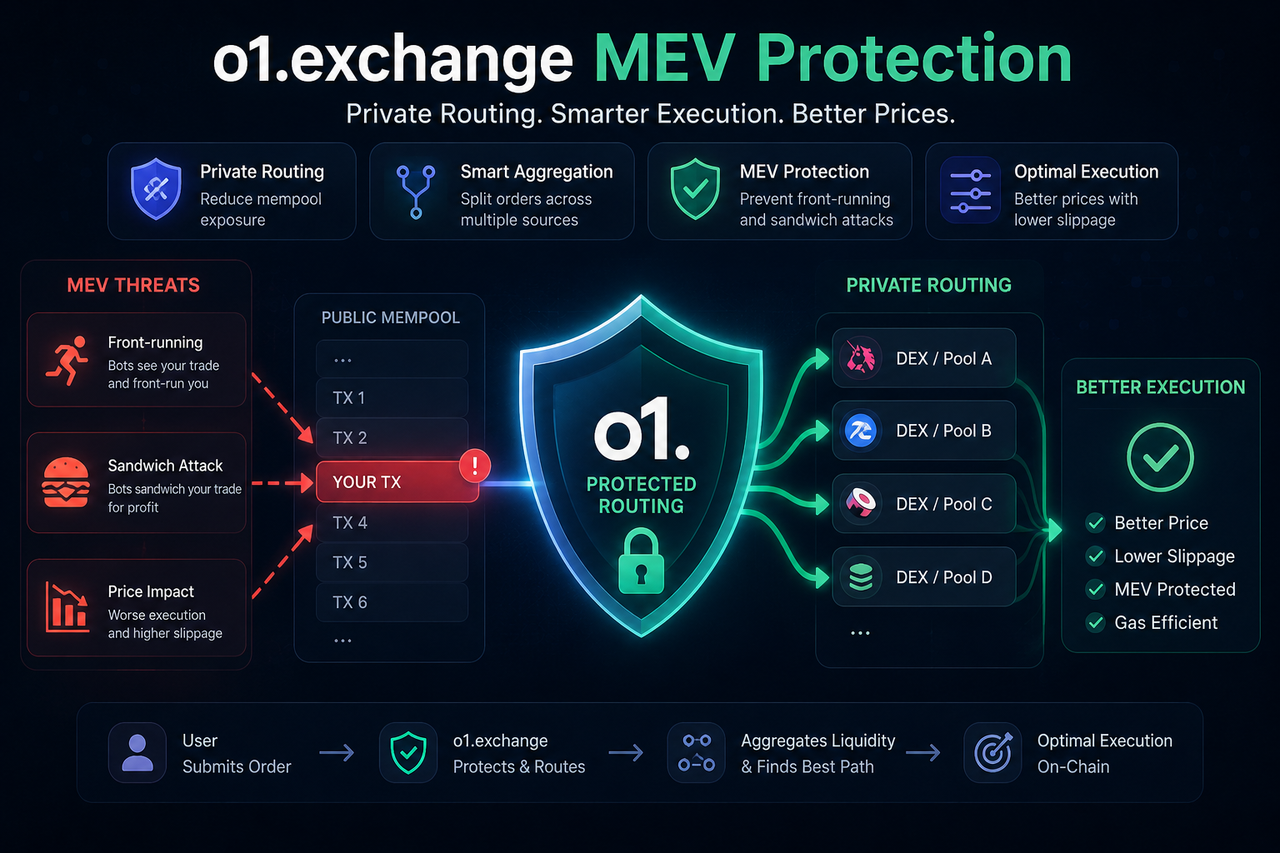
o1.exchange mitigates MEV risk through a combination of aggregated routing, trade protection mechanisms, slippage optimization, and private execution paths. Its goal is to maintain on-chain transparency while reducing the potential for trade exploitation, ultimately improving execution quality and efficiency for users.
What Is MEV?
MEV stands for Maximal Extractable Value, often translated as 'maximum extractable value'.
MEV refers to the additional profits obtained by block producers, validators, or third-party bots through transaction reordering, insertion, or block reorganization.
In most cases, MEV arises from market price movements, arbitrage opportunities, and the informational value embedded in user transactions.
While some MEV is a natural byproduct of market mechanics, certain forms directly harm ordinary users' trading outcomes.
How Is MEV Generated?
Transactions on blockchain networks are not executed instantly.
When a user submits a transaction, it typically enters the mempool first, awaiting selection by a validator for inclusion in a block.
Because mempool information is public, other participants can view transaction details — including direction, size, and target asset — well before execution.
Bots use this visibility to predict price movements and insert their own trades before or after the target transaction, capturing profits.
This behavior forms the foundation of most MEV activities.
What Is Front-Running?
Front-running is one of the most common MEV types.
When a bot detects that a user is about to execute a transaction likely to move the price upward, it submits its own transaction first, paying a higher gas fee to secure earlier execution.
By the time the user's transaction executes, the market price has already shifted.
The bot profits from the price differential, while the user ends up buying at a higher price or selling at a lower price.
What Is a Sandwich Attack?
A sandwich attack is one of the most widespread MEV attack vectors in DeFi.
The attacker executes a buy order before the user's trade to drive up the price, waits for the user's order to fill, and then immediately executes a sell order to profit.
The user's order is effectively sandwiched between two adversarial transactions — hence the name.
For large orders or low-liquidity assets, the price impact of a sandwich attack is typically more severe.
How Does Private Routing Reduce MEV Risk?
The public mempool is the root cause of most MEV activity.
If a transaction can reduce its time in the public mempool, bots have fewer opportunities to exploit its information.
Private routing is a transaction protection strategy that executes part of the trade before it enters the public market.
This reduces the chance of the transaction being monitored, copied, or front-run, thereby improving execution security.
As on-chain trading volume grows, private routing has become an increasingly important tool for trade protection.
How Does o1.exchange Reduce MEV Impact Through Routing Optimization?
o1.exchange's core trading engine scans multiple liquidity sources to find the optimal execution path.
This aggregated routing mechanism not only improves price quality but also reduces the risk of single liquidity pool exposure.
When the system splits orders across multiple sources, attackers face greater difficulty predicting the full trade path.
For larger orders, multi-path execution also mitigates the price impact of a single trade on the market, reducing the opportunities for sandwich attacks.
How Does Automatic Slippage Management Protect Users?
Slippage is a key metric measuring the gap between the expected price and the actual execution price.
MEV attacks often widen slippage, increasing user trading costs.
o1.exchange dynamically adjusts trading parameters based on market liquidity and order size, conducting risk assessments before execution.
If market conditions shift significantly, the system may recalculate the optimal path or trigger user-defined protection conditions.
This mechanism mitigates the impact of abnormal price swings on trade outcomes.
Why Does Aggregated Trading Help Reduce MEV Risk?
The core benefit of aggregated trading goes beyond simply finding the best price.
When a trade draws from multiple liquidity sources, the execution path becomes more complex.
For attackers, predicting price movements and execution routes becomes significantly harder.
At the same time, the aggregator can leverage deeper overall liquidity to execute trades, reducing price deviation after a single market shock.
This makes aggregated routing a powerful tool against certain MEV risks.
Conclusion
MEV is a fundamental feature of on-chain trading environments. Common forms include front-running, sandwich attacks, and trailing arbitrage. Because blockchain transactions must propagate in a public setting, some participants can extract extra value from transaction data, affecting ordinary users' outcomes.
o1.exchange mitigates MEV risk through aggregated routing, private execution paths, order splitting, and automatic slippage management. While MEV cannot be entirely eliminated, these protective measures reduce trade exposure, improve execution quality, and deliver a more predictable on-chain trading experience.
FAQs
Does MEV affect ordinary users?
Yes. MEV can lead to worse execution prices, higher slippage, and increased trading costs.
What is a sandwich attack?
A sandwich attack is an adversarial trading pattern where the attacker places a buy order before the user's trade and a sell order after, profiting from the price movement.
How does private routing reduce MEV risk?
Private routing minimizes the time a transaction spends in the public mempool, reducing the window for bots to monitor and exploit it.
Why does an aggregator help prevent MEV?
An aggregator splits orders across multiple liquidity sources, increasing execution path complexity and reducing price impact from single-market shocks.
Can o1.exchange completely avoid MEV?
No. MEV is intrinsic to blockchain transaction ordering. The current industry approach focuses on reducing its impact through trade protection and execution optimization, not full elimination.
Related Articles

In-depth Explanation of Yala: Building a Modular DeFi Yield Aggregator with $YU Stablecoin as a Medium

Exploring 8 Major DEX Aggregators: Engines Driving Efficiency and Liquidity in the Crypto Market

What Is Copy Trading And How To Use It?

Sui: How are users leveraging its speed, security, & scalability?

What Is Technical Analysis?
