How Does Moody's (MCO) Business Model Work? Analysis of Ratings and Data Services Revenue.
Moody's (MCO) operates a business model centered on two core services: credit rating and risk analysis. It generates revenue by providing credit assessments, financial data, and risk management tools to corporations, governments, financial institutions, and investors.Unlike traditional financial services firms, Moody's sells credit intelligence and risk assessment capabilities rather than capital. Credit ratings help capital markets evaluate borrower default risk, while its analytics and data services enable institutional clients to manage risk, meet regulatory requirements, and improve decision-making efficiency.
Thanks to high barriers to entry in the credit rating industry and the subscription-based revenue model of financial data services, Moody's has built a business model that delivers both high profit margins and stable cash flows. This is a key reason MCO has long been regarded as a critical infrastructure player in global finance.
MCO Stock Basics
MCO's ticker is Moody’s Corporation, and the company trades on the New York Stock Exchange. As a major force in global credit ratings, Moody's operations span credit ratings, risk analysis, financial data, regulatory technology, and enterprise risk management solutions. The company currently operates through two primary segments:
| Business Segment | Primary Function |
|---|---|
| Moody’s Investors Service (MIS) | Credit rating services |
| Moody’s Analytics (MA) | Risk analysis and data services |
The credit rating business has long been the company's core revenue driver, while the analytics and software segment is becoming an increasingly important growth engine. By industry classification, Moody's is typically categorized as a financial information services firm rather than a traditional bank or insurer.
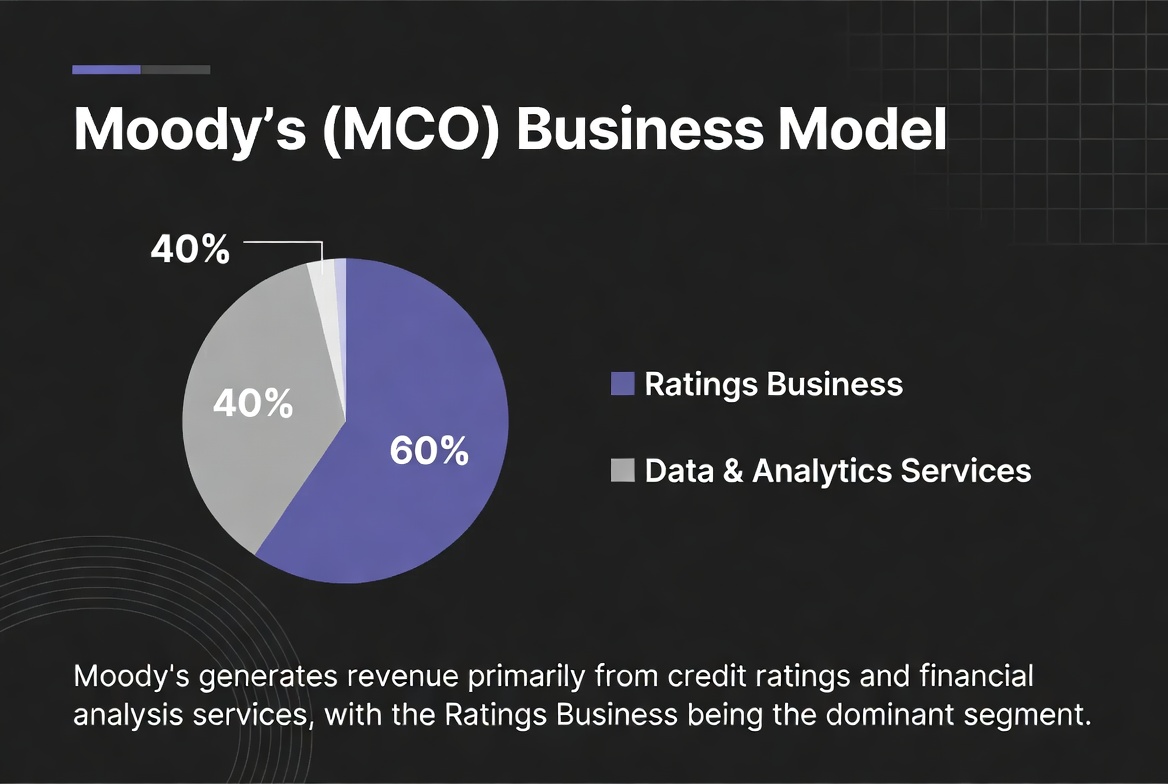
Moody's Revenue Sources
Moody's generates revenue from two main segments. The first is its credit rating business. When corporations issue bonds, financial institutions raise capital, or governments issue sovereign debt, they typically need credit ratings. Rating service fees thus form one of Moody's most significant revenue streams.
The second is its analytics and data services business. As financial markets increasingly demand data and risk management capabilities, Moody's provides clients with software platforms, financial data, credit research tools, and regulatory compliance solutions.
Overall, Moody's revenue mix has evolved from a single reliance on ratings to a balanced model where both ratings and data businesses contribute meaningfully. This diversification reduces the company's exposure to any single market cycle.
How the Credit Rating Business Generates Revenue
The credit rating business is Moody's flagship operation. When a corporation or government plans to issue bonds, it typically hires a rating agency for a credit assessment. The agency analyzes the issuer's financial health, industry conditions, cash flow capacity, and debt structure before assigning a credit rating.
After the issuer pays the rating fee, Moody's completes the rating report and provides ongoing surveillance.
Revenue from credit ratings is closely tied to bond issuance activity.
When the bond market is active and financing demand is strong, rating demand typically rises in tandem.
When interest rates rise or capital market financing slows, rating revenue may be affected.
As a result, bond issuance volume is widely viewed as a key driver of Moody's rating business.
How Risk Analytics and Data Services Drive Growth
Risk analytics and data services have become one of Moody's fastest-growing segments. Moody’s Analytics primarily serves:
- Banks
- Insurance companies
- Asset managers
- Corporate clients
- Government agencies
Its product suite includes:
- Risk management software
- Credit analysis platforms
- Financial databases
- Macroeconomic models
- ESG risk analysis tools
- Stress testing solutions
As global financial regulation tightens, institutions increasingly demand risk management systems and data analysis tools. Unlike one-off rating projects, analytics services typically operate under long-term contracts and subscription models, generating more stable revenue. This is a key reason Moody's has steadily increased investment in its analytics business.
How Recurring Revenue Strengthens Business Stability
Recurring revenue is a hallmark of Moody's business model. While the rating business enjoys high margins, it is sensitive to the bond issuance cycle.
When market financing activity declines, new rating projects may decrease.
The analytics and software business, by contrast, exhibits very different characteristics. Many financial institutions maintain long-term subscriptions to Moody's data platforms and risk management tools, paying ongoing service fees.
This model provides Moody's with more stable and predictable cash flows. From a business perspective, a rising share of recurring revenue typically means:
| Feature | Impact on the Company |
|---|---|
| Greater revenue stability | Reduced exposure to market cycles |
| Stronger customer retention | Higher renewal rates |
| More predictable cash flows | Supports long-term investment |
| Enhanced valuation flexibility | Greater market confidence |
Thus, the growth of the analytics and data business not only boosts revenue but also improves overall business quality.
How Financial Regulation Affects Moody's Business
Financial regulation is deeply intertwined with Moody's business. Credit ratings have long played a key role in bank capital regulation, insurance oversight, and bond market rules.
Many regulatory frameworks around the world reference rating agencies' credit assessments, making the rating system a core component of global financial infrastructure. At the same time, rating agencies themselves face strict oversight. Regulators typically require transparent rating processes, independent analysis, and robust conflict-of-interest management.
Since the financial crisis, major global markets have further tightened regulatory requirements for the rating industry. For Moody's, higher regulatory standards have increased compliance costs but also raised barriers to entry, allowing established rating agencies to sustain long-term competitive advantages.
How to Buy MCO (Moody's) Stock
MCO is listed on the New York Stock Exchange and is one of the most iconic publicly traded companies in the global credit rating industry. Investors can buy MCO stock through traditional securities brokers, gaining exposure to the company's performance and the broader financial market.
Beyond traditional markets, some digital asset platforms offer CFD products linked to U.S. stock prices. For instance, the Gate CFD market supports trading in certain U.S. stock CFDs, allowing users to participate in price movements using digital assets. CFDs are leveraged derivatives with risk profiles different from actual stocks. Before trading, you should fully understand the product mechanics, margin requirements, and associated risks.
Summary
Moody's (MCO) business model rests on two pillars: credit ratings and risk analysis. The credit rating business generates revenue from the global bond market, while its analytics and data services drive sustained growth through subscriptions. As financial institutions increasingly demand risk management, data analysis, and regulatory compliance solutions, the analytics business continues to gain importance. The industry barriers created by credit ratings and the recurring revenue from data services together form the core of Moody's competitive advantage.
FAQ
What is Moody's main source of revenue?
Moody's primarily earns revenue from credit rating services and risk analysis services. The credit rating business serves bond issuers, while the analytics business provides data, software, and risk management tools to financial institutions.
Why does the credit rating business have high profit margins?
The credit rating business relies mainly on professional expertise and brand reputation, with relatively low marginal costs. High industry barriers to entry also support strong profitability.
What is Moody’s Analytics?
Moody’s Analytics is the company's analytics and data services division, offering risk management software, financial data platforms, regulatory technology, and credit analysis tools.
Why is recurring revenue important to Moody's?
Recurring revenue reduces the impact of the bond issuance cycle on performance and improves cash flow stability and customer retention.
Does financial regulation affect Moody's business?
Yes, financial regulation influences both the rating industry's operating rules and increases demand for risk management tools, making it a significant factor for Moody's business.
Is MCO a financial company or a technology company?
MCO is generally classified as a financial information services company, combining credit ratings, financial data, analytics software, and risk management services.
Related Articles

How Does PAXG Work? In-Depth Overview of the Physical Gold Tokenization Mechanism

How is the price of PAXG determined? Pegging mechanism, trading depth, and influencing factors

Gate Research: 2024 Cryptocurrency Market Review and 2025 Trend Forecast

Altseason 2025: Narrative Rotation and Capital Restructuring in an Atypical Bull Market

The Impact of Token Unlocking on Prices