Kinetiq's Technical Architecture: How Does a Liquid Staking Protocol Work?
In a DPoS network, liquid staking isn’t simple token wrapping — it’s a cross-layer state machine. It must keep pooled assets aligned with validator delegation records while outputting standard ERC-20 tokens on HyperEVM for DeFi consumption. Kinetiq puts validator management algorithms on-chain and modularizes the redemption queue and buffer pool, addressing pain points like native staking lock-ups, manual validator selection, and capital that can't be reused. For the Hyperliquid ecosystem, it's the infrastructure layer linking HYPE staking rates to HyperEVM TVL.
From a system decomposition standpoint, Kinetiq operates as a three-tier collaboration: "application contract layer → delegation engine → L1 staking execution." The following sections sequentially cover core contract division of labor, the kHYPE exchange rate accounting model, StakeHub scoring and rebalancing logic, yield and capital efficiency optimization, synergy with HyperEVM, differences from traditional staking, common sector challenges, and technical evolution directions — offering a structured reference for developers and researchers evaluating protocol implementation and kHYPE integration.
Kinetiq Core Technical Architecture Breakdown
Kinetiq smart contracts are deployed primarily on HyperEVM, an EVM-compatible execution layer directly connected to HyperCore (the high-performance order book and consensus engine). The typical relationship between user asset flows and on-chain components is shown below:
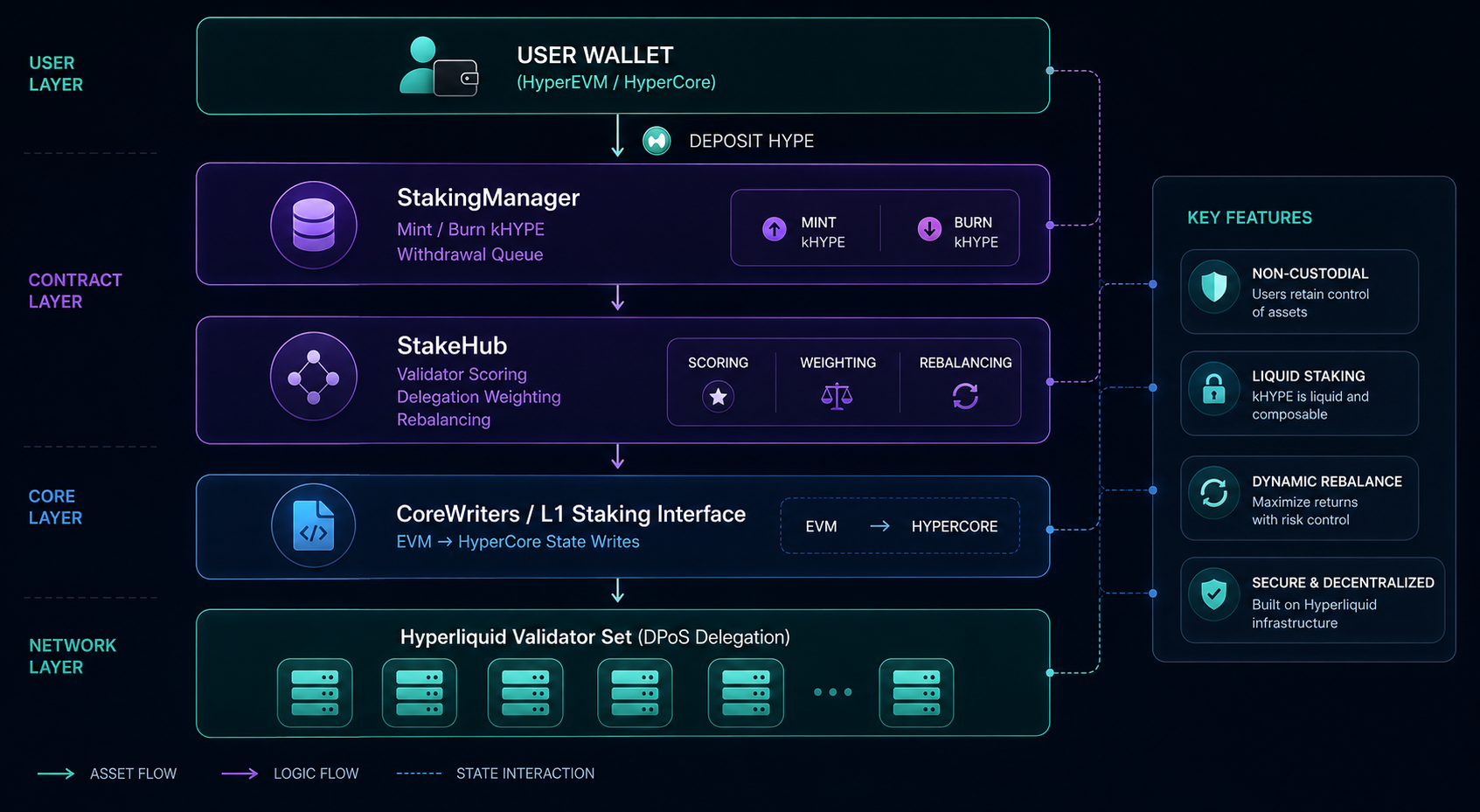
StakingManager is the entry point: it handles HYPE staking requests and mints kHYPE based on the current kHYPE:HYPE exchange rate. For unstaking, it records a withdrawal ID, burns kHYPE after the delay period, and returns HYPE. Third-party documentation also mentions StakingAccountant manages global share accounting and a buffer pool reserves liquidity HYPE to partially fulfill redemptions while validator undelegation is pending, reducing wait friction during liquidity crunches.
Around 2025, Hyperliquid introduced CoreWriters (formerly Write Precompiles) and Read Precompiles, enabling HyperEVM contracts to send staking operations to HyperCore and read validator status — completing the "EVM accounting + L1 delegation" loop without centralized custody. This is Kinetiq's key differentiator from generic EVM LSTs: deep integration with the chain's native staking module rather than relying on external bridges or custodial agents.
On security, the team has disclosed that contracts have been audited by Spearbit, Zenith, Pashov, and Code4rena, employ multi-sig management and emergency pause, and are monitored on-chain by Hypernative. The protocol mainnet launched on July 15, 2025, and the kHYPE contract address (HyperEVM) is 0xfD739d4e423301CE9385c1fb8850539D657C296D (verify on block explorer).
How kHYPE Enables Liquid Staking
kHYPE (Kinetiq Staked HYPE) is an ERC-20 LST representing a share of the staking pool. Technically, it uses a non-rebasing model where the exchange rate appreciates while the token quantity stays fixed:
- When users stake HYPE, the amount of kHYPE to be minted is calculated using the current kHYPE:HYPE exchange rate (as cumulative rewards increase, the same HYPE amount yields fewer kHYPE, but existing kHYPE's redemption value rises).
- After validator rewards enter the pool, the protocol updates the exchange rate; kHYPE balances don't require manual claim actions, simplifying balance accounting in DeFi integrations.
- Minimum stake via the protocol is 5 HYPE; smaller amounts can be obtained by purchasing kHYPE on DEXs via HyperCore/HyperEVM.
Yield and fees (2026 rules): A 10% performance fee is charged on staking rewards, with 70% used for open market buybacks of KNTQ and 30% going to the Kinetiq treasury. Native unstaking incurs a 0.10% fee (in kHYPE). Users needing instant liquidity can trade kHYPE on DEXs, order books, or the protocol frontend — which may incur slippage but avoids waiting in the unstaking queue.
Redemption paths: Queue unstaking has a total delay of approximately 8–9 days (including ~1 day delegation lock period + ~7 days unstaking queue, aligned with Hyperliquid's native rhythm); unstaking cannot be initiated within 24 hours after staking. kHYPE stops accumulating rewards while in the queue. If HYPE is on HyperCore, users must first execute [Transfer to EVM] in the official dApp before using Kinetiq staking; cross-chain swaps from Ethereum/Base to kHYPE on HyperEVM are also supported via Enso and similar tools.
How the StakeHub Validator Management System Works
StakeHub is Kinetiq's autonomous validator scoring and staking allocation engine, driving the quality of kHYPE's underlying delegation. Its operation can be broken into four steps:
-
Real-time scoring (0–100) Validators are evaluated across five dimensions: reliability (uptime and block production), security (slash history and operations), economics (fee rates and yield stability), governance (proposal voting activity), and longevity (run time and client updates). These multi-dimensional scores are combined into a single trustworthiness metric.
-
Delegation decisions Staking weight is only allocated to validators above a threshold, eliminating subjective manual selection and reducing user research overhead.
-
Smart rebalancing 7×24 performance monitoring; when low-efficiency or risk signals are detected, staking is gradually migrated from underperforming validators and new high-scoring nodes are onboarded. In case of major faults, emergency rebalancing can be triggered. Rebalancing frequency adjusts based on significant score changes, slashing risk, or new validator additions, seeking a balance between yield, security, and network disruption.
-
Risk control Limits excessive concentration on any single validator; emphasizes geographic and operator diversification. Scores and delegation ratios are published on-chain, available as a "validator data oracle" for third-party LSTs and staking dashboards. The team emphasizes no hidden fee redirections and no opaque manual overrides.
Currently, Hyperliquid hasn't enabled slashing, but the FAQ clearly states it may be introduced in the future; StakeHub's security dimensions and diversified delegation are proactive designs to address tail risks.
How Kinetiq Optimizes Staking Yield and Capital Efficiency
On yield optimization: StakeHub distributes staking across multiple validators and continuously directs it to high-scoring nodes, reducing yield leakage from single-point inefficiency. Rewards are automatically reflected in the kHYPE:HYPE exchange rate, eliminating the need for users to track claim windows. The protocol charges a 10% performance fee on staking rewards in exchange for automated delegation, buffer redemption, and DeFi composability — users must weigh "net staking APY" against "service premium."
On capital efficiency: kHYPE can be used in HyperEVM as lending collateral, LP, in Kinetiq Earn vault strategies, perpetual margin, etc., enabling "staking yield + secondary yield" stacking. It's tradable on both HyperCore and HyperEVM, shortening capital lock-up periods. Compared to native staking's fund lock-up, kHYPE allows the same economic stake to be traded with separate exposure to safety and liquidity risks; arbitrageurs can also profit from kHYPE/HYPE price deviations from the redemption value.
Note: Stacking DeFi introduces additional smart contract and market risks. The protocol's unstaking delay means "book redemption" and "instant sale" are two distinct liquidity paths, and the optimal capital efficiency solution varies by user risk tolerance.
Ecosystem Synergy Between HyperEVM and Kinetiq
HyperEVM provides Kinetiq with a Solidity deployment environment, ERC-20 standards, and Ethereum toolchain compatibility; HyperCore handles native HYPE staking and high-frequency trading liquidity. Their synergy is shown below:
| Layer | Role | Relationship with Kinetiq |
|---|---|---|
| HyperCore | Consensus, order book, native HYPE | Staking delegation finally settled; kHYPE tradeable on its market |
| HyperEVM | DeFi and protocol contracts | kHYPE issuance, StakeHub logic, Earn / Markets products, etc. |
| Cross-layer interface | CoreWriters, etc. | EVM contracts trigger L1 staking state changes |
When ecosystem protocols (lending, CDP, yield trading, etc.) integrate kHYPE, Kinetiq TVL and HyperEVM DeFi TVL create a positive feedback loop: more collateral scenarios absorb kHYPE, and larger pooled staking scale enhances LST depth and pricing stability. Extended products like Markets by Kinetiq (HIP-3), kmHYPE, and the institutional line iHYPE extend the technical architecture from a single LST to derivatives and compliance channels, but the core still depends on the staking position represented by kHYPE.
How Kinetiq Differs from Traditional Staking
| Dimension | Native / Manual Staking | Kinetiq Liquid Staking |
|---|---|---|
| Liquidity | HYPE locked | kHYPE tradable and collateralizable |
| Validators | User self-selects, self-maintains | StakeHub algorithmic delegation |
| Yield collection | Claim or reinvest per network rules | Auto-accumulated via exchange rate, no claim needed |
| Custody | User wallet self-custody | Non-custodial smart contract pooling |
| Fees | No protocol-level performance fee (only validator commission) | 10% performance fee on staking rewards, etc. |
| Redemption | Native unstaking period | Queue ~8–9 days or DEX instant exit |
Compared to centralized staking services, Kinetiq emphasizes on-chain transparency, protocol-defined redemption rules, and DeFi composability. Compared to generic cross-chain LSTs, its advantage is native CoreWriters integration with Hyperliquid, reducing reliance on external bridges and custodians. Trade-offs include a more complex contract stack, trust in StakeHub governance and parameters, and the potential for LST secondary market prices to temporarily deviate from intrinsic redemption value.
Challenges Facing the Liquid Staking Sector
Common technical challenges in the liquid staking sector that Kinetiq faces include:
- Smart contract risk: Even after multiple audits, upgrades, composability calls, and unknown vulnerabilities can't be eliminated; DeFi legos amplify the attack surface.
- Validator and consensus risk: Inefficient validators, future slashing, and over-concentrated delegation can harm pool net asset value; algorithms can mitigate but not eliminate.
- Liquidity and pricing risk: During market panic, kHYPE may trade at a discount to redemption value; insufficient LP depth amplifies slippage.
- Governance and parameter risk: Performance fee, buffer pool rules, and StakeHub weight adjustments affect all holders; governance attacks or low participation are potential hazards.
- Ecosystem competition risk: Alternative LSTs like wstHYPE can divert flow; native zero-fee staking appeals to price-sensitive users.
- Regulatory and compliance uncertainty: Institutional products (iHYPE) and cross-border fund flows may be impacted by policy changes on interface design.
In response, Kinetiq's approach includes: multi-sig and pause switches, StakeHub diversified delegation with on-chain transparent scoring, buffer pool to ease redemption pressure, continuous auditing and Hypernative monitoring, and opening StakeHub data for ecosystem reuse.
Future Technical Directions for Kinetiq
Based on official docs and ecosystem trends, technical evolution may focus on:
Making the StakeHub data layer public: Serving as an on-chain validator "oracle" for more LSTs and dashboards, strengthening the network-level decentralization narrative.
Expanding cross-layer and cross-chain entry points: Optimizing the HyperCore ↔ HyperEVM asset path; improving one-click kHYPE acquisition from Ethereum/Base via Enso, etc.
Deep integration of products and HIP-3: Coordinating Markets, Launch, kmHYPE with the staking pool and CoreWriters, exploring reuse of staked assets in on-chain derivatives (with risk isolation).
Scoring model iteration: As the Hyperliquid validator set and data availability mature, dynamically adjusting the five-dimension weights and rebalancing trigger conditions.
Developer tools: Dedicated APIs, richer on-chain metrics and simulation environments to reduce third-party integration costs for kHYPE.
Security and formal verification: Continuous auditing of new modules (e.g., sKNTQ, Markets); strengthening emergency rebalancing and risk limits after slashing is enabled.
Whether these directions materialize depends on governance priorities, revenue structure, and the Hyperliquid main chain upgrade pace. Tracking GitHub, documentation updates, and on-chain StakeHub dashboards is more valuable than any single roadmap.
Summary
Kinetiq's technical architecture boils down to: using StakingManager and kHYPE on HyperEVM for share accounting and liquidity tokenization, using StakeHub for automated on-chain validator delegation, and then syncing with HyperCore staking state via CoreWriters — achieving non-custodial liquid staking. The exchange-rate-based kHYPE, buffer pool redemptions, and layered DeFi integration together create a capital efficiency advantage over native staking; the performance fee, unstaking delay, and LST discount are quantifiable trade-offs.
For developers and users, understanding this architecture helps in correctly choosing between "queue redemption vs. secondary market exit," evaluating DeFi stack risks, and assessing kHYPE's infrastructure role in the HyperEVM ecosystem. Before participation, please refer to kinetiq.xyz/docs and on-chain contract states, and independently verify exchange rates, delay parameters, and security announcements.
Source (for reference only):
在 DPoS 网络中,流动性质押并非简单的「代币包装」,而是一套跨层状态机:既要保证池化资产与验证者委托账目一致,又要在 HyperEVM 输出标准 ERC-20 供 DeFi 调用。Kinetiq 将验证者管理算法链上化、将赎回队列与缓冲池模块化,直接回应原生质押锁仓、手动选验证者及资本无法复用等痛点;对 Hyperliquid 生态而言,这是连接 HYPE 质押率与 HyperEVM TVL 的基础设施层。
从系统拆解角度,Kinetiq 的运作可理解为「应用合约层—委托引擎—L1 质押执行」三级协作。后文依次说明核心合约分工、kHYPE 汇率记账模型、StakeHub 评分与再平衡逻辑、收益与资本效率优化、与 HyperEVM 的协同、相对传统质押的差异、赛道共性挑战及技术演进方向,为评估协议实现与集成 kHYPE 的开发者、研究者提供结构化参考。
Kinetiq 的核心技术架构解析
Kinetiq 智能合约主要部署在 HyperEVM——与 HyperCore(高性能订单簿与共识引擎)直连的 EVM 兼容执行层。用户侧资产流与链上组件的典型关系如下:
StakingManager 是交互入口:处理 HYPE 质押请求、按当前 kHYPE:HYPE 汇率铸造 kHYPE;解质押时记录 withdrawal ID,在延迟期满后销毁 kHYPE 并返还 HYPE。第三方资料亦提及 StakingAccountant 负责全局份额记账,以及 缓冲池(buffer pool) 预留流动性 HYPE,以便在验证者解委托尚未完成时仍能部分满足赎回需求,降低流动性挤兑时的等待摩擦。
Hyperliquid 在 2025 年 前后引入 CoreWriters(原 Write Precompiles)与 Read Precompiles,使 HyperEVM 合约可向 HyperCore 发送质押相关操作、读取验证者状态,无需中心化托管即可完成「EVM 记账 + L1 委托」闭环。这是 Kinetiq 相对通用 EVM LST 的关键差异:与链原生质押模块深度耦合,而非依赖外部桥或托管机构代质押。
安全层方面,官方披露合约经 Spearbit、Zenith、Pashov、Code4rena 审计,采用多签管理、紧急暂停,并由 Hypernative 做链上事件监控。协议主网于 2025 年 7 月 15 日 上线,kHYPE 合约地址(HyperEVM)为 0xfD739d4e423301CE9385c1fb8850539D657C296D(以区块浏览器为准)。
kHYPE 如何实现流动性质押
kHYPE(Kinetiq Staked HYPE)是代表质押池份额的 ERC-20 LST。技术实现上采用「汇率升值、数量不变」的非 rebasing 模型:
-
用户质押 HYPE 时,按当时 kHYPE:HYPE 汇率计算应铸造的 kHYPE 数量(随累计奖励上升,同等 HYPE 可换得的 kHYPE 会减少,但已有 kHYPE 的赎回价值上升)。
-
验证者奖励进入池子后,协议更新兑换率;钱包内 kHYPE 余额无需手动 claim,利于 DeFi 集成时的余额会计。
-
直接通过协议质押最低 5 HYPE;更小额度可通过 HyperCore / HyperEVM 上 DEX 购入 kHYPE。
收益与费用(2026 年规则):对质押奖励收取 10% 业绩费,其中 70% 用于公开市场回购 KNTQ、30% 进入 Kinetiq 金库。原生解质押收取 0.10% 手续费(以 kHYPE 计)。用户若需即时流动性,可在 DEX、订单簿或协议前端交易 kHYPE,可能产生滑点,但无需等待解押队列。
赎回路径:队列解押总延迟约 8–9 天(含约 1 天 委托锁定期 + 约 7 天 解押队列,与 Hyperliquid 原生节奏对齐);首次质押后 24 小时 内不可发起解押。排队期间 kHYPE 不再累积奖励。若 HYPE 位于 HyperCore,需先在官方 dApp 执行「Transfer to EVM」再调用 Kinetiq 质押;亦支持经 Enso 等从 Ethereum / Base 跨链兑换为 HyperEVM 上的 kHYPE。
StakeHub 验证者管理系统如何运作
StakeHub 是 Kinetiq 的自主验证者评分与质押分配引擎,驱动 kHYPE 底层委托质量。其运作可分为四步:
-
实时评分(0–100) 从五个维度量化验证者:可靠性(在线与出块)、安全性(slash 历史与运维)、经济学(费率与收益稳定性)、治理(提案投票活跃度)、存续(运行时长与客户端更新)。多维分数合成为单一可信度指标。
-
委托决策 仅将质押权重分配给高于阈值的验证者;避免人工主观选验证者,降低用户研究成本。
-
智能再平衡 7×24 监控表现;检测低效或风险信号后,逐步将质押从劣化验证者迁出,并纳入新高分节点;重大故障时可触发紧急再平衡。再平衡频率随分数显著变化、slash 风险或新验证者加入而调整,力求在收益、安全与网络干扰之间折中。
-
风险控制 限制单一验证者过度集中;强调地理与运营者分散;评分与委托比例链上发布,可供第三方 LST、质押仪表盘作为「验证者数据预言机」调用。官方强调无隐藏费率重定向、无不透明人工覆盖。
当前 Hyperliquid 尚未启用 slash,但 FAQ 明确未来可能引入;StakeHub 的安全维度与分散委托即为应对尾部风险的前置设计。
Kinetiq 如何优化质押收益与资本效率
收益优化侧,StakeHub 将质押分散至多验证者并持续导向高分节点,减少因单点低效导致的收益漏损;奖励自动计入 kHYPE:HYPE 汇率,避免用户遗漏 claim 窗口。协议层对质押奖励收取 10% 业绩费,换取自动化委托、缓冲赎回与 DeFi 可组合性——用户需在「净质押 APY」与「服务溢价」之间权衡。
资本效率侧,kHYPE 可在 HyperEVM 用于借贷抵押、LP、Kinetiq Earn 金库策略、永续保证金等,实现「质押收益 + 二级收益」叠加;在 HyperCore 与 HyperEVM 均可交易 kHYPE,缩短资金占用周期。相较原生质押资金锁定,kHYPE 使同一经济权益在安全性与流动性之间可分离交易,套利者亦可在 kHYPE/HYPE 偏离赎回价时参与价格收敛。
需注意的是:叠加 DeFi 会引入额外智能合约与市场风险;协议解押延迟意味着「账面赎回」与「即时卖出」是两条不同流动性路径,资本效率最优解因用户风险偏好而异。
HyperEVM 与 Kinetiq 的生态协同关系
HyperEVM 为 Kinetiq 提供 Solidity 部署环境、ERC-20 标准及与 以太坊 工具链的兼容性;HyperCore 则承载 HYPE 原生质押与高频交易流动性。二者协同体现为:
| 层级 | 角色 | 与 Kinetiq 的关系 |
|---|---|---|
| HyperCore | 共识、订单簿、原生 HYPE | 质押委托最终落地;kHYPE 可在本层市场交易 |
| HyperEVM | DeFi 与协议合约 | kHYPE 发行、StakeHub 逻辑、Earn / Markets 等产品 |
| 跨层接口 | CoreWriters 等 | EVM 合约触发 L1 质押状态变更 |
生态协议(借贷、CDP、收益交易等)集成 kHYPE 后,Kinetiq TVL 与 HyperEVM DeFi TVL 形成正反馈:更多抵押场景吸纳 kHYPE,池化质押规模扩大又增强 LST 深度与定价稳定性。扩展产品上,Markets by Kinetiq(HIP-3)、kmHYPE、机构线 iHYPE 等,使技术架构从单一 LST 延伸至衍生品与合规通道,但核心仍依赖 kHYPE 所代表的质押头寸。
Kinetiq 与传统 Staking 模式有何不同
| 维度 | 原生 / 手动质押 | Kinetiq 流动性质押 |
|---|---|---|
| 流动性 | HYPE 锁定 | kHYPE 可交易、可抵押 |
| 验证者 | 用户自选、自行维护 | StakeHub 算法委托 |
| 收益领取 | 依网络规则领取或复投 | 汇率自动累积,无需 claim |
| 托管 | 用户钱包自持 | 非托管智能合约池化 |
| 费用 | 无协议层业绩费(仅验证者佣金) | 10% 质押奖励业绩费等 |
| 赎回 | 原生解押周期 | 队列约 8–9 天 或 DEX 即时退出 |
与中心化质押服务相比,Kinetiq 强调链上透明、协议定义赎回规则及 DeFi 可组合;与通用跨链 LST 相比,其优势在于 Hyperliquid 原生 CoreWriters 集成,减少对外部桥与托管的依赖。代价是更复杂的合约栈、对 StakeHub 治理与参数的信任,以及 LST 二级市场价格可能短期偏离内在赎回价值。
Liquid Staking 赛道面临哪些挑战
Kinetiq 所处 Liquid Staking 赛道的共性技术挑战包括:
-
智能合约风险:即便经多家审计,升级、组合调用与未知漏洞仍无法归零;DeFi 乐高放大攻击面。
-
验证者与共识风险:验证者低效、未来 slash、委托过度集中,均可能损害池子净值;算法可缓解但无法消除。
-
流动性与定价风险:市场恐慌时 kHYPE 相对赎回价值折价;LP 深度不足放大滑点。
-
治理与参数风险:业绩费、缓冲池规则、StakeHub 权重调整影响所有持有人;治理攻击或低参与度是潜在隐患。
-
生态竞争风险:wstHYPE 等替代 LST 分流;原生零费率质押对价格敏感用户更具吸引力。
-
监管与合规不确定性:机构产品(iHYPE)与跨境资金流动可能受政策变化影响接口设计。
对这些挑战,Kinetiq 的应对路径包括:多签与暂停开关、StakeHub 分散委托与链上透明评分、缓冲池缓解赎回压力、持续审计与 Hypernative 监控,以及将 StakeHub 数据开放给生态复用。
Kinetiq 技术未来的发展方向
结合官方文档与生态动态,技术演进可能集中在:
StakeHub 数据层公共化:作为链上验证者「预言机」,服务更多 LST 与仪表盘,强化网络级去中心化叙事。
跨层与跨链入口扩展:优化 HyperCore ↔ HyperEVM 资产路径;完善经 Enso 等从 Ethereum / Base 一键获得 kHYPE 的体验。
产品与 HIP-3 深度整合:Markets、Launch、kmHYPE 与质押池、CoreWriters 协同,探索质押资产在链上衍生品中的复用(需平衡风险隔离)。
评分模型迭代:随 Hyperliquid 验证者集与数据可用性成熟,动态调整五维权重与再平衡触发条件。
开发者工具:专用 API、更完善的链上指标与模拟环境,降低第三方集成 kHYPE 的成本。
安全与形式化验证:对新模块(如 sKNTQ、Markets)持续审计;在 slash 启用后强化紧急再平衡与风险限额。
方向是否落地,取决于治理优先级、收入结构与 Hyperliquid 主链升级节奏;跟踪 GitHub、文档更新与链上 StakeHub 面板,比单一路线图更具参考价值。
总结
Kinetiq 的技术架构本质上是:在 HyperEVM 上用 StakingManager 与 kHYPE 完成份额记账与流动性代币化,用 StakeHub 在链上自动化验证者委托,再经 CoreWriters 等与 HyperCore 质押状态同步,从而在非托管前提下实现流动性质押。汇率型 kHYPE、缓冲池赎回、分层 DeFi 集成,共同构成相对原生质押的资本效率优势;业绩费、解押延迟与 LST 折价则是需要量化评估的代价。
对开发者与用户而言,理解该架构有助于正确选择「队列赎回 vs 二级市场退出」、评估 DeFi 叠加风险,并判断 kHYPE 在 HyperEVM 生态中的基础设施地位。参与前请以 kinetiq.xyz/docs 及链上合约状态为准,独立验证汇率、延迟参数与安全公告。
Related Articles

The Future of Cross-Chain Bridges: Full-Chain Interoperability Becomes Inevitable, Liquidity Bridges Will Decline

Solana Need L2s And Appchains?

Sui: How are users leveraging its speed, security, & scalability?

Navigating the Zero Knowledge Landscape

What is Tronscan and How Can You Use it in 2025?
