Kaskad vs Aave: What Makes Kaspa-Based Lending Different from Ethereum DeFi?
Kaskad and Aave are both decentralized lending protocols built on an overcollateralized model, allowing users to access on-chain liquidity by using digital assets as collateral. However, the two differ clearly in their underlying network architecture, governance model, risk controls, and ecosystem positioning.On-chain lending protocols are among the most important pieces of financial infrastructure in DeFi. Users can access liquidity by collateralizing digital assets, without relying on banks or centralized institutions. In the Ethereum DeFi ecosystem, Aave has long been one of the most representative on-chain money market protocols. As Kaspa begins to expand its Layer2 and smart contract capabilities, Kaskad has become an important lending protocol within Kaspa DeFi.
Although Kaskad and Aave both use an overcollateralized lending model, the difference between them is not simply “deployment on different networks.” From their underlying architecture and risk controls to governance logic and the direction of AI-native DeFi, the two protocols represent lending systems built for different stages and different goals in DeFi.
Brief Overview of Kaskad and Aave and Their Core Differences
As a decentralized lending protocol running on Igra Layer2 within the Kaspa ecosystem, Kaskad allows users to borrow assets by collateralizing digital assets while keeping exposure to their original holdings. Its overall architecture is designed around Kaspa’s high-speed blockDAG network, while also exploring AI Agents and automated financial systems.
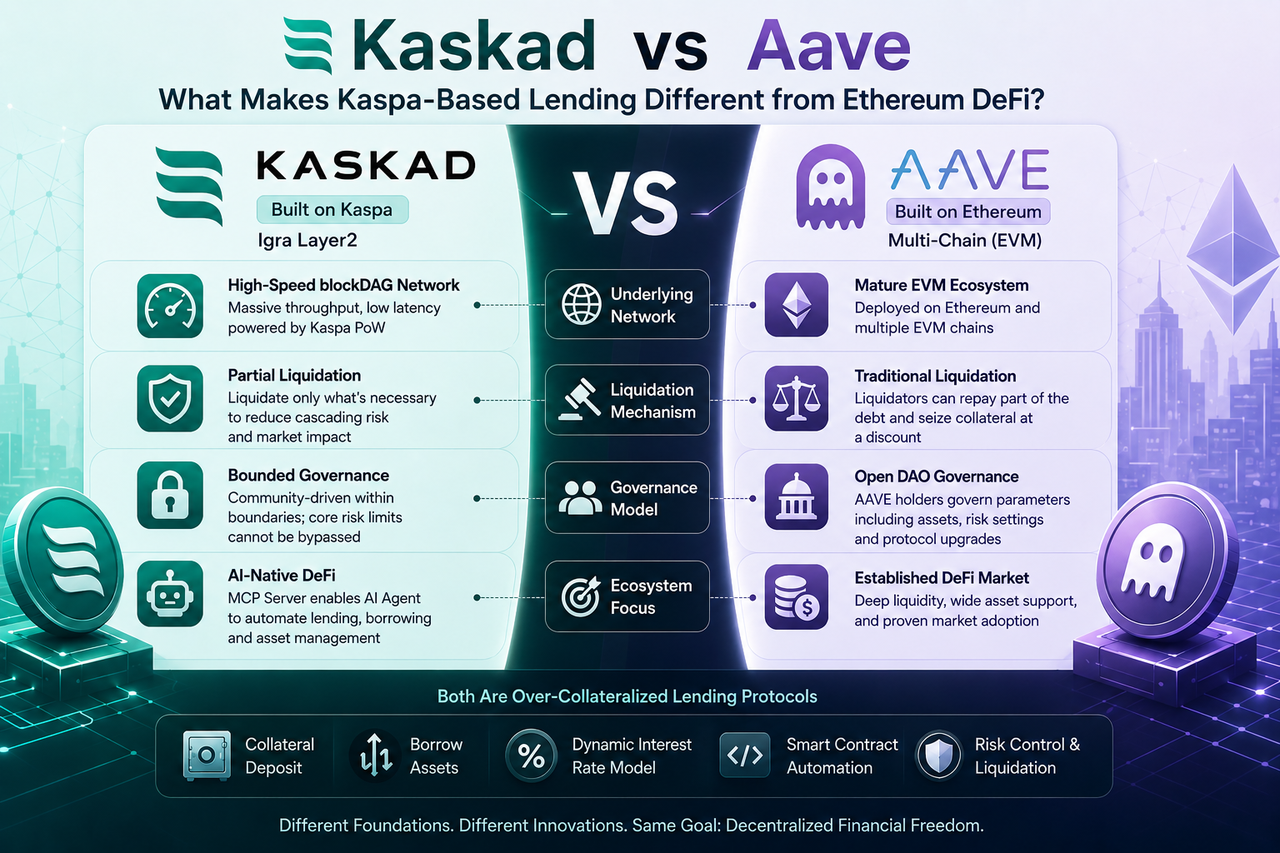
As one of the most representative lending protocols in the Ethereum DeFi ecosystem, Aave has now been deployed across multiple EVM networks, including Ethereum, Arbitrum, Optimism, and Polygon.
Aave’s core model is also based on overcollateralized lending. After users supply assets, they can borrow other digital assets, while the protocol uses a dynamic interest rate model to automatically balance market supply and demand.
| Comparison Dimension | Kaskad | Aave |
|---|---|---|
| Underlying ecosystem | Kaspa + Igra Layer2 | Ethereum + EVM |
| Network structure | blockDAG | Traditional blockchain |
| Lending model | Overcollateralized | Overcollateralized |
| Liquidation mechanism | Partial Liquidation | Standard liquidation |
| Governance model | Bounded Governance | DAO Governance |
| AI Agent interface | MCP Server | No native support yet |
| Market maturity | Early-stage ecosystem | Mature market |
| Liquidity depth | Relatively low | Higher |
| Core direction | AI-native DeFi | Multichain liquidity market |
What Do Kaskad and Aave Have in Common in Their Lending Mechanisms?
In terms of core logic, Kaskad and Aave are both typical on-chain money market protocols.
Both use an overcollateralization mechanism, which means users must first provide collateral worth more than the value of the assets they want to borrow. The protocol then adjusts lending and borrowing rates automatically through a dynamic interest rate model based on market utilization.
In addition, both protocols rely on smart contracts to automatically execute:
-
Asset deposits
-
Loan settlement
-
Interest rate calculation
-
Liquidation logic
-
Risk controls
This model allows lending markets to operate continuously without centralized institutions.
How Is Kaskad’s Partial Liquidation Different from Aave?
The liquidation mechanism is one of the key differences between the two protocols.
Aave uses a more traditional on-chain liquidation model. When a user’s Health Factor falls below the safety threshold, liquidators can repay part of the debt and receive collateral assets at a discount.
By contrast, Kaskad places greater emphasis on Partial Liquidation.
Its core idea is:
The protocol prioritizes liquidating only the “necessary portion,” rather than selling a large amount of the user’s collateral all at once.
This mechanism aims to:
-
Reduce cascading liquidations during periods of sharp market volatility
-
Lower immediate selling pressure in the market
-
Reduce the user’s one-time loss
-
Improve protocol stability
For a new ecosystem where liquidity depth is still developing, this type of risk buffer is especially important.
Comparison of Kaskad and Aave’s Liquidation Mechanisms
The liquidation mechanism is one of the major differences between the two.
Aave mainly uses a traditional liquidation model. When a user’s Health Factor falls below the threshold, liquidators can repay part of the debt and receive the corresponding collateral at a discount.
Kaskad, on the other hand, places greater emphasis on Partial Liquidation.
| Comparison Dimension | Kaskad | Aave |
|---|---|---|
| Liquidation model | Partial Liquidation | Standard on-chain liquidation |
| Liquidation goal | Prioritize restoring position safety | Quickly reduce protocol bad debt |
| User impact | Relatively lower loss per event | May trigger larger-scale liquidation |
| Market impact | Reduces cascading sell-off risk | Relies more heavily on market liquidity |
| Suitable ecosystem | Emerging high-speed PoW DeFi | Mature EVM DeFi |
How Do Kaskad and Aave Differ in Governance?
Aave uses a traditional DAO governance structure. AAVE holders can participate in governance over protocol parameters, including adding new assets, modifying interest rate parameters, and adjusting risk management rules.
Kaskad, meanwhile, introduces the concept of “Bounded Governance.”
The core difference is this:
Even when the community can participate in governance, the protocol’s key risk boundaries cannot be arbitrarily overridden.
For example:
-
The LTV of high-risk assets cannot be raised without limit
-
Core liquidation logic cannot be bypassed
-
Key security modules cannot be disabled
This design attempts to strike a balance between decentralized governance and protocol security.
By comparison, Aave places greater emphasis on open DAO governance, while Kaskad places more weight on protocol-level safety boundaries.
Which Lending Protocol Is Better Suited to Different Users?
There is no absolute answer to whether Kaskad or Aave is “better.”
For users looking for mature liquidity, broad asset support, and a stable market environment, Aave is closer to the mainstream DeFi market.
For users focused on the Kaspa ecosystem, high-speed PoW networks, AI-native DeFi, new financial infrastructure, and Layer2 innovation, Kaskad offers more room for exploration and ecosystem growth.
In practice, the two represent on-chain financial systems at different stages of development.
Summary
Kaskad and Aave both use an overcollateralized lending model, but they differ significantly in underlying architecture, risk controls, governance logic, and ecosystem direction.
Aave is more representative of the mature Ethereum DeFi lending market, while Kaskad places greater emphasis on Kaspa blockDAG, high-speed PoW networks, and AI-native DeFi infrastructure.
FAQs
What Is the Biggest Difference Between Kaskad and Aave?
The biggest difference lies in their underlying ecosystems and protocol direction. Aave belongs to the mature Ethereum DeFi lending market, while Kaskad places more emphasis on Kaspa blockDAG and AI-native DeFi.
Did Kaskad Reference Aave’s Architecture?
Yes. Kaskad’s overall lending model and money market logic are similar to Aave’s, but it has been optimized for the Kaspa ecosystem.
What Is Partial Liquidation?
Partial Liquidation means the protocol liquidates only part of a position instead of fully closing it all at once, helping reduce the risk of cascading liquidations.
Why Does Kaskad Support AI Agents?
Kaskad provides an MCP Server, allowing AI Agents to automatically execute lending, borrowing, and asset management operations.
Related Articles

In-depth Explanation of Yala: Building a Modular DeFi Yield Aggregator with $YU Stablecoin as a Medium

Sui: How are users leveraging its speed, security, & scalability?

What Is a Yield Aggregator?

Dive into Hyperliquid

Espresso Shared Sequencer Mechanism Explained: How Espresso Builds the Layer 2 Shared Sequencing Layer