How to Buy US Stocks with USDT? The Complete Guide to Trading US Stocks, ETFs, and Nasdaq Assets Using Stablecoins
Compared with traditional overseas brokers, crypto platforms often deliver price exposure to assets like Apple, NVIDIA, Tesla, S&P 500, and NASDAQ ETFs through instruments such as CFDs (Contracts for Difference), tokenized stocks, and RWAs (Real World Assets), while also enabling settlement in stablecoins.In the past, most users who wanted to buy U.S. stocks typically had to open an overseas brokerage account and link an international bank card to fund it. But as cross-border financial regulations tighten, some internet brokerages restructure their international offerings, and global demand for dollar-denominated assets continues to climb, more people are looking for more flexible ways to invest in U.S. equities.
Meanwhile, the growth of the crypto industry has pushed stablecoins into a "digital dollar" role. Stablecoins like USDT and USDC are not only used for crypto trading but are also increasingly adopted by platforms for settling TradFi (Traditional Finance) assets. This means users can access U.S. stocks, ETFs, and commodity markets through crypto platforms without needing a traditional bank account.
How to Buy U.S. Stocks with USDT?
Gate recently launched its U.S. stock trading service, enabling users to trade over 10,000 assets—including stocks and ETFs from major U.S. securities markets—directly with USDT on the platform. These cover the NYSE, NASDAQ, and other major trading markets and liquidity networks.

Unlike the common RWA mappings or tokenized derivatives seen in the market, Gate integrates with compliant brokerages to offer users direct spot trading services, independent of the traditional CFD framework—with no funding rates or overnight holding fees, making it better suited for long-term asset allocation.
This feature is now seamlessly integrated into the Gate App (update to the latest version on Android, or version 8.21.5 on iOS, then access it via the TradFi section). Users only need to complete KYC verification and meet regional eligibility requirements to efficiently transfer crypto assets to U.S. stock positions and trade at market prices during trading hours. Going forward, Gate will expand to 24/7 trading, introduce margin trading and one-click asset transfers between brokerages, and provide unified views of holdings, P&L, and corporate actions like dividends.
From an industry perspective, most crypto platforms don't offer direct real stock trading. Instead, they provide exposure to U.S. stock price movements through CFDs (Contracts for Difference), tokenized stocks, or RWA products.
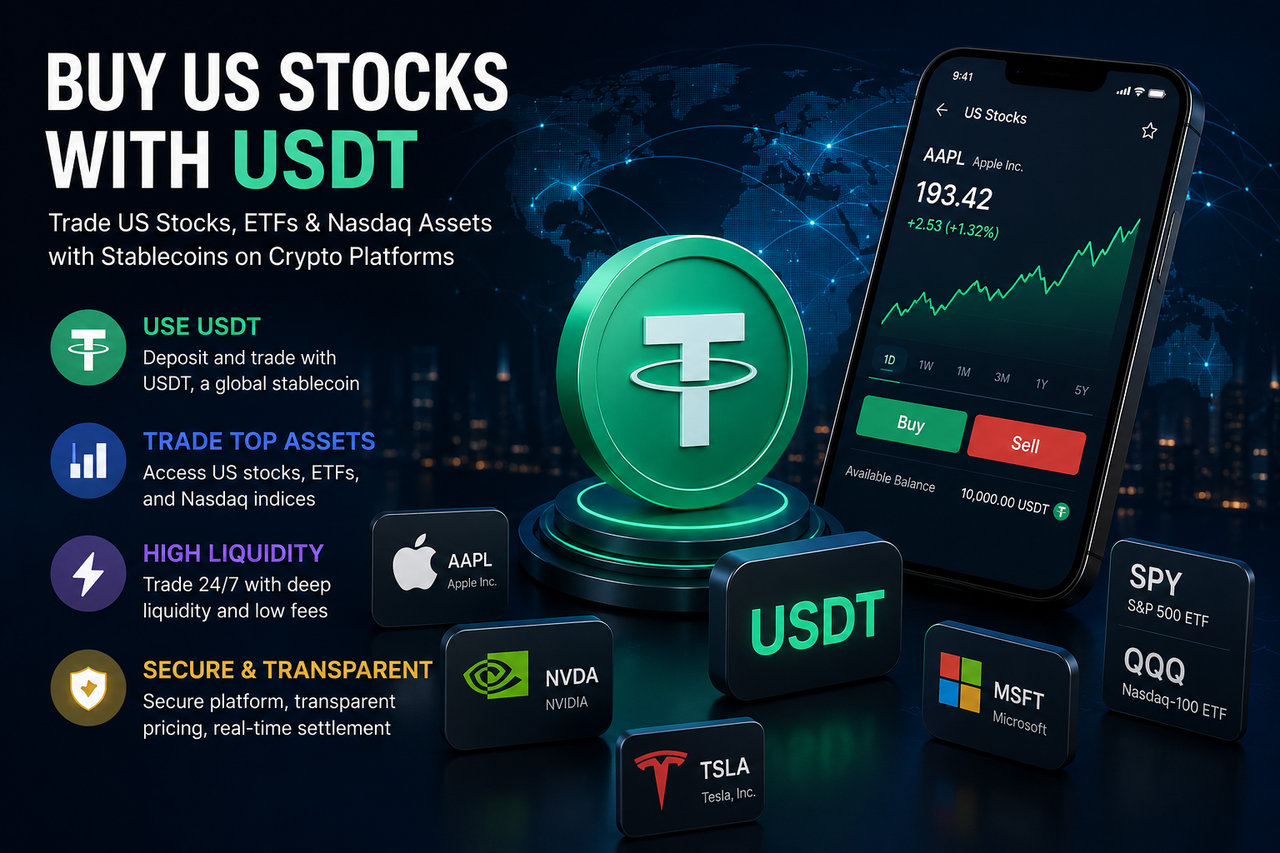
Typically, users follow this process:
First, register on a crypto platform that supports TradFi products and complete KYC identity verification. Then, deposit USDT as margin. Navigate to the TradFi or Stocks product page to select and trade the desired stock or ETF.
Currently, some platforms support:
- Apple
- NVIDIA
- Tesla
- Amazon
- NASDAQ index-related products
- S&P 500 ETF
- Gold ETF
Users can gain exposure to price movements of these assets using stablecoins, without needing a traditional brokerage account.
What's the Underlying Mechanism of Buying U.S. Stocks with USDT?
There are two main underlying structures for "Buying U.S. Stocks with USDT."
The first is stock CFDs. Users don't actually own the stocks but trade the price movements. Through a settlement mechanism based on the price difference, users realize profits or losses from those movements. This model typically supports leverage and allows both long and short positions.
The second is tokenized stocks. Here, a custodian holds the actual stocks and issues corresponding tokens on-chain. For example, one on-chain stock token might represent one real share. This structure is closer to asset mapping, but compliance and redemption mechanisms vary significantly across platforms.
So when users search for "Buy U.S. Stocks with USDT," they need to determine whether they're dealing with CFDs, on-chain securities, or other RWA products.
How Are Stock CFDs Different from Real Stocks?
This is one of the most confusing points for users.
Owning real stocks means you actually hold equity in the company, typically with voting rights, shareholder benefits, and long-term holding attributes. Stock CFDs, in contrast, are derivatives—you're trading the price, not the actual security.
Therefore, stock CFDs are better for:
- Short-term trading
- Leveraged trading
- Short-selling strategies
- High-liquidity trading
Real stocks are more suited for long-term asset allocation and value investing.
For most crypto platforms, CFDs are easier to integrate with existing derivatives systems. That's why most "Buy U.S. Stocks with USDT" offerings today are CFD structures.
Why Are More Users Turning to Crypto Platforms for Global Asset Allocation?
The driving force behind this trend is the convergence of global capital markets and the crypto market.
In the past, the crypto market and traditional financial markets were largely separate. But with the rise of stablecoins, RWAs, and asset tokenization, users can now trade all in one place:
- BTC and ETH
- U.S. stocks
- ETFs
- Gold
- Crude oil
- U.S. Treasuries
This means crypto platforms are evolving from digital currency exchanges into global asset trading gateways.
For many users, using USDT to allocate global assets not only lowers the barrier to cross-border finance but also improves capital efficiency. Stablecoins are thus becoming a key bridge connecting Crypto and TradFi.
What Are the Risks of Buying U.S. Stocks with USDT?
While stablecoins lower the entry barrier for trading global assets, users need to be aware of several risks.
First, stock CFDs often involve leverage, which can amplify both gains and losses in volatile markets. Second, the compliance structures for tokenized stocks and RWA products vary across platforms—users should examine asset custody, liquidity, and regulatory risks.
Also, since most products don't represent actual stock ownership, users may not have traditional securities rights. Stablecoins themselves also carry liquidity and regulatory change risks.
So before entering these markets, users must fully understand the product structure, not just focus on price movements.
Summary
USDT is transitioning from a crypto trading medium into a key financial infrastructure connecting global capital markets. Through CFDs, tokenized stocks, and RWA products, more users are using stablecoins to trade U.S. stocks, ETFs, and NASDAQ-linked assets.
For users who can't easily access overseas brokerages and want to improve global asset allocation efficiency, crypto platforms offer a new on-ramp. But at the same time, users need to understand the differences between CFDs, Tokenized Stocks, and real stocks, and pay close attention to product structures and associated risks.
FAQs
Can I directly buy Apple and NVIDIA stocks with USDT?
Some crypto platforms support trading stock-related products for Apple, NVIDIA, Tesla, etc., using USDT. However, in most cases, these are CFDs or tokenized stocks, not actual stock holdings.
Does buying U.S. stocks with USDT always mean I own real stocks?
Not necessarily. Many platforms offer stock CFDs or on-chain mapped assets. Check the specific product structure.
What is a stock CFD?
A stock CFD (Contract for Difference) allows you to trade the price movements of a stock without actually owning the underlying shares.
Do I need an overseas bank card to buy U.S. stocks with USDT?
Some crypto platforms let you trade directly with stablecoins, so an overseas bank card may not be required.
Are tokenized stocks legal?
Regulations for tokenized stocks vary by country and region. Legality depends on the platform's jurisdiction and compliance structure.
Related Articles

Exploring 8 Major DEX Aggregators: Engines Driving Efficiency and Liquidity in the Crypto Market

What Is Copy Trading And How To Use It?

What Is Technical Analysis?

How to Do Your Own Research (DYOR)?

What Is Fundamental Analysis?
