How press fits into a crypto communications playbook
“Communications,” or “comms,” is the umbrella term for the strategies companies use to, well, communicate with different groups of people — employees, media, investors, and others.
Communications includes creating your own content (aka “going direct”) on both your site and social media channels; penning thought leadership pieces; coordinating internal communications to your employees; working with influencers (“key opinion leaders” or KOLs); and pitching events and speaking opportunities that are both organic and paid. And of course, comms includes interfacing with the media (aka public relations or publicity).
No one communication strategy or tactic is better than the other. So how do you figure out which approach is right for you?
In this post, I’ll lay out how to think about your comms strategy and the levers you have available to achieve it, and then argue that traditional media relations — despite its unsavory reputation within some tech circles — remains an important tool in getting your message out as a startup.
How to think about your comms strategy
My mental model for a communications strategy is built around the answers to three questions:
- What is your business goal?
- What audience(s) do you need to reach to achieve your goal?
- What are the best tactics to reach that / those audience(s)?
Standing above all of this is your message and narrative — the problem you and your team are solving, how the world will look when you solve that problem, and who will be better off in that new world.
Your core narrative and messages should hold true no matter who you’re talking to or through which medium you’re communicating. But you’ll lean into different elements depending on who you’re talking to. For example, investors will care about the details and future growth prospects, while the media will care about the headline and how you got to where you are today.
What levers can you pull?
While business goals and audiences will vary from project to project, the levers or tactics you can use remain the same. Those levers include:
- Owned content: Think creating your own blog, producing a video, or posting a whitepaper on your website.
- Social (brand & personal): While you don’t own the channel, social is one of the best ways to reach your community where they are. For a startup, it’s a combination of your brand account (corporate handle), and personal accounts (i.e., those of your founders and employees).
- Community building: Whether through Discord, Signal, Telegram, or WhatsApp, online community management allows you to connect with developers, partners, or other key audiences who are building in your ecosystem.
- Speaking opportunities and conferences: This includes both speaking and appearing at important IRL community events and conferences.
- Media / press: The last lever includes both proactive and reactive dealings with the press — whether it’s reaching out to pitch a story idea, offering an expert for comment, pitching a contributed article; or responding to a media inquiry. Press here includes both the crypto trade press (e.g., Coindesk, The Block, etc.), and traditional media (e.g., The Wall Street Journal, Bloomberg, etc.).
Where the press fits for founders
The last of these tactics — media relations (aka public relations, or PR) — is the most controversial among many tech founders. And not for nothing: While it’s true that some reporters and outlets have become increasingly hostile to tech, it remains one of the topics I’m most often asked about when advising startups.
Many founders ask how they can secure coverage for their funding round in TechCrunch or a glowing profile in Fortune. Or they’re curious about how to get on TBPN or sit down with the Bankless guys for an hour-long podcast.
Why? Because — no matter how you feel about the media overall — press coverage combines third-party validation with the potential to grow a company’s audience and reach by getting in front of new people: potential hires, potential customers, or potential influencers in your category. Reaching a different audience also helps to grow your own channels, and most startups can’t afford to dismiss the opportunity to broaden their reach and exposure.
When the founding team of Kalshi recently sat down with CBS Sunday morning, they reached a different audience from the “chronically online” online of tech Twitter. Tarek Mansour, Kalshi’s CEO, shared the story of a Kalshi team member’s mom that speaks to the power of reaching different audiences through traditional media:
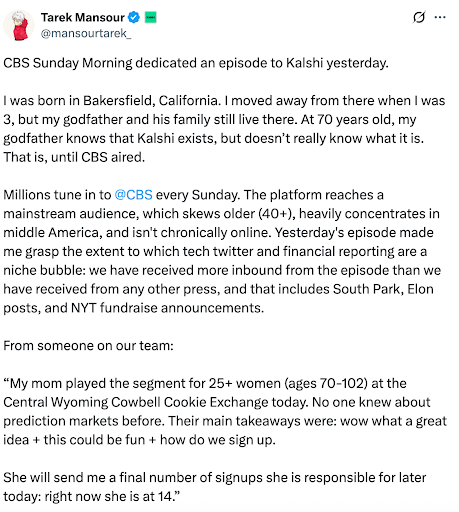

It’s the reason that media relations is still an incredibly important part of the communications toolkit. Media can drive people back to your own channels, help build your (and your company’s) profile, and make everything else — from hiring to selling — go faster. Media can also make your “go-direct” strategy more effective in the long run.
Don’t fear media relations. Learn how to use it to cut through all the noise.
Reaching the media: Cut through the noise
It’s true that we’re oversaturated with information and content. Nowhere is this more true than for the journalists you’re trying to reach.
Take a look at the inbox of any journalist, podcast host, or other content creator: You’ll be horrified because you’ll see hundreds, if not thousands, of emails from PR people shilling their particular client or project. In fact, some sources show that the number of media relations professionals to journalists is 6 to 1. Because they’re inundated, it’s almost impossible for a journalist to sort through what’s real and what’s fluff.
Why? Many of these PR people haven’t received the proper training, or lack the confidence to push back on bad ideas that their clients propose. So they flood the zone with terrible pitches — increasing the frustration of journalists, producers, podcast hosts, and other content creators.
Then add in the pitches from projects that promise incredible solutions to important problems, but that all fall flat or simply are vaporware. Taken together, bad pitches and overpromising creates an environment where “cutting through the noise” is harder than ever.
But the very scarcity of journalistic resources relative to the glut of slop means that those who can effectively articulate their story and build relationships with the remaining media professionals will be at a distinct advantage.
Engaging with media: Where to start
There are four things founders should remember when trying to cut through all the noise and engage with the media:
- Founders are the best spokespeople. It is impossible to outsource the narrative or story of your company. While hiring a communications or PR person, agency, or freelancer can help, they can only get your foot in the door. Founders are the ones who must craft and deliver their own story in a compelling way.
- Relationships are key. Look at media relations similar to business development. Whether it’s pitching a speaking opportunity or simply replying on X, building a personal relationship with reporters, podcasters, and influencers is essential. Many times stories are written, podcasts are produced, or speaking opportunities are given due to personal relationships. Why? Because journalists and influencers trust the founders and PR people they’ve developed a relationship with, because those PR people have a track record of delivering access, answers, or other useful resources to them.
2a. So how do you build relationships with key media? It varies – but offering to be a resource. Focus on how you can add value to their reporting first, without pumping your project. You can also use speaking opportunities and conferences to meet folks – the same way you would from a business development perspective.
- The press is neither friend nor foe. Certain publications do indeed have an agenda, but more than anything, journalists are looking for a good story. But remember, reporters aren’t your friend trying to help you. The art is learning how to engage constructively and knowing when not to. (There are definitely times to just STFU.)
- Your story must fit into the context of the larger world. The best storytelling founders can see how their company, project, product, and people fit within the larger context of both their industry and the world at large. Helping reporters both understand you and how you fit into that bigger story, trend, or movement will go a long way in cutting through the noise. Think, for example, of the “end of year” wraps — from Spotify to Google search to a16z and Coinbase’s states of crypto. Each of these took a moment in time – looking at the past year, and added a unique POV / insight that only it could give, while also making it useful and viral through charts and visuals. Founders can also latch on to hot topics like the growth of stablecoins, AI x crypto, or policy debates around DeFi.
But the main point is to connect your story to what’s happening in the world.
The best defense is a good offense
“But,” you may ask, “what if I never want to engage with the media?”
That’s a nice wish to have, but unfortunately, as a startup grows, it will become impossible to remain out of the public eye.
The best way to ensure that you are not on the backfoot when faced with a tough story or crisis — fair or not — is to already have relationships with the media and to have built an initial rapport. Like anything in life, having a relationship makes tough conversations easier.
Crisis communications is a specialized skill, and one for another post. But in short the best defense is having a good offense, including already having built up your communications channels, established relationships with key reporters and influencers, and understanding your core audience before the crisis arrives.
The press has become scary to some or a convenient scapegoat for others, but with the right preparation and the right mindset, it can be a powerful unlock for founders.
Here’s to building in public — and mastering the tools to do it well.
Paul Cafiero (@ PaulCaf) is a Communications Partner on the a16z crypto marketing team. He works closely with a16z crypto’s policy team and portfolio companies. Before joining a16z crypto, he was a part of the Brunswick Group, a strategic communications agency, where he worked with crypto, tech, and media clients on high-profile crises and financial situations.
Disclaimer:
- This article is reprinted from [a16zcrypto]. All copyrights belong to the original author [a16zcrypto]. If there are objections to this reprint, please contact the Gate Learn team, and they will handle it promptly.
- Liability Disclaimer: The views and opinions expressed in this article are solely those of the author and do not constitute any investment advice.
- Translations of the article into other languages are done by the Gate Learn team. Unless mentioned, copying, distributing, or plagiarizing the translated articles is prohibited.
Related Articles

The Future of Cross-Chain Bridges: Full-Chain Interoperability Becomes Inevitable, Liquidity Bridges Will Decline

Solana Need L2s And Appchains?

Sui: How are users leveraging its speed, security, & scalability?

Navigating the Zero Knowledge Landscape

What is Tronscan and How Can You Use it in 2025?
