How Does Injective Cross-Chain Work? IBC, Peggy Bridge and Asset Liquidity Explained
Users who search for the cross-chain mechanism of Injective are usually trying to understand how assets from networks such as Cosmos or Ethereum enter Injective and then take part in on-chain trading, derivatives, DeFi applications, or liquidity markets. For a finance-focused public blockchain, cross-chain capability directly affects asset sources, market depth, and application usability.
This topic generally involves three layers. IBC handles interoperability within the Cosmos ecosystem, Peggy Bridge connects Ethereum assets, and Injective Bridge integrates different cross-chain paths into a unified asset flow entry point for users and applications. According to official information, Injective Bridge uses technologies such as Peggy and IBC to support cross-chain asset transfers.
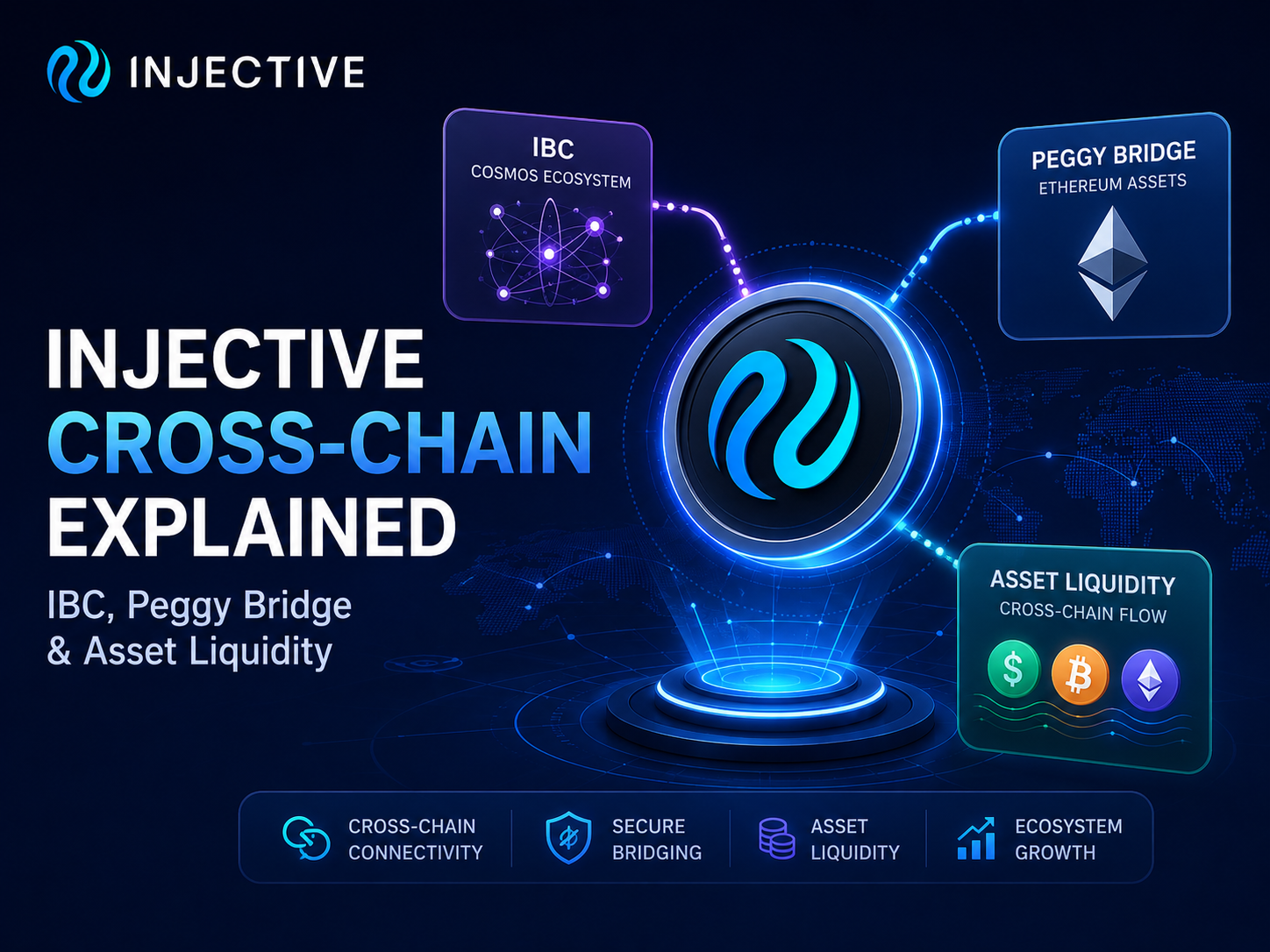
What Is Injective’s Cross-Chain Mechanism?
Injective’s cross-chain mechanism can be understood as a system for asset and message interoperability. Its role is to allow assets from different blockchains to enter the Injective network and be used in on-chain financial applications. It is not a single bridging tool, but a cross-chain infrastructure made up of multiple interoperability components, including IBC, Peggy Bridge, and Wormhole.
The core idea is to turn external assets into on-chain assets that Injective can recognize, trade, and settle. First, the user selects the source chain and target chain. The cross-chain system then verifies the asset lockup or transfer request. Next, the Injective network generates or receives the corresponding asset representation. Finally, the user can use these assets in Injective’s trading, lending, or derivatives applications.
Structurally, Injective’s cross-chain mechanism is designed to serve on-chain finance, not merely to move assets from one place to another. Official materials note that IBC allows different chains to transfer assets and arbitrary messages, enabling multiple independent networks to become part of an interconnected ecosystem.
This mechanism matters because Injective’s order books, derivatives, and DeFi applications all require support from assets originating across different networks. The stronger its cross-chain capability, the broader the range of collateral, tradable assets, and liquidity sources Injective can access.
How IBC Works in Injective
IBC is the core protocol that connects Injective with the Cosmos ecosystem. It can be understood as a communication standard among Cosmos networks, used to transfer assets, data, and cross-chain messages between different blockchains.
In Injective, IBC operates through light client verification and channel connections between chains. First, a user initiates a transfer from a Cosmos chain that supports IBC. The source chain then records the asset transfer and generates a cross-chain message. Next, a relayer passes the message to Injective. Finally, Injective verifies the message and confirms the corresponding asset balance for the user.
Structurally, IBC is not a custodial bridge in the traditional sense. It is closer to an interchain communication protocol, allowing multiple Cosmos networks to recognize state changes across chains through standardized channels and verification logic. Official information shows that Injective governance proposals have promoted IBC integration, allowing Injective to connect with the broader Cosmos ecosystem.
This means assets in the Cosmos ecosystem can enter Injective’s on-chain financial environment. For users, IBC lowers the cost of cross-chain asset movement. For applications, it expands the range of available assets and improves market depth.
How Peggy Bridge Connects Ethereum Assets
Peggy Bridge connects Injective with the Ethereum ecosystem, allowing Ethereum assets such as ERC-20 tokens to enter the Injective network. It can be understood as Injective’s native cross-chain bridge mechanism for Ethereum.
Its operating logic revolves around locking, verification, and mapping. First, the user submits an asset bridging request on Ethereum. Peggy Bridge-related contracts or modules then confirm the asset status. Next, the Injective side generates the corresponding asset representation based on the verification result. Finally, the user can use these Ethereum assets on Injective for trading or DeFi applications.
Structurally, Peggy Bridge connects Ethereum’s asset layer with Injective’s financial execution layer. Official materials state that Injective Bridge uses Peggy to connect cross-chain interactions and support asset movement between Injective and other blockchains.
Peggy Bridge is important because the Ethereum ecosystem holds a large amount of stablecoins, major crypto assets, and DeFi liquidity. Through Peggy Bridge, Injective does not need to rely only on assets within Cosmos. It can also bring Ethereum assets into its on-chain order books and financial application system.
How Injective Enables Cross-Chain Asset Flow
Injective’s cross-chain asset flow essentially depends on coordination between the source chain, bridging protocol, verification module, and target chain account. Assets are not simply moved from one wallet to another. Instead, they go through on-chain confirmation, cross-chain message transmission, and accounting on the target chain.
A typical process can be summarized in the following stages:
| Process Stage | User Action | System Action |
|---|---|---|
| Initiate cross-chain transfer | Select the source chain, target chain, and asset | Generate a cross-chain request |
| Source chain confirmation | Submit a transaction | The asset is locked or transferred |
| Message transmission | Wait for confirmation | A relayer or bridging module transmits the data |
| Target chain crediting | Check the balance | Injective confirms the asset representation |
| Application use | Trade or provide liquidity | The asset enters on-chain financial use cases |
This process shows that cross-chain mechanisms involve both user actions and system verification. What users see is an asset entering one network from another. What the system handles is consistency among asset status, message proofs, and account balances.
After that, users can use cross-chain assets in Injective’s spot markets, derivatives markets, or other DeFi applications. Ultimately, these assets become part of order book depth, collateral, and trading pair composition, affecting the liquidity efficiency of the entire Injective financial ecosystem.
How Cross-Chain Mechanisms Affect Injective’s Liquidity
Cross-chain mechanisms affect Injective’s liquidity mainly through asset sources, trading depth, and application composition. On-chain financial protocols need various assets as trading instruments, collateral, and settlement tools, so cross-chain capability determines how much external capital and how many asset types Injective can absorb.
The key is to open capital entry points across different ecosystems. Through IBC, assets from the Cosmos ecosystem can enter Injective. Through Peggy Bridge, Ethereum assets can participate in Injective markets. Through other cross-chain frameworks, more non-Cosmos assets can also be brought into the trading environment. Official materials show that Injective’s Ionic Upgrade further integrated IBC, Wormhole, and Peggy Bridge, allowing users to bridge IBC ecosystem assets, Wormhole-supported assets, and ERC-20 assets.
Structurally, cross-chain liquidity is not a single asset inflow, but a tradable asset pool formed jointly by multiple ecosystems. First, external assets enter Injective. Users then use those assets for trading or liquidity provision. Applications gain deeper markets and more trading pairs. Finally, the on-chain financial ecosystem achieves higher capital efficiency.
This means Injective’s competitiveness depends not only on its own on-chain users, but also on its ability to absorb assets from external ecosystems.
What Are the Features of Injective’s Cross-Chain Security Mechanisms?
Injective’s cross-chain security mechanisms center on verification, message transmission, and on-chain confirmation. The key issue for a cross-chain system is not just speed, but how to ensure that the source chain state and the target chain crediting result remain consistent.
IBC’s security foundation comes from interchain verification and standardized communication. It uses light clients, channels, and relayers to transmit state between chains, allowing the target chain to verify messages from the source chain. Compared with bridge models that rely entirely on centralized custody, IBC places greater emphasis on protocol-level verification.
Peggy Bridge focuses more on the security of asset mapping between Ethereum and Injective. First, the user initiates an operation on Ethereum. The bridging system then confirms the related transaction. Next, the Injective side processes the corresponding asset based on the verification result. Finally, the asset becomes available on the target chain.
Structurally, Injective’s security mechanism is made up of on-chain contracts, the validator network, cross-chain modules, and relayer systems. Official materials mention that Injective Bridge uses Peggy and IBC to support cross-chain interactions, which means different asset paths use different security models.
The importance of this design is that it allows Injective to choose the appropriate cross-chain framework based on the source chain, rather than placing all assets under the same bridge risk model.
What Challenges Does Injective’s Cross-Chain Architecture Face?
The main challenges facing Injective’s cross-chain architecture come from bridge security, liquidity fragmentation, cross-chain user experience, and the complexity of maintaining multiple protocols. The stronger the cross-chain capability, the more asset standards, network states, and security assumptions the system must handle.
First, different cross-chain protocols do not share the same risk model. Frameworks such as IBC, Peggy Bridge, and Wormhole each have their own verification methods and operating logic. Then, when users move assets across multiple networks, transaction confirmation time, fees, wallet compatibility, and asset display methods can all affect the experience. After assets enter Injective, there must also be sufficient trading demand and application use cases. Otherwise, liquidity may remain on-chain without being fully utilized.
Structurally, multi-chain access expands asset coverage while also increasing system coordination costs. Cross-chain assets need clear identification of their source, standard, and risk attributes. Otherwise, users may struggle to distinguish between native assets, bridged assets, and mapped assets.
Ultimately, the effectiveness of Injective’s cross-chain architecture depends on the balance among security mechanisms, user experience, application demand, and market depth. Cross-chain functionality is not a standalone feature, but one of the core infrastructure layers supporting the long-term operation of Injective’s financial ecosystem.
Conclusion
Injective’s cross-chain mechanism is built around IBC, Peggy Bridge, and multi-chain bridging frameworks. Its goal is to allow assets from Cosmos, Ethereum, and other ecosystems to enter Injective’s on-chain financial system.
In terms of process, users first initiate a cross-chain request. The source chain then confirms the asset status. Next, the cross-chain module transmits and verifies the message. Finally, Injective confirms the asset balance for the user and supports its use in trading, derivatives, or DeFi applications.
IBC strengthens interoperability across the Cosmos ecosystem, Peggy Bridge connects Ethereum assets, and the unified bridging architecture expands Injective’s asset coverage. Overall, the cross-chain mechanism affects not only asset transfers, but also Injective’s liquidity, market depth, and ability to expand its financial applications.
FAQs
What Is Injective’s Cross-Chain Mechanism Mainly Used For?
Injective’s cross-chain mechanism is mainly used to connect assets across different blockchains, allowing assets from ecosystems such as Cosmos and Ethereum to enter Injective and participate in on-chain trading, DeFi applications, and financial markets.
What Role Does IBC Play in Injective?
IBC connects Injective with the Cosmos ecosystem. It transfers assets and messages through an interchain communication protocol, allowing different Cosmos networks to interoperate with Injective.
How Does Peggy Bridge Connect Ethereum?
Peggy Bridge uses Ethereum-side contracts and Injective-side modules to process asset status, allowing Ethereum assets such as ERC-20 tokens to be mapped to or used within the Injective network.
What Can Injective Cross-Chain Assets Be Used For?
Injective cross-chain assets can be used for spot trading, derivatives markets, collateral, liquidity provision, and other on-chain financial applications, depending on asset support and application integration.
What Risks Exist in Injective’s Cross-Chain Mechanism?
The main risks include bridge security, cross-chain message delays, differences in asset standards, liquidity fragmentation, and user operation errors. Different cross-chain paths correspond to different security models.
Related Articles

In-depth Explanation of Yala: Building a Modular DeFi Yield Aggregator with $YU Stablecoin as a Medium

The Future of Cross-Chain Bridges: Full-Chain Interoperability Becomes Inevitable, Liquidity Bridges Will Decline

Solana Need L2s And Appchains?

Sui: How are users leveraging its speed, security, & scalability?

Navigating the Zero Knowledge Landscape
