How Does IBIT (iShares Bitcoin Trust) Work? Spot Bitcoin ETF Mechanism Analysis
IBIT (iShares Bitcoin Trust)'s core function is to provide investors with exposure to Bitcoin's price movements through an ETF structure, allowing them to participate in Bitcoin market volatility via a traditional securities account without needing to directly hold Bitcoin or manage a digital wallet.Compared to buying BTC directly, IBIT integrates digital assets into the traditional financial system, enabling institutional capital, pension funds, wealth management platforms, and regular securities investors to allocate Bitcoin using familiar trading methods.
With regulatory approval of spot Bitcoin ETFs, IBIT has become one of the key bridges linking the crypto market with traditional finance.
IBIT's Core Positioning
IBIT's core positioning is not to create new digital assets but to wrap Bitcoin into an ETF product that complies with traditional securities market rules. Investors purchase ETF shares, which are backed by the fund's actual Bitcoin holdings.
For traditional investors, buying Bitcoin directly often requires digital wallets, exchange accounts, and private key management. IBIT, however, lets them trade through their existing securities accounts, significantly lowering the barrier to entering the digital asset market.
From a market structure perspective, IBIT is more of a "bitcoin investment tool" than a functional blockchain asset. IBIT does not participate in on-chain governance or handle payments or settlements. Its primary purpose is to provide investors with market exposure to Bitcoin price movements.
This positioning makes IBIT a critical gateway for traditional financial institutions entering the digital asset market. Many institutional investors that could not directly hold crypto assets can now allocate to Bitcoin through the ETF framework.
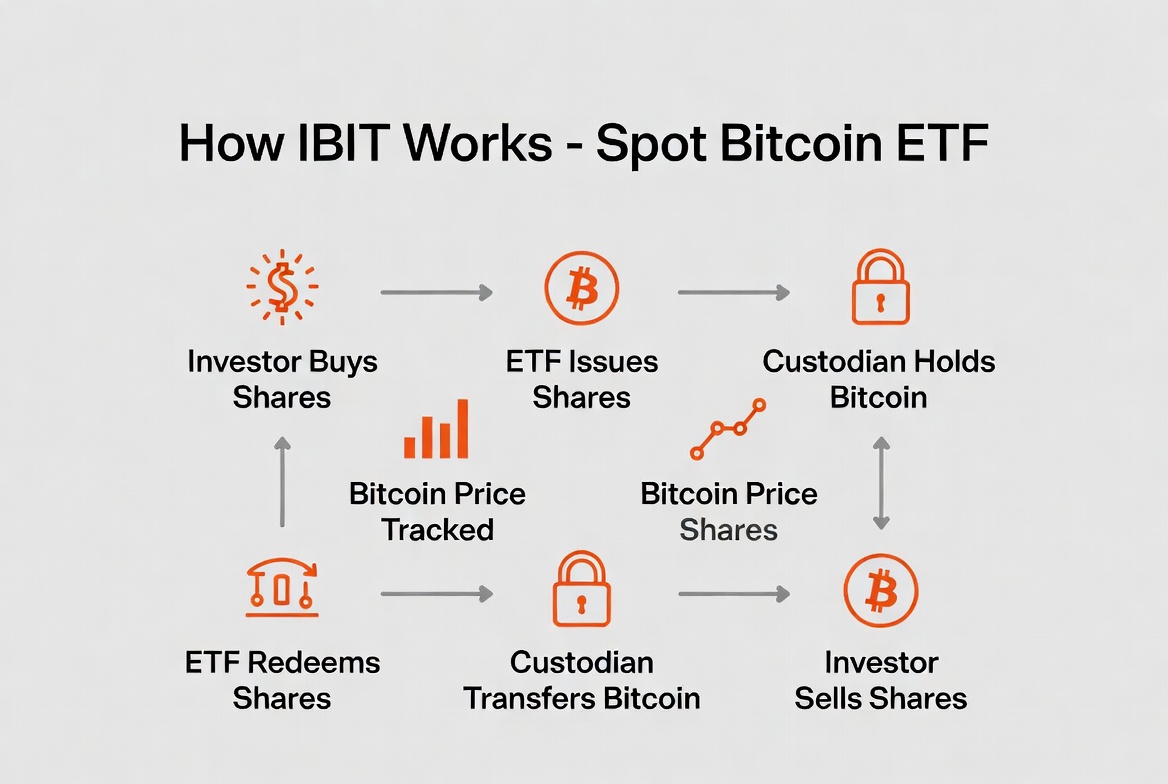
Why a Spot Bitcoin ETF Can Track BTC
A spot Bitcoin ETF can track BTC because the fund directly holds real Bitcoin assets.
When investors buy IBIT, the fund manager increases Bitcoin reserves in line with capital inflows. As the fund's Bitcoin holdings grow, the ETF's net asset value moves in sync with the Bitcoin market price.
Unlike futures ETFs, IBIT does not simulate price performance using futures contracts. Futures ETF prices can be affected by rollover costs and contract structures, while spot ETFs depend directly on the underlying asset's value, resulting in generally higher tracking efficiency.
Although securities market trading hours do not fully match those of the crypto market, the ETF's net asset value adjusts continuously based on Bitcoin market prices. Therefore, over the long term, IBIT and BTC price trends typically exhibit a high degree of correlation.
How IBIT's Asset Custody Structure Works
The asset custody system is a critical infrastructure for a spot Bitcoin ETF to operate properly.
Since the ETF holds a large amount of real Bitcoin, the fund manager must entrust these assets to professional custodians. The custodian handles private key management, asset security, on-chain transfers, and reserve verification, reducing digital asset custody risks.
In traditional financial markets, stock ETFs are typically custodied by custodian banks. For a spot Bitcoin ETF, the custody object is digital assets, requiring specialized institutions with crypto asset management expertise.
This division of labor creates a structure where the fund manager, custodian, authorized participants, and regulatory system collaborate. The asset manager runs fund operations, the custodian ensures asset security, and market participants provide ETF liquidity.
For many institutional investors, the custody structure is as important as the ETF itself. Asset safety, audit transparency, and compliance management are essential prerequisites for institutional capital to enter the digital asset market.
How ETF Shares Are Created and Redeemed
The creation and redemption mechanism of ETF shares is a key reason IBIT maintains long-term price stability.
When market demand for IBIT increases, authorized participants can submit cash to the fund. The fund then uses that cash to buy Bitcoin and creates new ETF shares for market circulation.
Conversely, when demand falls, authorized participants can return ETF shares to the fund and complete the corresponding redemption. This mechanism dynamically adjusts ETF supply based on market demand.
The creation and redemption process effectively reduces deviations between the ETF's market price and its net asset value. When premiums or discounts appear, arbitrage capital typically drives the price back to a reasonable range, enhancing tracking capability.
Throughout the ETF industry's history, this mechanism has been widely used for stock, bond, and commodity ETFs. IBIT extends this proven model into the digital asset space.
How Bitcoin Price Affects IBIT
Bitcoin price is the most direct factor influencing IBIT's volatility.
Since IBIT holds real Bitcoin, when the BTC market price rises, the fund's portfolio value typically increases accordingly. Similarly, the ETF's net asset value and market price tend to rise.
Beyond price, Bitcoin market sentiment also affects IBIT's performance. Institutional capital inflows, regulatory changes, macroeconomic liquidity, and market risk appetite can all influence BTC price and, in turn, affect the ETF.
During bull markets, rising Bitcoin prices typically drive sustained ETF inflows. In periods of declining risk appetite, outflows and price corrections may occur simultaneously.
Historically, IBIT and BTC maintain a high correlation. Therefore, when analyzing IBIT, market participants typically monitor the Bitcoin spot market, ETF fund flows, and overall digital asset market sentiment.
How IBIT Differs from Traditional ETFs
From a fund structure perspective, IBIT and traditional ETFs are both exchange-traded funds, tradable in real time on securities markets and managed through a net asset value system.
However, the biggest difference is the underlying asset type. Traditional ETFs typically hold stocks, bonds, commodities, or index components, whereas IBIT's underlying asset is Bitcoin.
This difference means IBIT is influenced not only by capital market factors but also by the operational dynamics of the digital asset market. For example, Bitcoin halving cycles, on-chain capital flows, and crypto market regulatory policies can all become unique variables affecting IBIT.
Additionally, the Bitcoin market operates 24/7, while securities markets have fixed trading hours. Therefore, under certain extreme conditions, IBIT may experience price gaps at market open, a phenomenon relatively rare in traditional stock ETFs.
In essence, IBIT is a product of combining traditional ETF architecture with the digital asset market, possessing dual attributes of traditional financial instruments and crypto asset investment products.
What Are the Main Use Cases for IBIT
For institutional investors, the most common use case is digital asset allocation. Some institutions treat Bitcoin as an alternative asset and include it in diversified portfolios via the ETF.
For wealth management firms, IBIT offers a solution that does not require direct digital asset custody. Advisors can use the ETF to provide clients with Bitcoin market exposure while maintaining a traditional securities account management model.
For individual investors, IBIT lowers the technical barrier to participating in the Bitcoin market. They don't need to learn on-chain wallets or manage private keys; they can gain exposure to digital asset prices through a familiar securities trading environment.
As TradFi and Crypto markets continue converging, demand for derivative trading around Bitcoin ETFs is growing. Beyond direct ETF purchases, some investors also watch CFD products and other instruments tied to the ETF price, participating in market fluctuations through different approaches.
From a long-term perspective, IBIT is not just an ETF—it represents the process of digital assets gradually entering the global mainstream asset allocation system.
Summary
IBIT is one of the most representative products in the spot Bitcoin ETF market. Its core value lies in providing investors with Bitcoin price exposure through traditional securities markets.
Through real Bitcoin reserves, a professional custody system, and the ETF creation and redemption mechanism, IBIT effectively tracks the Bitcoin market price. At the same time, the ETF structure offers a more mature and compliant way for institutional capital to enter the digital asset market.
As traditional finance and the crypto market continue to integrate, IBIT has become an important window for observing institutional allocation trends, the maturity of the digital asset market, and the financialization of Bitcoin.
FAQ
What is IBIT?
IBIT is a spot Bitcoin ETF launched by BlackRock's iShares, tracking BTC market price performance by holding real Bitcoin assets.
Does IBIT actually hold Bitcoin?
Yes. IBIT is a spot Bitcoin ETF whose underlying assets consist of actually held Bitcoin, not futures contracts or other derivatives.
Why can IBIT track the Bitcoin price?
IBIT holds real Bitcoin reserves and uses the ETF net asset value calculation mechanism together with the creation and redemption mechanism, allowing the fund's price to stay aligned with the Bitcoin market price over the long term.
What is the difference between IBIT and a Bitcoin futures ETF?
A spot Bitcoin ETF holds real Bitcoin, while a futures ETF mainly holds Bitcoin futures contracts. A spot ETF typically reflects Bitcoin market price changes more directly.
What is the difference between IBIT and buying BTC directly?
Buying BTC gives you ownership of the digital asset, while buying IBIT gives you ETF shares. IBIT is better suited for investors who want to participate in the Bitcoin market through a traditional securities account.
How do I trade IBIT?
IBIT can be bought and sold through securities accounts that support U.S. stock trading. Some platforms also offer CFD products related to Bitcoin ETFs, allowing investors to participate in the market through price fluctuations without directly holding ETF shares.
Related Articles

In-depth Explanation of Yala: Building a Modular DeFi Yield Aggregator with $YU Stablecoin as a Medium
BTC and Projects in The BRC-20 Ecosystem

What Is a Cold Wallet?

Blockchain Profitability & Issuance - Does It Matter?
What is the Altcoin Season Index?