How Futures Trading Features Shape Trader Psychology: Execution Discipline Explained Through the Gate Exchange
Why Contract Trading Intensifies Market Sentiment
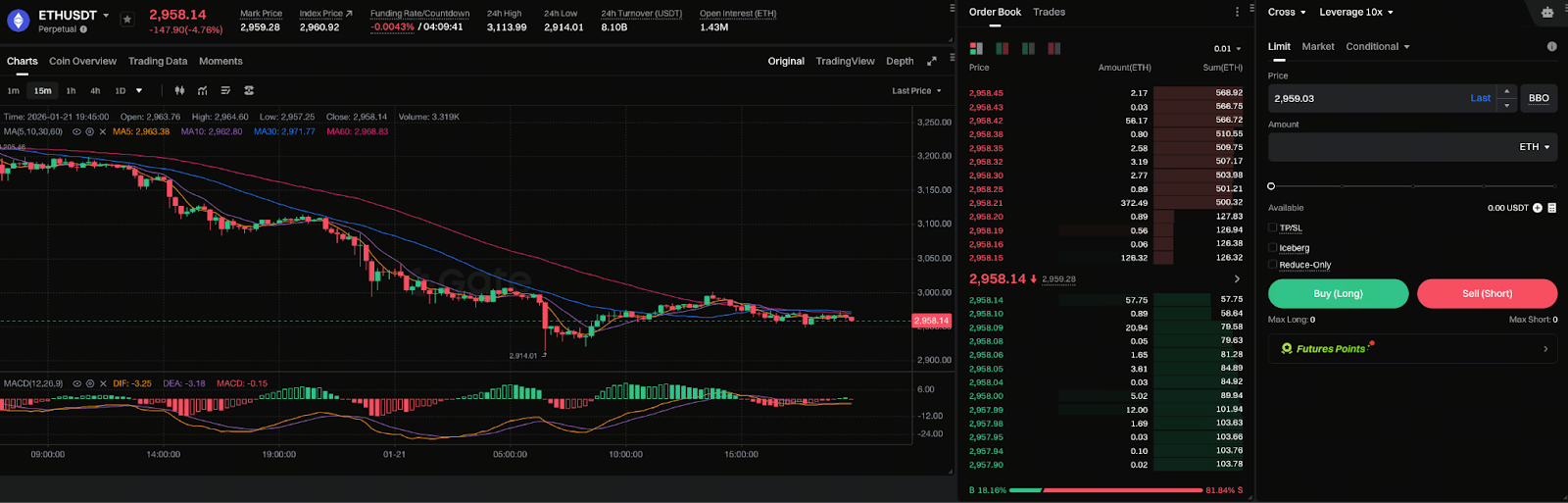
Chart: https://www.gate.com/futures/USDT/ETH_USDT
Contract trading triggers stronger emotional fluctuations than spot trading. The reasons are clear: price movements are faster, profit and loss swings are larger, and decision windows are shorter.
On Gate, rapid changes in account balances within the contract trading interface often directly influence users’ pace of decision-making.
How Contract Trading Features Relate to Emotional Volatility
Contract trading features are inherently neutral, but they can amplify human weaknesses.
Typical emotional patterns include:
- Overconfidence during profitable trades
- Wishful thinking amid unrealized losses
- Poor position increases when trying to break even
Without discipline, contract trading features can accelerate poor decision-making.
Leverage and Its Psychological Impact
Leverage is the most psychologically challenging aspect of contract trading. On Gate:
- Higher leverage leads to greater account volatility
- Decision-making timeframes are sharply reduced
- Emotions are more likely to drive trading behavior
Many beginners lose not to market trends, but to the psychological imbalance caused by high leverage.
How Stop-Loss and Take-Profit Orders Reduce Emotional Interference
Stop-loss and take-profit orders serve as both risk management and psychological management tools.
On Gate, setting stop-loss and take-profit in advance helps:
- Avoid last-minute hesitation
- Reduce repeated decision changes
- Minimize execution errors caused by emotions
For beginners, automated execution is more reliable than spontaneous decisions.
Psychological Pitfalls of Forced Liquidation
Many traders view forced liquidation emotionally, seeing it as a “failure.” Functionally, however, forced liquidation is simply the final safeguard for risk management.
Gate’s contract trading system includes forced liquidation mechanisms to:
- Prevent unlimited losses
- Protect overall account security
The real issue is not forced liquidation itself, but prior decisions regarding position size and leverage.
Frequent Trading and Decision Fatigue
Contract trading interfaces are packed with information and can easily prompt frequent trading. Yet excessive trading leads to decision fatigue, not market advantage. On Gate, contract trading features allow fast order placement, but frequent use is not required. The more you trade, the more psychological resilience you need.
How Gate Contract Trading Features Constrain Irrational Actions
Gate’s feature design includes multiple constraint mechanisms:
- Real-time risk ratio alerts
- Clear forced liquidation price display
- Automatic stop-loss and take-profit execution
The core purpose of these features is to help traders minimize emotional trading, not to heighten excitement.
Conclusion: Features Are Tools, Discipline Is Essential
Contract trading is not a test of judgment—it’s a test of execution. Features provide the tools, but cannot replace discipline. On a mature platform like Gate, contract trading features are already highly refined. Long-term results depend on whether you can consistently make rational decisions within the framework these features provide.
Related Articles

AI-Native Settlement Layers: How United Stables Is Building the Next Financial Rail

The ve(3,3) Flywheel Explained: How AERO Tokenomics Powers Aerodrome’s DeFi Economy

How Does PAXG Work? In-Depth Overview of the Physical Gold Tokenization Mechanism

Aerodrome Tokenomics: How ve(3,3) Powers Base's Most Profitable DEX

How is the price of PAXG determined? Pegging mechanism, trading depth, and influencing factors
