How Does an Axelar GMP Message Work? Full Cross-Chain Communication Flow Explained
As the blockchain industry gradually moves from single-chain ecosystems into a multichain stage, data, assets, and applications across different networks have become increasingly fragmented. Ecosystems such as Ethereum, Arbitrum, Avalanche, Cosmos, and Solana each have their own liquidity and smart contract environments, but these chains often cannot interact directly with one another.
Early cross-chain bridges were mainly used for asset transfers, such as moving tokens from Ethereum to another chain. But as Web3 applications have become more complex, token transfers alone are no longer enough for developers. More cross-chain applications now need “interchain smart contract communication,” including cross-chain DeFi, interchain governance, cross-chain games, and chain abstraction wallets.
Against this backdrop, cross-chain messaging protocols have become an important part of Web3 infrastructure. What the market needs is not just a “cross-chain bridge,” but a communication layer that allows blockchains to exchange information directly and execute logic across chains.
What Is General Message Passing (GMP)?
General Message Passing (GMP) is a cross-chain messaging mechanism provided by Axelar. It is used to enable smart contract calls between different blockchains.
Traditional cross-chain bridges usually only complete asset locking and mapping. In other words, users lock tokens on the source chain and receive corresponding assets on the destination chain. GMP, however, can transmit not only tokens, but also “execution instructions.”
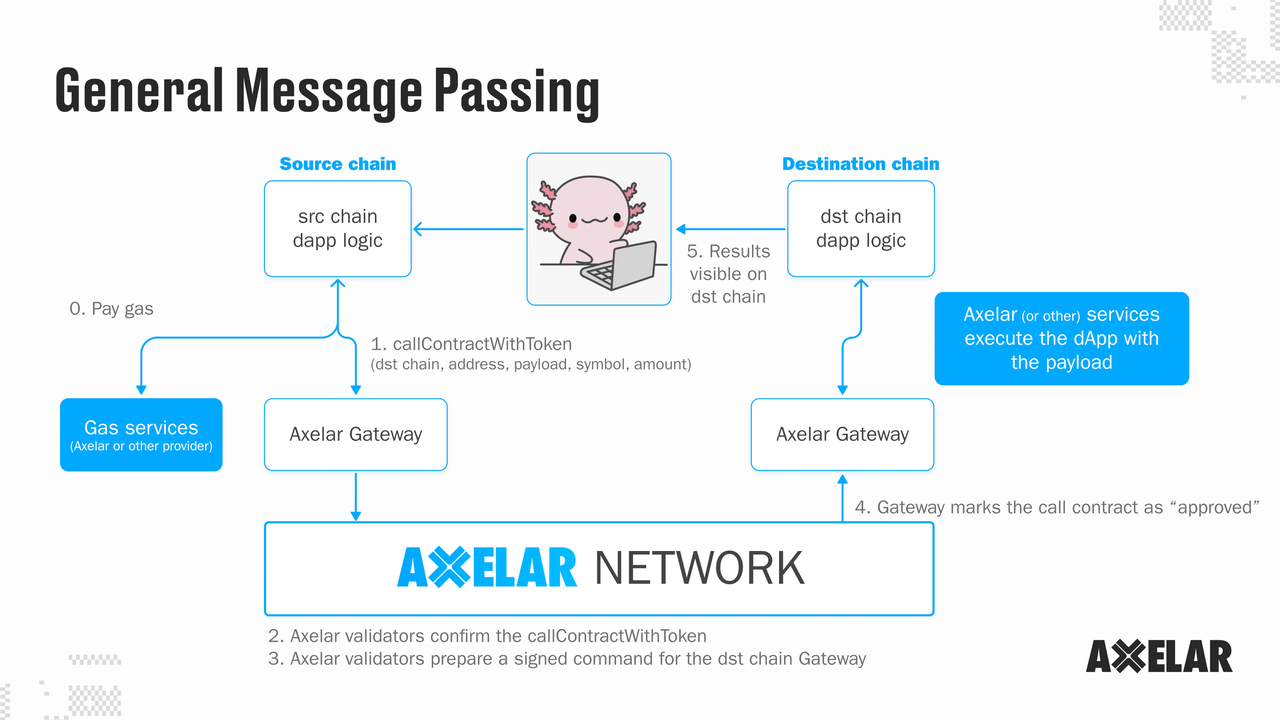
Developers can use GMP to send function call requests between chains, allowing smart contracts on the destination chain to automatically execute the corresponding logic. This means blockchains are no longer connected only by asset flows. They can support real application interaction across chains.
From an architectural perspective, GMP is more like a cross-chain API system, allowing different blockchains to communicate with one another much like internet services.
How Is GMP Different From a Traditional Cross-Chain Bridge?
The biggest difference between GMP and a traditional cross-chain bridge is that GMP does not focus only on asset transfers. Instead, it focuses on cross-chain logic execution.
Traditional cross-chain bridges usually follow a “lock assets, verify event, mint assets on the destination chain” process. Their main goal is to move token liquidity. But in more complex application scenarios, developers often also need to call functions across chains, synchronize states, and automatically execute transaction logic.
GMP allows developers to send cross-chain messages directly. For example, a DeFi application can trigger lending logic on the source chain and automatically complete a swap or liquidation operation on the destination chain.
For this reason, GMP is viewed as an important underlying capability for chain abstraction and cross-chain applications.
How Is a GMP Message Initiated?
A GMP communication process usually begins with a user or application action on the source chain.
Developers call the Axelar Gateway contract on the source chain and submit a cross-chain message. This message usually includes information about the destination chain, the destination contract address, the function to be executed, and the relevant parameters.
After the transaction is confirmed, the Gateway records the corresponding event and broadcasts it to the Axelar validator network.
From the user’s perspective, this process looks similar to a normal on-chain transaction, but underneath, it has already entered the cross-chain communication flow.
How Do Axelar Validators Confirm Cross-Chain Messages?
Axelar uses an independent PoS validator network to maintain cross-chain security.
After the source-chain Gateway emits an event, Axelar validators listen for state changes on the relevant chain and verify whether the message actually occurred. Once multiple validators confirm it, the network generates the corresponding signature through a consensus mechanism.
This process is similar to transaction confirmation in a blockchain network, but the object being confirmed is not an ordinary transfer. It is a cross-chain message event.
Because validators need to stake AXL tokens, malicious behavior can lead to slashing. This mechanism helps improve the security of cross-chain communication.
How Is a GMP Message Executed on the Destination Chain?
After the validator network completes consensus, Axelar sends the verified cross-chain execution request to the Gateway on the destination chain.
Once the destination-chain Gateway receives the message, it calls the target smart contract and executes the corresponding function. For example, a cross-chain DeFi application can automatically complete a swap, lending action, or liquidity operation.
This process is usually completed automatically by smart contracts on the destination chain, so users do not need to perform additional manual steps.
From an architectural perspective, GMP effectively enables “Chain A to call a smart contract on Chain B,” which is difficult for traditional bridging solutions to achieve.
How Are GMP Gas and Fees Generated?
GMP execution involves multiple chains, so its fee structure is relatively complex.
Users usually need to pay source-chain gas, cross-chain validation fees, and destination-chain execution fees. Axelar provides a Gas Service to manage destination-chain execution costs in a unified way.
Developers can prepay gas for the destination chain in advance, so users do not need to hold gas tokens separately on multiple blockchains.
This mechanism is especially important for the chain abstraction experience because it reduces operational complexity during multichain interactions.
What Challenges Does GMP Face?
Although GMP provides stronger cross-chain capabilities, cross-chain communication itself remains complex.
First, confirmation times vary between different blockchains, so cross-chain execution is usually slower than single-chain transactions. Second, security models are more complicated in multichain environments, and cross-chain protocols have always been a major focus for attackers.
In addition, as the number of supported chains grows, validation and maintenance costs will also continue to increase. Finding the right balance among security, efficiency, and decentralization remains a challenge for all cross-chain protocols.
Conclusion
Axelar’s General Message Passing (GMP) is a cross-chain messaging mechanism used to enable smart contract calls and state synchronization between different blockchains.
Unlike traditional cross-chain bridges, which mainly focus on asset transfers, GMP places greater emphasis on “cross-chain logic execution,” allowing developers to build composable cross-chain applications across multiple blockchains.
A typical GMP message goes through several steps, including initiation on the source chain, validator confirmation, Axelar consensus, and execution on the destination chain, with cross-chain security maintained by a decentralized validator network.
FAQs
How Is GMP Different From a Regular Cross-Chain Bridge?
Regular cross-chain bridges are mainly used for asset transfers, while GMP focuses more on cross-chain messages and function execution.
Does GMP Support Cross-Chain Smart Contract Calls?
Yes. Developers can use GMP to call smart contract functions directly between different blockchains.
How Does Axelar Verify Cross-Chain Messages?
Axelar uses a PoS validator network to listen for source-chain events and confirm message authenticity through a consensus mechanism.
Is GMP Only for EVM Chains?
No. Axelar supports multiple ecosystems, including EVM chains and some Cosmos ecosystem chains.
Why Is GMP Related to Chain Abstraction?
GMP can hide the complexity of cross-chain interactions, allowing users to interact without needing to know which specific blockchain they are using. This is why it is considered important infrastructure for chain abstraction.
Who Pays the Fees for GMP?
The fees are usually paid by the user or application, including source-chain gas, cross-chain validation fees, and destination-chain execution fees.
Does GMP Have Security Risks?
As with all cross-chain protocols, GMP must deal with security challenges in multichain environments, so validation mechanisms and network security design are very important.
Related Articles

The Future of Cross-Chain Bridges: Full-Chain Interoperability Becomes Inevitable, Liquidity Bridges Will Decline

Solana Need L2s And Appchains?

Sui: How are users leveraging its speed, security, & scalability?

Navigating the Zero Knowledge Landscape

What is Tronscan and How Can You Use it in 2025?
