How Does Allora Network Work? A Complete Walkthrough of Its Decentralized AI Inference Process
Allora Network is often used in on-chain AI inference and prediction scenarios, but its internal process is not handled by a single server like a traditional AI API. Instead, Allora uses decentralized node collaboration, model competition, and on-chain verification to keep AI inference improving in an open and transparent environment.
Within the decentralized AI sector, Allora Network is viewed as infrastructure for the “Prediction Layer.” Compared with platforms that mainly provide AI computing power or model training, Allora places greater emphasis on the reliability of prediction results, information efficiency, and collaboration among models. This makes it especially relevant to DeFi risk management, AI Agents, and automated financial systems.
How Does the Topic Market Organize AI Tasks?
A Topic is the core structure used to organize AI inference tasks in Allora Network. Each Topic represents a specific prediction question, such as asset volatility forecasting, market trend assessment, or on-chain risk scoring.
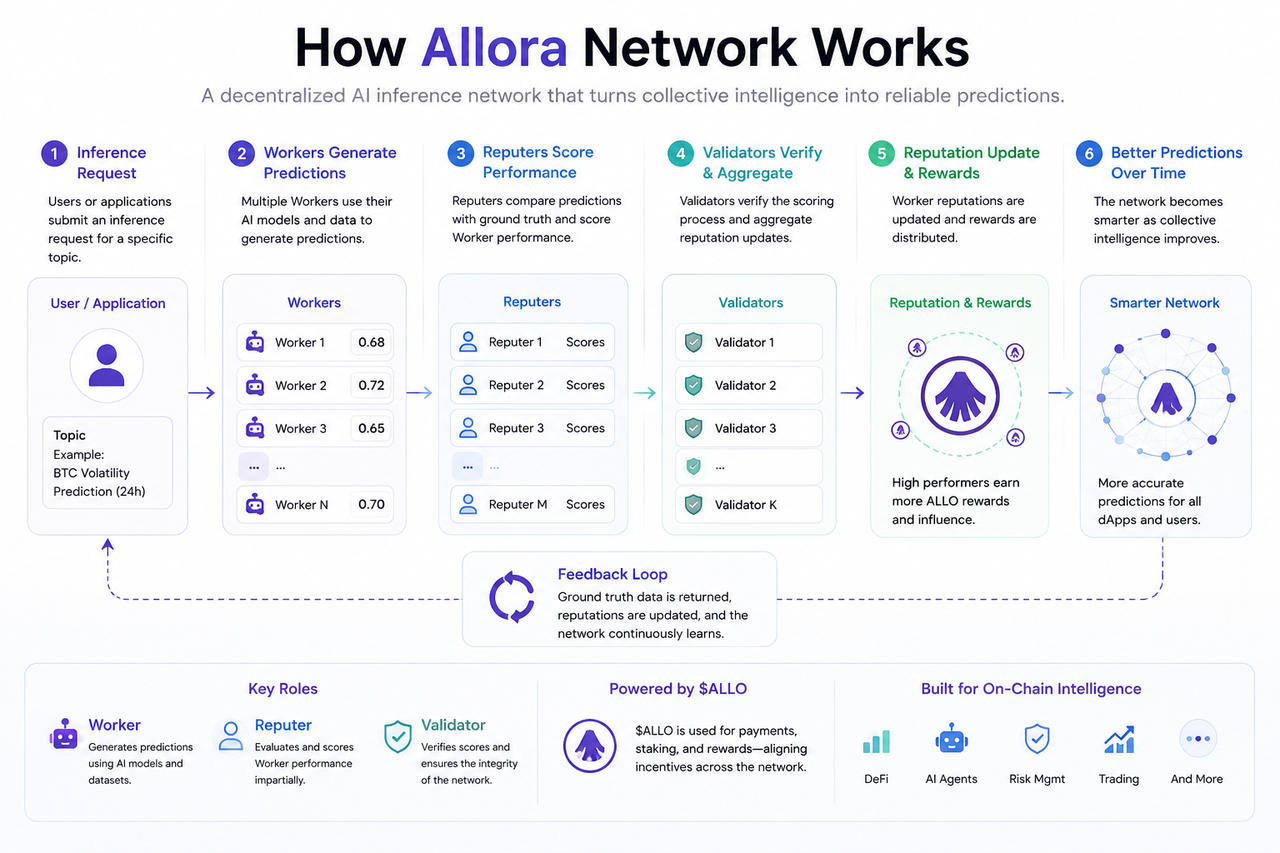
Different Workers submit prediction results around the same Topic. Because each Topic has its own reward pool and scoring system, the network can support multiple AI use cases at the same time.
The Topic mechanism gives the network a modular structure. New prediction tasks can be added continuously without changing the protocol’s underlying logic.
How Do Workers Generate Prediction Results?
Workers are the node role responsible for producing AI inference results. A Worker may use machine learning models, quantitative strategies, or statistical analysis tools to generate prediction data.
After the network issues an inference request, Workers produce outputs based on their own models and submit the results on-chain. Since different Workers may use entirely different data sources and algorithms, their predictions often vary.
This multi-model competition mechanism helps reduce the risk of failure from any single model. The network does not assume that one model is always correct. Instead, it dynamically adjusts model weight based on long-term performance.
How Do Reputers Evaluate Model Performance?
Reputers are responsible for evaluating the quality of Workers’ predictions. They compare historical predictions with actual outcomes and generate reputation scores for different Workers.
The reputation system is a key part of Allora. Workers with higher accuracy receive stronger reputations and gain greater influence in future inference tasks.
Reputers themselves are also subject to network oversight. If a Reputer consistently provides distorted scoring results, its own reputation will also decline.
This two-layer evaluation mechanism avoids reliance on a single point of trust and improves the stability of predictions across the network.
What Role Do Validators Play in the Network?
Validators verify Reputer scoring and the reward distribution process. Their role is similar to consensus nodes in a blockchain, helping preserve fairness across the prediction market.
After Workers submit prediction results, Validators confirm whether the scoring process follows protocol rules and then finalize reward settlement.
The presence of Validators helps reduce the risk of malicious manipulation. For example, when certain nodes attempt to increase their own rewards through false scoring, Validators can prevent abnormal data from entering the final settlement stage.
How Does a Complete AI Inference Process Work?
A complete inference process usually includes six steps:
-
A user or application sends an inference request to the network
-
The request enters a specific Topic market
-
Workers submit prediction results
-
Reputers score prediction accuracy
-
Validators verify the scoring and reward logic
-
The network distributes rewards using ALLO and updates reputation weights
This process creates a continuous feedback loop. As more historical data accumulates, the network can gradually improve prediction quality.
Why Does Allora Continuously Improve Prediction Results?
Allora’s core logic is built on a “Collective Intelligence” mechanism. Multiple models participate in prediction together, while the network dynamically adjusts their influence based on long-term performance.
This mechanism is similar to price discovery in financial markets. High-quality models earn more rewards because they remain accurate over time, while lower-quality models gradually lose influence.
Because all nodes need accurate predictions to earn revenue, the network naturally forms a competitive environment that keeps improving.
How Is Allora’s Prediction Mechanism Different from Traditional AI APIs?
Traditional AI APIs usually provide model outputs through centralized companies, and users cannot verify training data, scoring logic, or model bias.
Allora uses on-chain verification and an open incentive mechanism to make the inference process transparent and composable. Any application can review model performance history and freely call prediction results from different Topics.
This structure is better suited to blockchain ecosystems because smart contracts need data sources that are trusted, public, and verifiable.
What Are the Limitations of Allora’s Prediction Mechanism?
Decentralized AI networks still face challenges related to data quality, inference latency, and incentive-driven strategic behavior. If the input data itself is biased, even collaboration among multiple models cannot fully prevent incorrect results.
Complex incentive mechanisms may also lead some nodes to try to manipulate the scoring system. As a result, the network needs to keep improving its reputation algorithms and verification rules.
In addition, compared with traditional centralized AI services, on-chain verification usually adds time and cost overhead.
Conclusion
Allora Network builds a decentralized AI inference network through the coordinated roles of Workers, Reputers, and Validators. Compared with traditional AI services, Allora places greater emphasis on the transparency, verifiability, and continuous improvement of prediction results.
This mechanism allows AI inference to become an infrastructure component within blockchain systems, providing composable intelligent services for DeFi, AI Agents, and automated financial systems. As demand for on-chain AI grows, prediction layer networks may become an important part of the Web3 intelligent economy.
FAQs
What Is a Worker in Allora Network?
A Worker is a node responsible for generating AI prediction results. It can use machine learning models, statistical analysis, or quantitative strategies to output inference data.
What Does a Reputer Do in Allora?
A Reputer evaluates the prediction accuracy of Workers and generates reputation scores based on long-term performance.
What Does a Topic Represent in Allora Network?
A Topic is a market structure used to organize AI inference tasks, with each Topic corresponding to a specific prediction question.
Why Does Allora Need Validators?
Validators verify the scoring and reward distribution process, helping ensure network fairness and data credibility.
What Is the Biggest Difference Between Allora and Traditional AI APIs?
Allora’s prediction process and model scoring can be verified on-chain, while traditional AI APIs are usually centralized services.
Why Do Allora’s Prediction Results Keep Improving?
The network dynamically adjusts model weights based on historical accuracy, allowing higher-quality models to receive more rewards and influence.
Related Articles

Blockchain Profitability & Issuance - Does It Matter?

Arweave: Capturing Market Opportunity with AO Computer
What Is Substrate? How Polkadot Uses It to Build a Parachain Ecosystem

What Are Polkadot Parachains? How They Enable Cross-Chain Scalability

How Cysic Works? A Detailed Look at Proof-of-Compute and ZK Compute Scheduling