Gold and Commodities in TradFi: How Traditional Markets Trade Physical Assets
Gold and commodities play a distinct role in TradFi because they anchor financial markets to the physical economy. Gold has historically functioned as both a commodity and a store of value, while other commodities reflect supply and demand dynamics across energy, manufacturing, and food systems. This real-world linkage explains why commodities are widely used for price discovery, risk management, and macroeconomic signaling.
At a market level, global gold and commodity markets are vast, spanning physical trading as well as futures, options, and exchange-traded products. Prices are shaped not only by supply and demand, but also by interest rates, currency movements, geopolitical events, and broader macroeconomic conditions.
This article explains how gold and commodity markets operate in TradFi, including physical versus financial commodity trading, pricing mechanisms, market structure, key risks, and how access to commodity markets is evolving.
Why Gold and Commodities Are Core TradFi Asset Classes
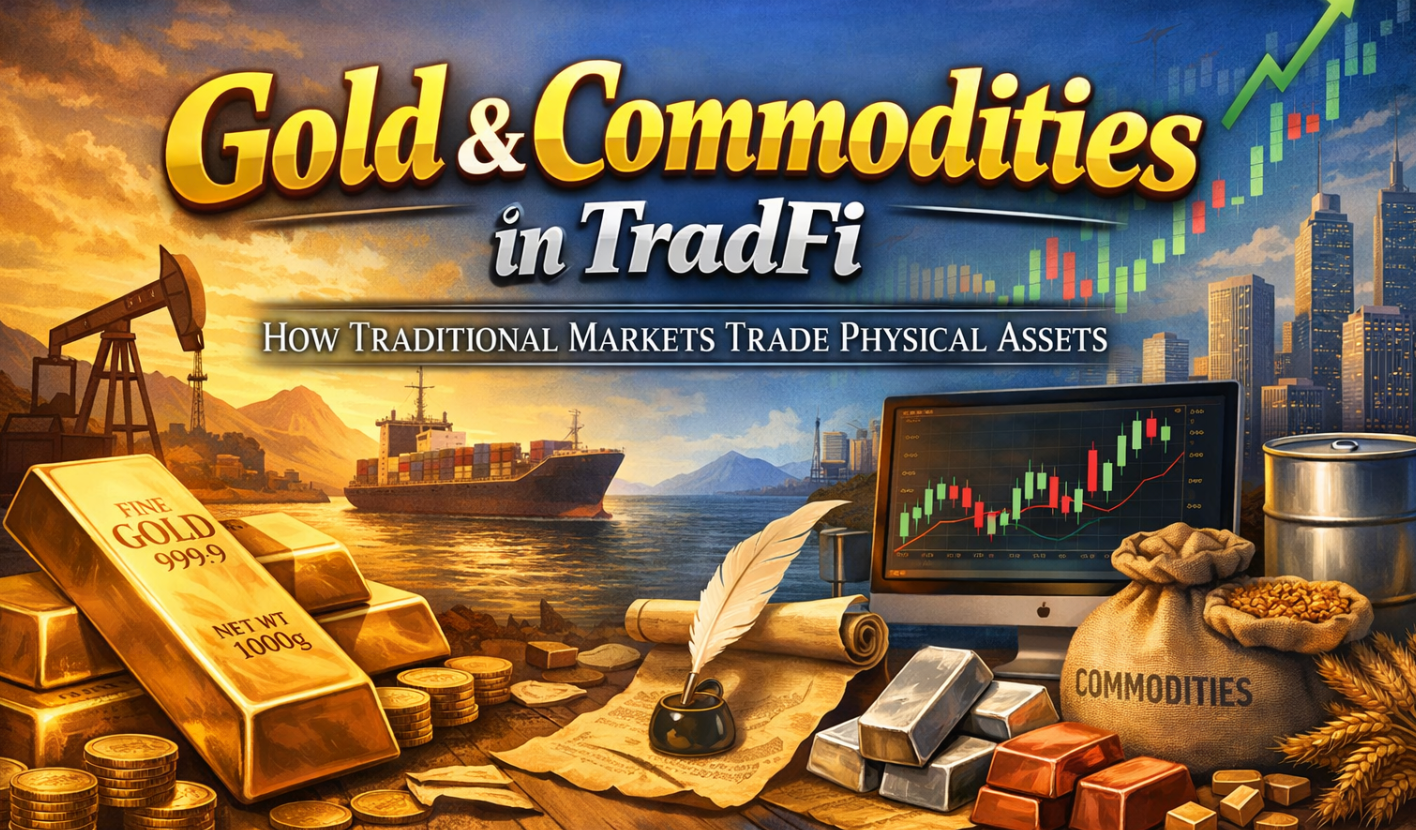
In the TradFi system, the importance of gold and commodities is not driven by speculation, but by their real-world anchoring. Unlike financial assets such as stocks and bonds, commodities are tied to tangible resources like energy, metals, and agricultural products. These assets are directly embedded in global economic activity and provide a foundational layer of support for investment portfolios. This real-world linkage explains why gold and commodities are consistently classified as core asset classes in TradFi investment frameworks.
Gold holds a particularly unique position. It is both a commodity and a historical monetary asset, long functioning as a store of value and a safe haven outside sovereign credit systems. During periods of macroeconomic uncertainty or monetary stress, capital often flows back into gold and key commodities, reinforcing their importance in core TradFi asset allocation.
Understanding these unique characteristics helps investors make more informed decisions around portfolio construction, risk management, and diversification.
Physical Commodities vs Financial Commodities
From a trading perspective, commodity markets can be divided into two main segments: physical commodity markets and financial commodity markets.
- Physical commodity markets focus on delivery, storage, transportation, and quality standards. Key participants include mining companies, energy producers, trading houses, and large industrial consumers. The primary objective is ensuring supply chain stability and the physical movement of goods.
- Financial commodity markets use instruments such as futures, options, ETFs, and swaps to convert commodity price movements into tradable financial exposure. These markets allow investors to hedge price risk or speculate on price changes without handling physical delivery.
Although closely connected, these two markets differ significantly in access barriers, efficiency, and capital characteristics. These differences also create structural inefficiencies and bottlenecks. Understanding them helps investors make better allocation and risk management decisions. These structural differences explain why most investors participate in commodity markets through financial instruments rather than physical ownership.
How Gold Markets Operate in Traditional Finance
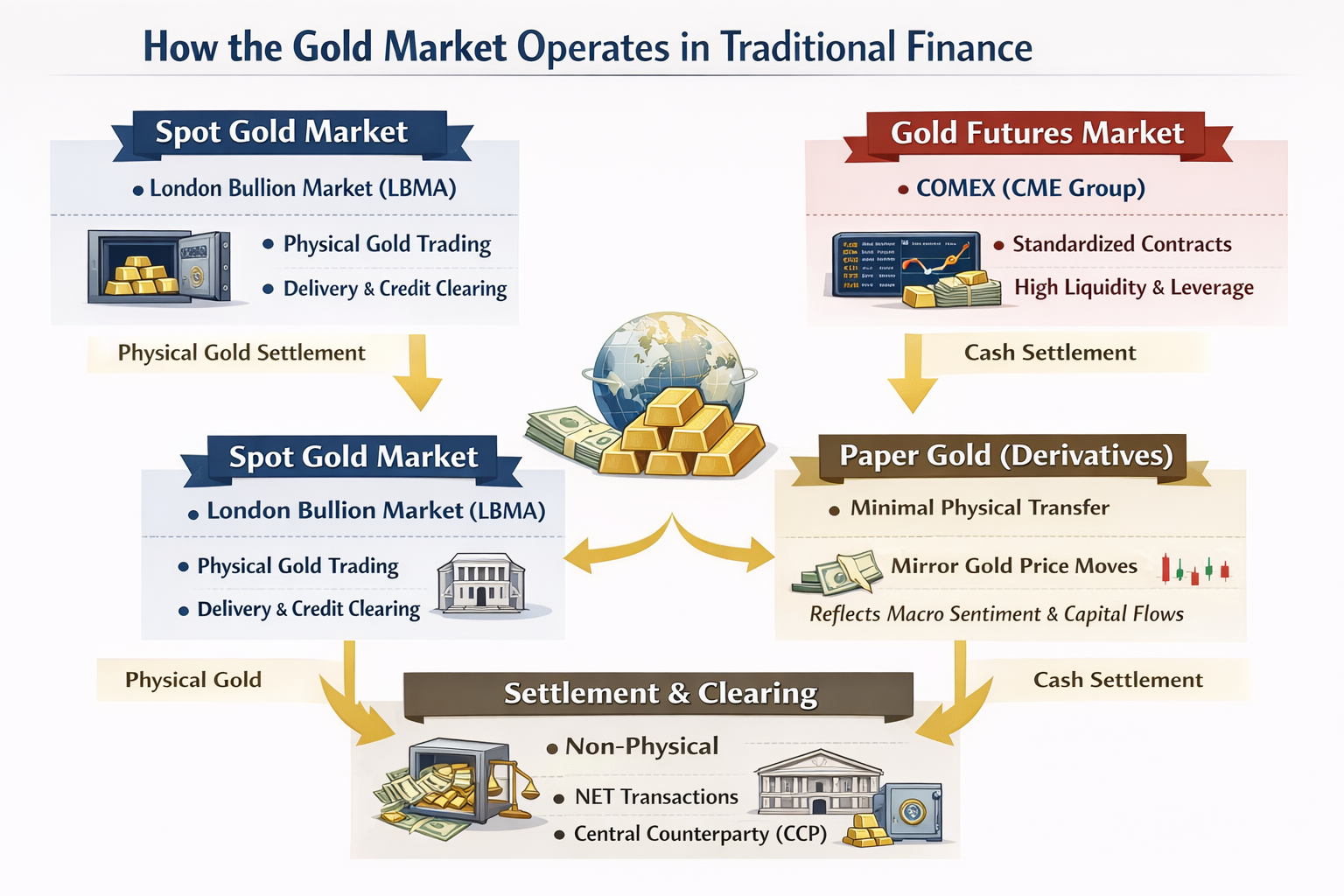
Within the TradFi commodity system, the gold market is one of the most mature and institutionalized. The spot gold market is represented by the London Bullion Market, which emphasizes physical reserves and clearing credibility. Meanwhile, gold futures trading is centered on COMEX, where standardized contracts improve liquidity and support price discovery.
Notably, the vast majority of gold trades do not involve physical delivery. Instead, transactions occur within a paper gold system. While this credit-based derivative structure significantly improves liquidity, it also means that gold prices increasingly reflect macroeconomic sentiment and capital expectations rather than physical circulation alone.
This structure is central to understanding how gold prices are formed in traditional financial markets. Understanding how the gold market functions is essential for managing liquidity, assessing price volatility, and building effective hedging and asset allocation strategies.
Commodity Pricing: Supply, Demand, and Macro Factors
In theory, commodity prices in TradFi markets are driven by supply and demand. In practice, however, macroeconomic factors often play a larger role. Key drivers include interest rates, US dollar strength, geopolitical events, inventory cycles, and policy interventions, all of which can amplify price movements.
The existence of futures markets means commodity prices reflect not only current supply and demand, but also market expectations for future conditions. While this improves price discovery, it also increases the influence of financial capital, sometimes weakening the pricing power of industrial participants such as producers and traders.
Understanding both supply-side drivers and macroeconomic influences is critical for managing price risk and forming effective commodity allocation strategies.
Structural Limitations of Traditional Commodity Markets
Despite their scale, TradFi commodity markets remain highly centralized. Clearing is dominated by major exchanges and clearing institutions, resulting in high participation barriers and limited cross-market arbitrage efficiency. Fragmentation across regions and commodity categories also leads to information gaps and delayed price transmission, reducing overall market efficiency.
For retail investors, direct participation in underlying commodity markets is extremely difficult. Most exposure comes through heavily structured financial products such as futures, options, or ETFs. This limits accessibility, transparency, and liquidity, while creating opportunities for innovation through crypto platforms and tokenized markets.
Commodities as Inflation Hedges and Safe-Haven Assets
Historically, commodities have been used in TradFi portfolios as both inflation hedges and defensive risk-management tools. During periods of high inflation or loose monetary policy, commodities are often viewed as natural inflation hedges. Energy, metals, and agricultural prices tend to rise alongside declining currency purchasing power, offering portfolio protection.
Gold, in particular, serves as a hedge against systemic risk. When confidence in financial system stability weakens, gold’s non-credit nature positions it as a capital safe haven. This is why commodities consistently occupy a distinct role in asset allocation, supporting diversification, long-term value preservation, and capital protection.
How Crypto Platforms Expand Access to Commodity Markets
As crypto infrastructure matures, more platforms are bringing commodities into on-chain and centralized crypto trading systems. Through synthetic assets, commodity indices, and commodity-linked contracts, these platforms lower entry barriers while enabling 24/7 trading and higher capital efficiency.
Using Gate TradFi contracts as an example, traders can access foreign exchange, indices, and commodities within a single trading interface. There is no need to manage physical delivery or move funds across platforms. All trades focus on price movements and settle through margin mechanisms and a USDT-based system.
This model allows crypto-native traders to extend their strategies and crypto derivatives into traditional financial markets seamlessly, switching between market rhythms and capturing cross-market opportunities more efficiently.
Final Thoughts
Gold and commodities are considered TradFi core assets as they directly connect financial systems with the real economy, offering value storage, inflation protection, and risk hedging. As financialization increases, traditional commodity markets have exposed structural limitations such as low efficiency, high access barriers, and limited transparency. As a result, most investors gain exposure only through derivatives rather than direct participation.
Against this backdrop, crypto platforms introduce new market structures and participation models. Through on-chain trading, synthetic assets, commodity-linked contracts, 24/7 trading, and margin settlement, investors can access commodity markets with greater flexibility and lower friction while deploying cross-market strategies more effectively. As commodity markets evolve, the intersection of TradFi infrastructure and crypto technology is becoming increasingly relevant for long-term investors.
Looking ahead, commodities will remain central to TradFi asset allocation, but how they are traded and accessed is evolving. For investors seeking both stability and diversification, understanding where traditional markets intersect with crypto infrastructure will be key to building efficient, resilient portfolios.
Further Reading
Related Articles

AI-Native Settlement Layers: How United Stables Is Building the Next Financial Rail

The ve(3,3) Flywheel Explained: How AERO Tokenomics Powers Aerodrome’s DeFi Economy

How Does PAXG Work? In-Depth Overview of the Physical Gold Tokenization Mechanism

Aerodrome Tokenomics: How ve(3,3) Powers Base's Most Profitable DEX

How is the price of PAXG determined? Pegging mechanism, trading depth, and influencing factors
