Gate Skills Hub Fully Upgraded: Building the Most Comprehensive AI Trading Strategy Marketplace
Skills Hub Fully Upgraded: Ushering in the Next Era of AI Trading
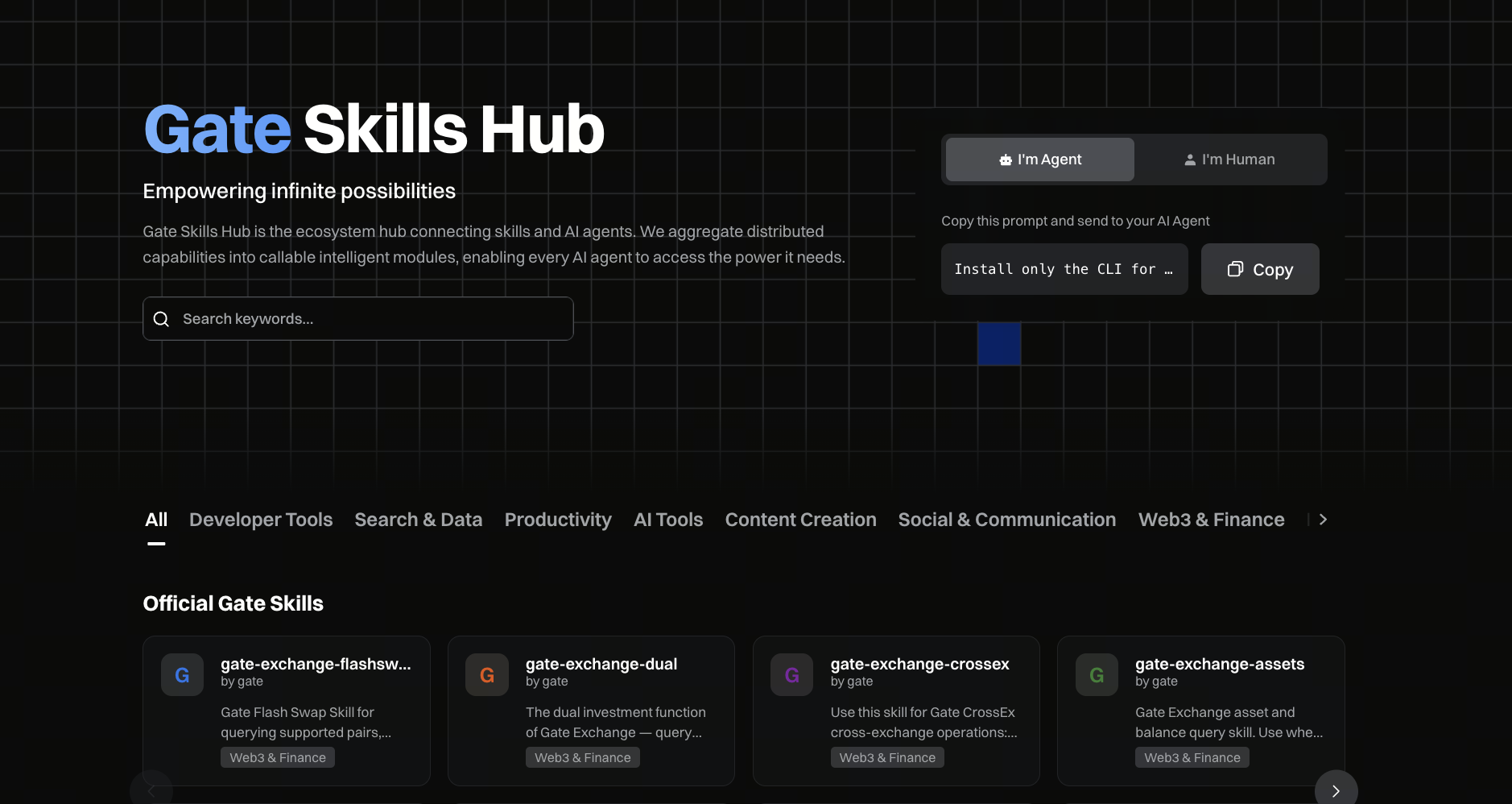 Image source: Gate Skills Hub Page
As a core pillar of the Gate for AI product suite, Skills Hub has undergone a complete overhaul, rapidly emerging as the industry’s most powerful AI trading strategy marketplace. This upgrade not only dramatically expands the breadth of available skills but also refines the user journey and strategy discovery experience, delivering enhanced support to traders.
By aggregating over 10,000 AI skills, Gate has catapulted its skill count from just 11 to an entirely new scale, comprehensively covering critical trading scenarios including market analysis, trade execution, arbitrage strategies, and risk management. This transformation means Gate now offers traders a broader array of choices and unlocks new possibilities for AI in trading, advancing the field toward more systematic and automated solutions.
From Fragmented Tools to a Structured Strategy Marketplace
A standout change in this upgrade is the exponential expansion in skill volume. Gate has not only increased the number of skills but also implemented rigorous quality screening. By leveraging open ecosystem resources like GitHub, Gate deduplicates and curates skills to ensure peak efficiency and practical value. Each skill includes essential metadata—such as author, popularity, and last updated date—empowering users to quickly assess value and relevance.
While many industry platforms offer only hundreds or thousands of skills, Gate has pioneered the leap from a “tool collection” to a genuine “strategy marketplace.” Users no longer need to hunt for scattered tools; instead, Gate’s platform provides a complete, optimized AI trading strategy marketplace where every skill is curated to meet user needs.
Smarter Categorization and Search: Pinpoint the Right Strategy
With the surge in available skills, Gate has delivered major enhancements to skill categorization and search functionality. The platform now features an eight-category system grounded in industry best practices, spanning the entire lifecycle from market analysis to trade execution. Whether users seek arbitrage strategies, risk controls, or market forecasting, they can easily locate relevant strategies within this framework.
Additionally, the platform now offers tag-based filtering, an intelligent classification engine, and multidimensional search capabilities to help users precisely target the strategies they require. By combining tags (such as #ETH, #Arbitrage, #LowRisk), users can rapidly pinpoint strategies that match their needs, then further refine results using advanced filters (name, description, tags, author, etc.). Together with real-time recommendations and dynamic sorting, Gate has streamlined the process of finding the right strategy, significantly reducing information overload.
Dual-Mode Design: Lowering Barriers, Boosting Efficiency
To serve diverse user profiles, Gate Skills Hub introduces a dual-path model: general users can generate and execute strategies with just a few clicks, while developers can deploy locally and build further using standard installation methods (like pip or npm). This approach lowers entry barriers, enabling even those without programming backgrounds to leverage AI skills, while also preserving the flexibility and depth required by advanced users.
For general users, the workflow is straightforward: select a strategy, generate the command, and copy it into the AI assistant. The AI handles loading and execution automatically—no installation, setup, or technical knowledge required. Developers, meanwhile, gain full control to customize and extend their own AI strategies and skills.
AI Trading Enters a Systematic Era
Unlike other industry offerings focused on isolated features, Gate Skills Hub emphasizes synergy and integration across skills. The platform enables users to link functions such as market analysis, strategy evaluation, trade execution, and risk management, supporting the creation of a comprehensive trading loop.
This advancement signals a shift from isolated AI applications to a truly systematic approach. AI is no longer just a supporting tool—it has evolved into a fully integrated trading participant with end-to-end execution capabilities. From market monitoring and decision-making to trade execution, AI now plays an active role throughout, driving greater efficiency and precision in trading.
Looking Ahead: Accelerating Intelligent Trading Infrastructure
With the full upgrade of Skills Hub, Gate is accelerating the deep integration of AI and trading. The platform will continue to expand its skill library, diversify trading strategy offerings, and strengthen the synergy between advanced features and core infrastructure to build a scalable, systematic intelligent trading foundation.
Gate’s ambition extends beyond offering powerful trading tools; it aims to create a system that enables the sustained and scalable application of AI in trading. As more skills are added and platform features are refined, Gate will make AI trading a central capability in everyday operations, propelling the entire industry toward greater intelligence and automation.
Conclusion
The comprehensive upgrade of Gate Skills Hub delivers an unprecedented intelligent experience to digital asset traders. From the expansion of available skills to more precise strategy search and the introduction of a dual-path model, Gate is building the industry’s most complete AI trading strategy marketplace through relentless innovation. Looking forward, as the platform’s capabilities continue to evolve, Gate will keep driving the progress of intelligent trading—making AI applications in trading more accessible, efficient, and central to the user experience.
Related Articles

AI-Native Settlement Layers: How United Stables Is Building the Next Financial Rail

The ve(3,3) Flywheel Explained: How AERO Tokenomics Powers Aerodrome’s DeFi Economy

How Does PAXG Work? In-Depth Overview of the Physical Gold Tokenization Mechanism

Aerodrome Tokenomics: How ve(3,3) Powers Base's Most Profitable DEX

How is the price of PAXG determined? Pegging mechanism, trading depth, and influencing factors
