Gate Research: Crypto Market Sees a Brief Relief Rebound | Polygon Leads x402 Agentic Payment Transactions
Crypto Market Overview
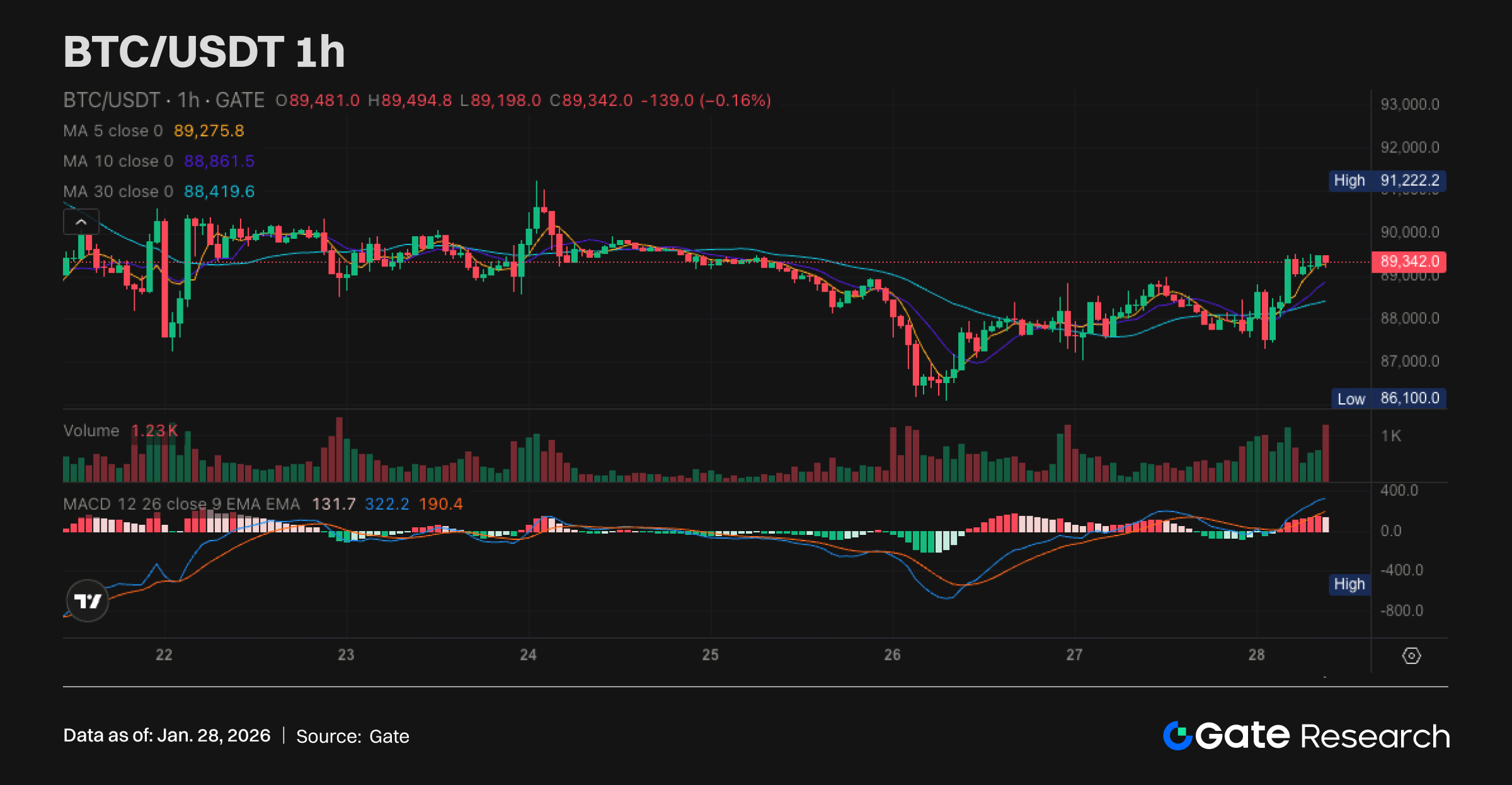
BTC (+0.85% | $89,342 USDT)
BTC posted a choppy relief repair over the past day, repeatedly oscillating within the $88,800–$89,800 range. The rebound after the sharp drop on the 26th is still intact, but overhead supply remains. The moving-average setup has flipped bullish, with MA5/MA10/MA30 forming a rising alignment and spot trading above all three, suggesting short-term strength while still in a repair phase. MACD is above the zero line and maintains a golden cross, with expanding red bars indicating improving bullish momentum. Overall, if BTC can hold above $89,000 and break $90,000 on stronger volume, it may retest the prior high area near $91,200; if it fails and slips below the $88,800–$88,400 support band, watch for rebound exhaustion and a pullback toward $87,000.
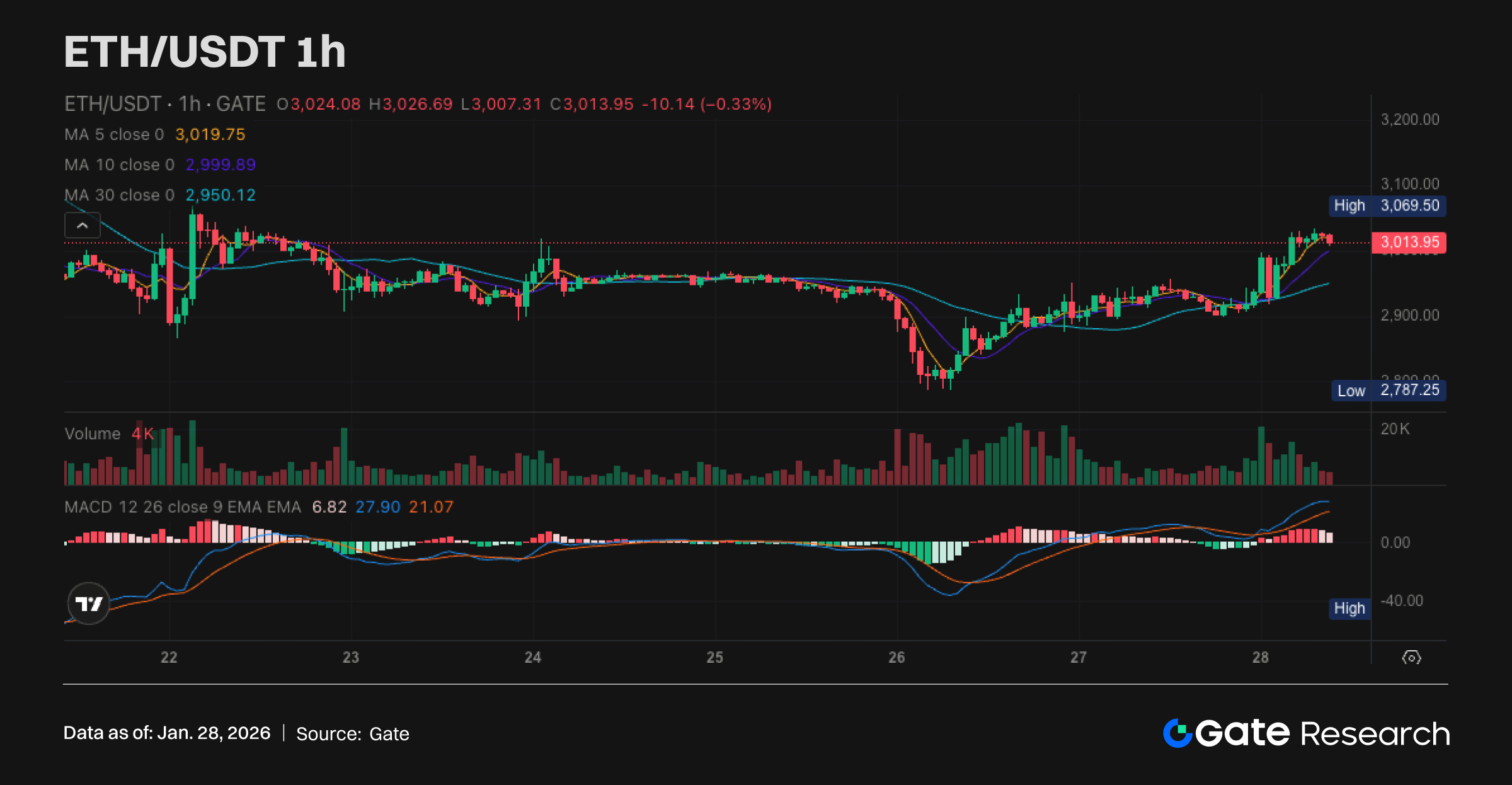
ETH (+2.75% | $3,013 USDT)
ETH pushed up and then pulled back into high-level consolidation, chopping around the $3,000 handle and remaining more sensitive than BTC in the short term. The MA structure is strengthening: MA5 has crossed above MA10 and both are turning higher, while MA30 is also lifting—signaling a shift from repair toward a more constructive bias, though the upside is still capped by prior resistance. MACD stays above the zero line with a golden cross; red bars remain positive but are expanding at a slower pace, implying bulls still lead but chase momentum is cooling. Overall, if ETH holds $3,000 and reclaims $3,050–$3,070, it could open room for further upside; if it breaks below the $2,990–$2,950 support zone, focus on demand near $2,900.
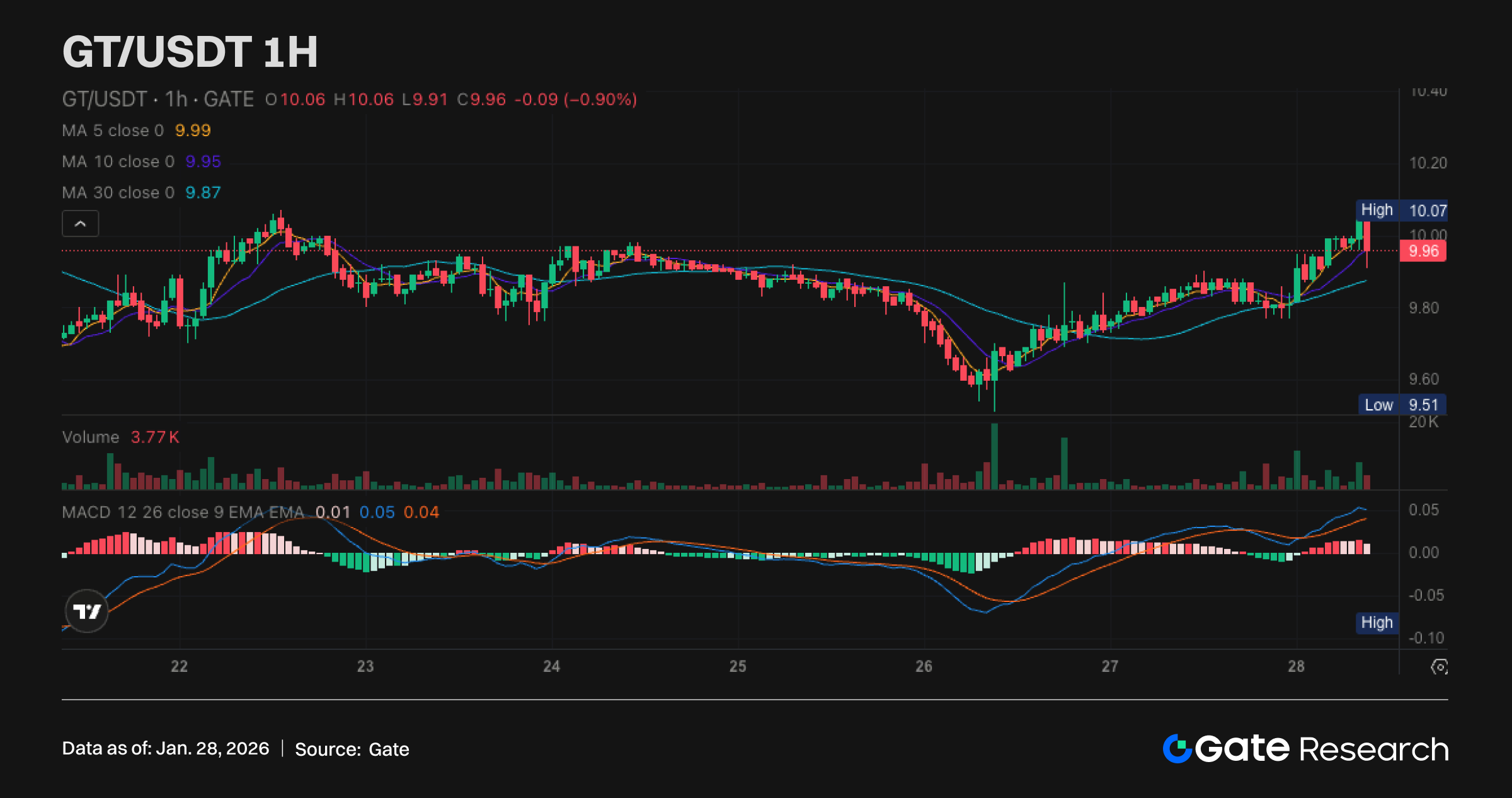
GT (+1.01% | $9.96 USDT)
GT showed relative resilience over the past day, rebounding from around $9.60 and briefly touching a high near $10.07 before pulling back slightly. It has since moved into short-term high-level consolidation, with overall volatility still lower than major coins. The moving-average structure has shifted from weak to improving: MA5 and MA10 have turned upward and are closely tracking higher, with price holding above them, while MA30 sits below and is starting to flatten—suggesting mid-term overhead pressure is easing and the structure is in a repair phase. MACD is oscillating near the zero line while maintaining a golden cross; the red histogram bars are gradually rising, indicating bullish momentum remains favorable, though there is a risk of momentum flattening at elevated levels. Overall, if GT can stabilize and hold $10.00–$10.07, it may extend the recovery and probe higher resistance; if it breaks back below $9.90, attention shifts to support around $9.70–$9.60.
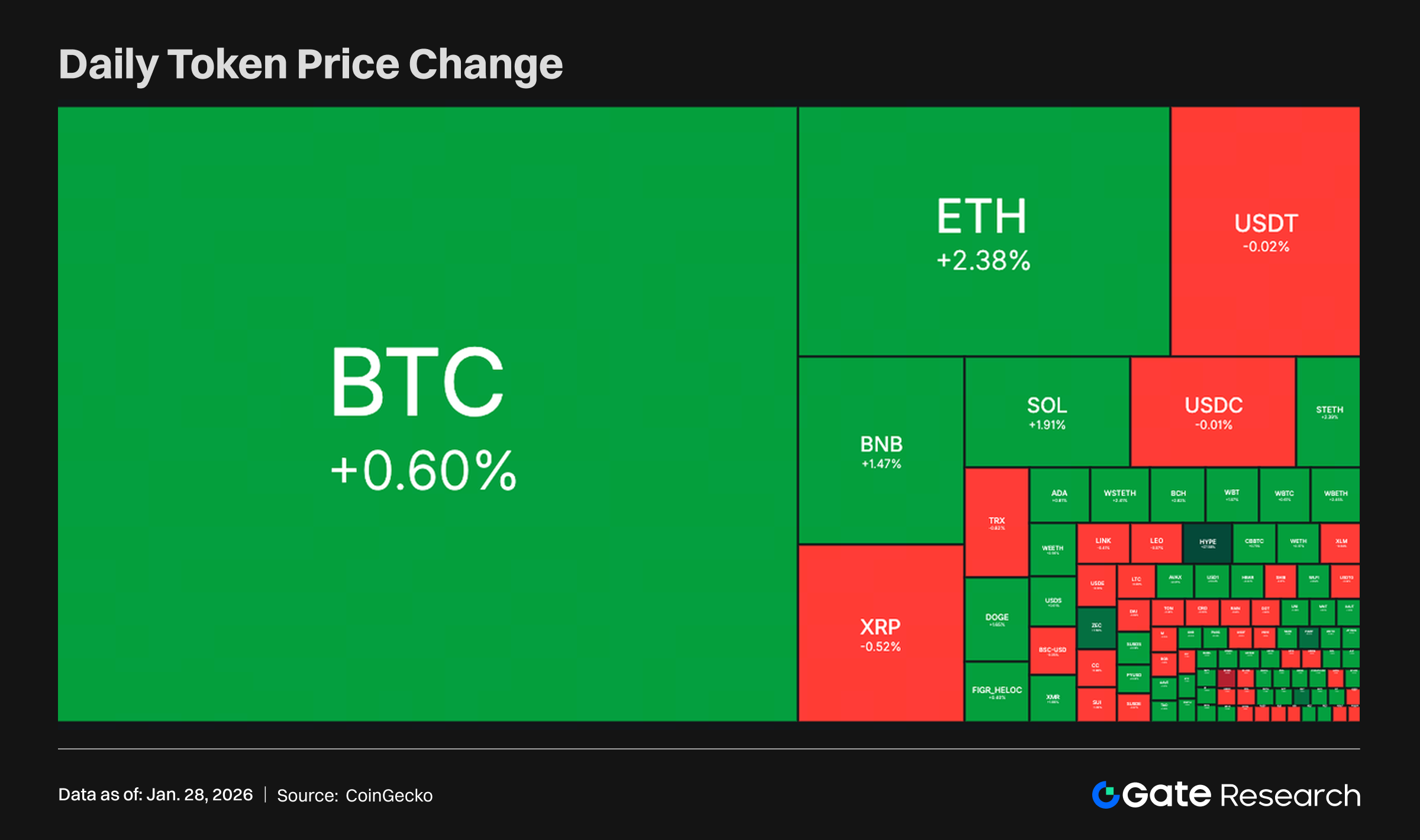
Tokens Heatmap
Over the past 24 hours, the broader crypto market staged a relief rebound with broad-based gains, as capital rotated back into core assets and large-cap majors. SOL and other higher-beta names strengthened in tandem, while stablecoins were largely flat—reflecting short-term switching between risk assets and cash equivalents.
On sentiment, the Fear & Greed Index stands at 29 (“Fear”). While it has recovered from last week’s and last month’s “Extreme Fear” levels, signaling a marginal improvement in risk appetite, it remains well below this year’s high of 61, suggesting the market has not shifted into a full risk-on regime. Overall, the move still looks like a technical bounce and position rebalancing after fear-driven selling; in the near term, price action may continue to alternate between rebound attempts and choppy consolidation, with the pace and persistence of incremental inflows still worth monitoring.
PIPPIN Pippin (+63.83%, circulating market cap ~$494M)
According to Gate market data, PIPPIN is trading around $0.49885, up roughly 63.83% in the past 24 hours. Pippin is an SVG unicorn character generated using the latest ChatGPT-4o LLM benchmark, created by Yohei Nakajima. He is known for a build-in-public style and “AI for VC” experiments, and previously open-sourced BabyAGI in March 2023—an autonomous agent paradigm centered on task-planning loops that drew broad attention.
This rally appears more driven by flow and technicals than by fundamental news: on the daily structure, price is clearly above MA5/MA10/MA30. After an earlier spike and a period of sideways consolidation, price is now pushing back toward the upper end of the range; rising volume can easily amplify momentum via breakout chasers and short-covering.
BNKR BankrCoin (+60.34%, circulating market cap ~$37M)
According to Gate market data, BNKR is trading around $0.0003765, up 60.34% over the past 24 hours. BankrCoin is a token narrative derived from the BankrBot ecosystem, positioning itself as a callable toolchain that combines “AI agents + multi-chain DeFi infrastructure + automated trading/operations.”
The surge is more likely an emotion/flow resonance driven by product-update buzz and renewed agent-trade narrative rotation. On one hand, Bankr-related posts have highlighted plugin launches, easy installation, and extensibility into automated on-chain actions—drawing attention from both developers and speculative capital. On the other hand, community reposts citing high fee generation over short windows and sharing trading return screenshots can reinforce “on-chain activity acceleration” expectations and pull in FOMO flows.
XRD Radix (+52.68%, circulating market cap ~$38.92M)
According to Gate market data, XRD is trading around $0.002988, up about 52.68% in the past 24 hours. Radix is a L1 project centered on an “asset-first” and composable DeFi narrative, emphasizing safer expression of native assets and transaction semantics, while continuously iterating wallet and app interaction UX.
The jump looks more like sentiment lift and capital rotation tied to concentrated roadmap/product messaging. On one side, wallet messaging around human-readable transactions and reviewing full asset flows/actions before signing resonates amid heightened security concerns, improving expectations for safer UX. On the other, updates around public Hyperscale testing, ecosystem season recaps, and governance progress strengthen the market’s narrative around performance delivery and an ecosystem entering its next phase—supporting short-term trading heat.
Hotpot Insights
Tether Launches USAT Dollar Stablecoin, A Dual-Track Strategy of Regulatory Segmentation and Distribution Expansion
Tether announced the official launch of USAT, a dollar-backed stablecoin (1:1) designed under the federal stablecoin framework established by the GENIUS Act. USAT is issued by Anchorage Digital Bank, with Bo Hines serving as CEO of the USAT business, while Cantor Fitzgerald is designated as the reserve custodian and preferred primary dealer. Strategically, USAT is positioned as stablecoin infrastructure tailored for domestic payment rails and more stringent compliance channels, while USDT will continue operating as the group’s core product line for global use cases. In effect, Tether is splitting “regulated scenarios” and “global circulation scenarios” into two parallel tracks—one optimized for stricter access and custody requirements, and the other preserving existing network effects and broad availability.
From a commercial perspective, launching a “framework-aligned” stablecoin is less about replacing USDT and more about using a compliant wrapper to onboard institutions, payments, and stricter clearing/custody systems. On one hand, Tether was reported to have generated roughly $15B in profit in 2025, reflecting strong carry economics from high-quality reserve assets. On the other hand, as of early January 2026, USDT’s market cap was about $187B, and its daily volume was reported to significantly exceed the combined total of major competitors—underscoring the strength of its global network effects. Meanwhile, Tether’s reserve and asset allocation is increasingly taking on “financial conglomerate” characteristics: beyond cash equivalents and bond-like reserves, it also holds Bitcoin and gold, and has expanded investment into data infrastructure, resources, and real-economy sectors. Placing Cantor Fitzgerald in the roles of reserve custodian and preferred primary dealer further strengthens links to traditional market-making and custody networks—externally reinforcing compliance/transparency narratives, and internally improving distribution and liquidity efficiency.
Kite Mainnet Roadmap Focuses on Agent-Native Trust and Pay-Per-Call Payments
Kite released its mainnet roadmap with a clear core thesis: to equip “agents that execute tasks” with three missing primitives—verifiable identity and authorization, programmable payments and settlement, and an end-to-end auditable accountability trail. The roadmap highlights native compatibility with x402, elevating “pay-per-call + standardized payment intents + settlement and reconciliation auditing” to protocol-level capabilities. This allows agents to pay for API calls, data, or services—and to complete delivery—much like issuing an HTTP request, with payment proofs and receipts recorded end-to-end. The system is decomposed into six independently evolvable pillars: KitePass identity anchors and programmable governance, stablecoin-native settlement plus a Facilitator component, zero-fee RPC/documentation/observability tooling for developers, network operations with external validators + VaaS and gradual decentralization, an AgenticFi component suite for agent financial activity, and an ecosystem growth engine driven by incentives and events.
On delivery cadence, Kite is taking a progressive mainnet rollout, aiming to ship in phases over 1–2 years, with priorities clearly weighted toward balancing security, auditability, and ecosystem scalability. The approach is to first close the minimal loop of trust and payments, then gradually open validator participation and roll out more complex finance and cross-chain modules—positioning Kite as a sustainable settlement and governance base layer for an “agent economy,” rather than a chain optimized purely for short-term TPS or app-count headlines. On the funding side, the project disclosed total financing of roughly $33M, including a round led by PayPal Ventures and General Catalyst. This mix of capital and strategic backers typically signals that the focus extends beyond the chain itself to coordinated execution across standards (x402), payment infrastructure, and developer ecosystem adoption.
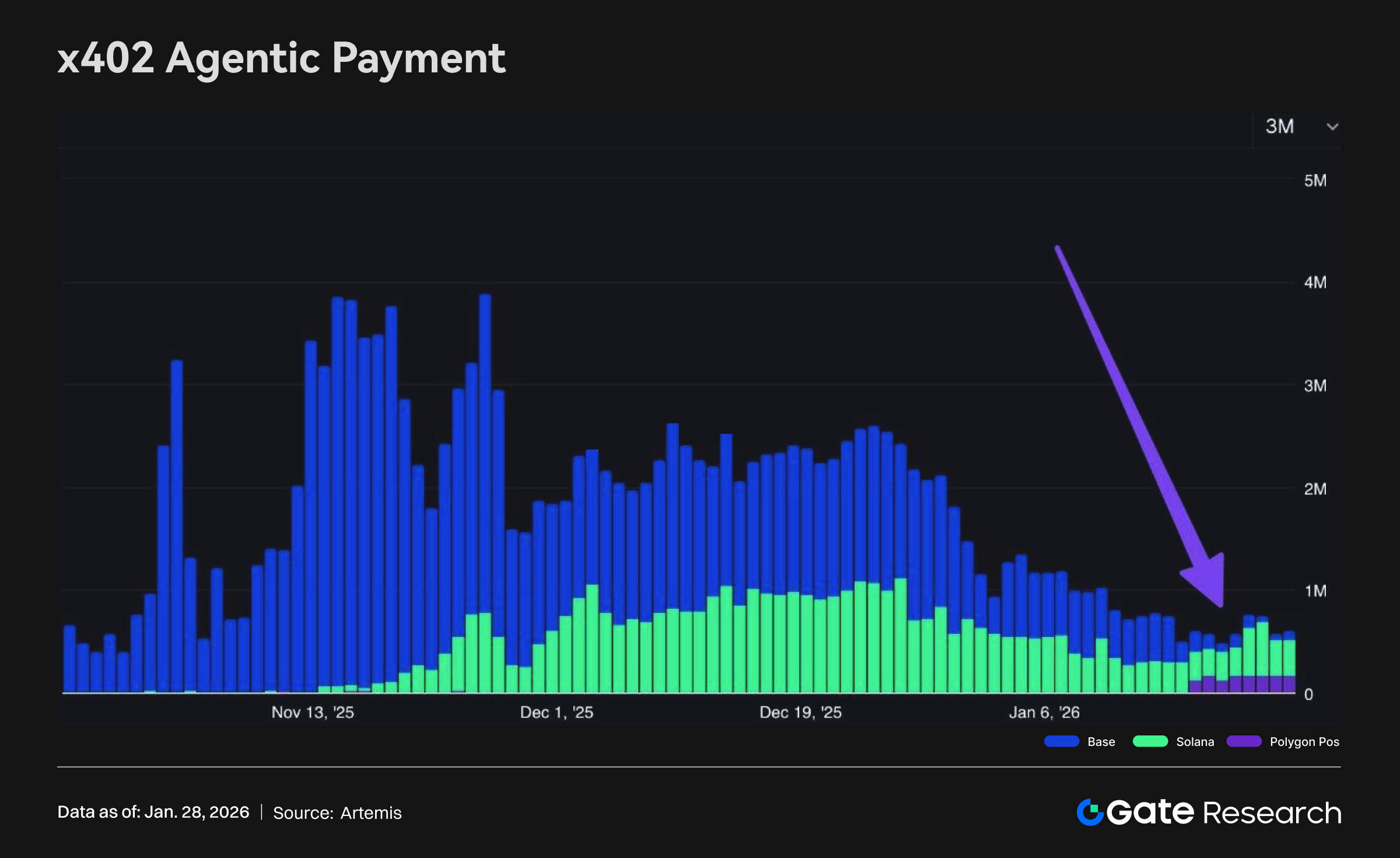
Polygon Leads x402 Agentic Payment Transactions, Base Weakens for Eight Straight Days
Artemis data shows that in x402 agentic payment transactions, Polygon’s daily volume has exceeded Base for eight consecutive days. Looking at the past three months of on-chain structural shifts: Base initially contributed the majority of volume but gradually declined after peaking; in the middle phase, Solana’s share increased, creating a “Base weakening, Solana strengthening” rebalancing; more recently, Polygon’s incremental growth has been more pronounced, enabling a short-term overtake and a sustained streak.
This outperformance appears more consistent with payment routing shifts and application migration than with simple market noise. As pay-per-call becomes a default pattern, developers and aggregators increasingly optimize for unit costs, confirmation experience, failure/retry overhead, and integration efficiency with standardized payment intents. If a chain offers better settlement reliability, more predictable fees, or stronger ecosystem incentives, it can quickly capture marginal flow in high-frequency, small-ticket, automated agent payment scenarios. If Polygon can convert this advantage into more durable SDK/payment components and merchant-side adoption, the lead could extend; if not, the surge may fade as an event-driven move without sustained real demand.
References
- Gate, https://www.gate.com/trade/BTC_USDT
- Farside Investors, https://farside.co.uk/btc/
- Gate, https://www.gate.com/trade/ETH_USDT
- Farside Investors, https://farside.co.uk/eth/
- Gate, https://www.gate.com/crypto-market-data
- Investing, https://investing.com/indices/usa-indices
- Investing, https://investing.com/currencies/xau-usd
- CoinGecko, https://www.coingecko.com/en/cryptocurrency-heatmap
- Gate, https://www.gate.com/announcements/article/48980
- X, https://x.com/Cointelegraph/status/2016292864989208640?s=20
- X, https://x.com/GoKiteAI/status/2016159368048521441?s=20
Gate Research is a comprehensive blockchain and cryptocurrency research platform that provides deep content for readers, including technical analysis, market insights, industry research, trend forecasting, and macroeconomic policy analysis.
Disclaimer
Investing in cryptocurrency markets involves high risk. Users are advised to conduct their own research and fully understand the nature of the assets and products before making any investment decisions. Gate is not responsible for any losses or damages arising from such decisions.
Related Articles

Gate Research: 2024 Cryptocurrency Market Review and 2025 Trend Forecast

Gate Research: BTC Breaks $100K Milestone, November Crypto Trading Volume Exceeds $10 Trillion For First Time

Gate Research-A Study on the Correlation Between Memecoin and Bitcoin Prices
Gate Research: Web3 Industry Funding Report - November 2024

Gate Research: October Crypto Market Review