Gate Metals Zone: Trading Gold and Silver Opportunities in Uncertain Markets
Market Uncertainty Fuels Demand for Safe-Haven Assets
When the global economy comes under pressure—whether from rising inflation, slowing growth, or geopolitical tensions—investors typically move capital into more stable asset classes. Gold and silver have long served as core safe-haven assets in financial markets.
These precious metals not only act as stores of value but also serve as key indicators of market sentiment. Their prices do not move in a strictly one-way direction. When economic prospects improve and risk appetite grows, capital often shifts to equities or other high-risk assets, putting downward pressure on gold and silver prices. As a result, the performance of precious metals is closely tied to the broader economic environment.
Key Drivers of Precious Metals Prices
Gold and silver prices rarely respond to a single event; instead, they reflect the combined impact of multiple factors.
-
Macroeconomic Data
Indicators such as inflation, interest rates, and employment reports shape how capital is allocated among asset classes. When inflation expectations rise, investors often favor precious metals to hedge against declining purchasing power. -
Central Bank Monetary Policy
Policy shifts by global central banks have a significant effect on markets. Easing measures typically boost gold's appeal, while rising interest rates may reduce the attractiveness of non-yielding assets. -
Geopolitical and Unexpected Events
International conflicts or major political incidents frequently trigger risk-off sentiment, prompting capital flows into gold and silver.
These factors intertwine, creating cyclical price movements in the precious metals market.
Accessing the Precious Metals Market with Perpetual Futures
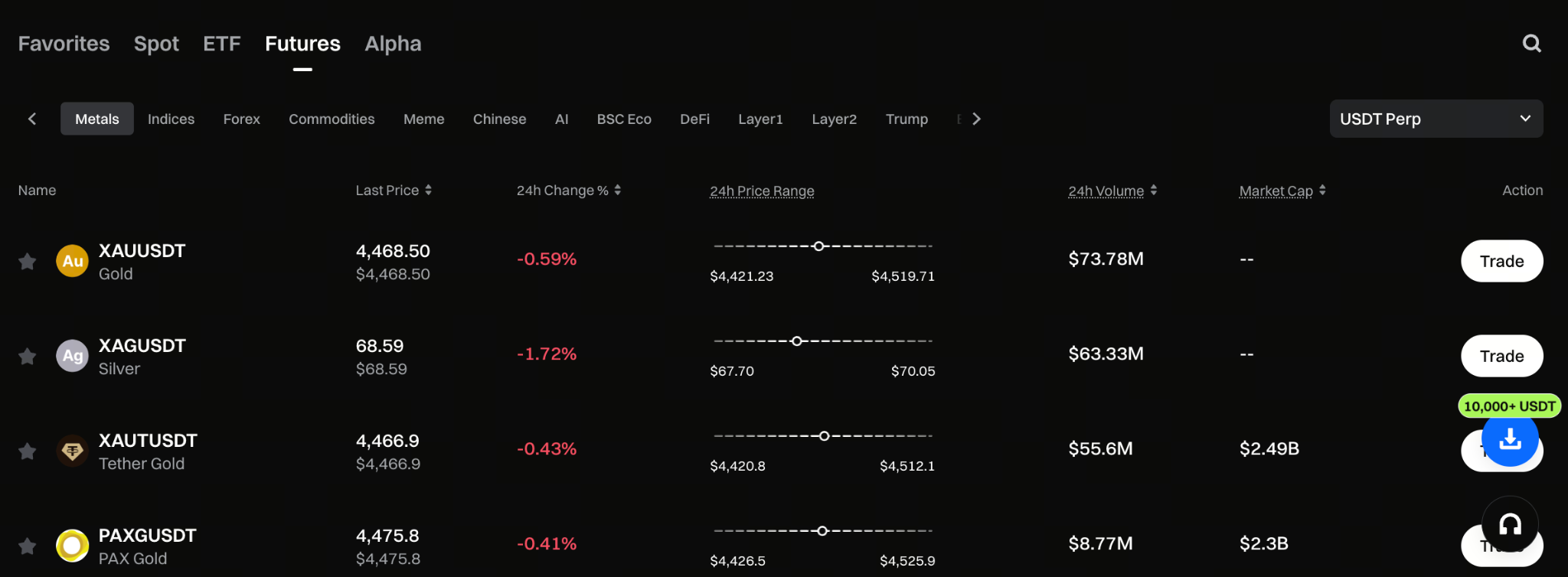
In fast-moving markets, flexible trading tools are essential. The Gate Metals section offers perpetual futures trading for precious metals, giving investors greater agility. Unlike traditional futures, perpetual futures have no expiration date, so traders can hold positions as long as market conditions warrant—without worrying about settlement deadlines.
Additionally, trades are settled in USDT, simplifying fund management and enabling quick adjustments to capital and positions when volatility strikes.
Start trading now in the Gate Metals section: https://www.gate.com/price/futures/category-metals/usdt
Advantages of Perpetual Futures
Perpetual futures attract traders due to their operational flexibility and strategic diversity, including:
- No expiration date means traders can freely adjust holding periods and strategies in response to market shifts.
- Leverage increases capital efficiency, allowing participation in larger markets with less upfront capital.
However, leverage also magnifies potential risks. Effective position sizing and fund management are critical. Strong risk control practices form the foundation of stable, long-term trading.
The Critical Role of Risk Management in Trading
In volatile markets, risk control is vital for trading stability. Comprehensive trading systems typically provide a range of risk management mechanisms to help users mitigate risk.
Examples include:
- Dynamic margin system: Adjusts margin requirements in response to market volatility
- Auto-close position mechanism: Executes timely stop-losses when risk thresholds are breached
- Funding rate mechanism: Reflects the balance of long and short positions and affects holding costs
These features help traders pursue returns while safeguarding capital and maintaining operational stability.
Trading Strategies for Different Market Conditions
In the precious metals market, traders often tailor their strategies to their own style and prevailing market conditions.
-
Short-Term Trading Strategies
Capitalize on short-term price movements for rapid entry and exit, typically with clear stop-loss and take-profit settings. -
Trend-Following Strategies
Open positions in the direction of established trends, adjusting holdings as the trend evolves. -
Hedging Strategies
Hold precious metals to reduce portfolio volatility during turbulent markets. -
Arbitrage Strategies
Seek returns by exploiting price differences between markets or trading products.
Each strategy suits different market conditions, and traders can adapt them to fit their personal approach.
Conclusion
As global economic conditions and market sentiment continue to shift, gold and silver remain key assets for investors. Their price trends often mirror changes in macroeconomic factors and risk appetite, providing a range of trading opportunities. With the perpetual futures trading tools available in the Gate Metals section, investors can access the precious metals market with greater flexibility, using leverage and diverse strategies to navigate volatility. In an era of persistent uncertainty, combining flexible trading instruments with robust risk management is essential for achieving long-term, stable results.
Related Articles

AI-Native Settlement Layers: How United Stables Is Building the Next Financial Rail

The ve(3,3) Flywheel Explained: How AERO Tokenomics Powers Aerodrome’s DeFi Economy

How Does PAXG Work? In-Depth Overview of the Physical Gold Tokenization Mechanism

Aerodrome Tokenomics: How ve(3,3) Powers Base's Most Profitable DEX

How is the price of PAXG determined? Pegging mechanism, trading depth, and influencing factors
