Gate Metals Zone: New Ways to Trade Gold and Silver in a Changing Market
Why Capital Flows to Precious Metals During Market Volatility
In financial markets, investors routinely adjust their asset allocation in response to the broader economic landscape. When global pressures arise—such as rising inflation, slowing growth, or geopolitical instability—risk awareness intensifies. During these periods, capital often shifts toward more stable asset classes, with gold and silver consistently recognized as key safe-haven assets.
However, precious metals prices do not always move in a single direction. When economic prospects improve and risk appetite grows, capital may flow into equities or other growth assets, placing downward pressure on gold and silver markets. As a result, fluctuations in precious metals prices often provide indirect insight into market sentiment and capital flows.
Key Factors Influencing Gold and Silver Prices
Price movements in the precious metals market result from a combination of factors rather than isolated events. The following are widely regarded as major indicators affecting gold and silver markets.
- Macroeconomic Data
Economic indicators such as inflation rates, interest levels, and employment reports significantly influence capital allocation across asset classes. When inflation is expected to rise, some investors turn to precious metals to hedge against declining purchasing power.
- Central Bank Policy Direction
Central bank monetary policy worldwide has a far-reaching impact on markets. Accommodative policies generally boost the appeal of assets like gold. Conversely, when interest rates rise, gold’s lack of yield can diminish its relative attractiveness.
- International Developments and Unexpected Events
Geopolitical conflicts or major international events often spark increased demand for safe-haven assets. When uncertainty rises, capital may flow into precious metals markets in the short term, driving price volatility.
The interplay of these factors leads to cyclical price shifts in the precious metals market.
Participate in Precious Metals Trading via Gate Metals Section
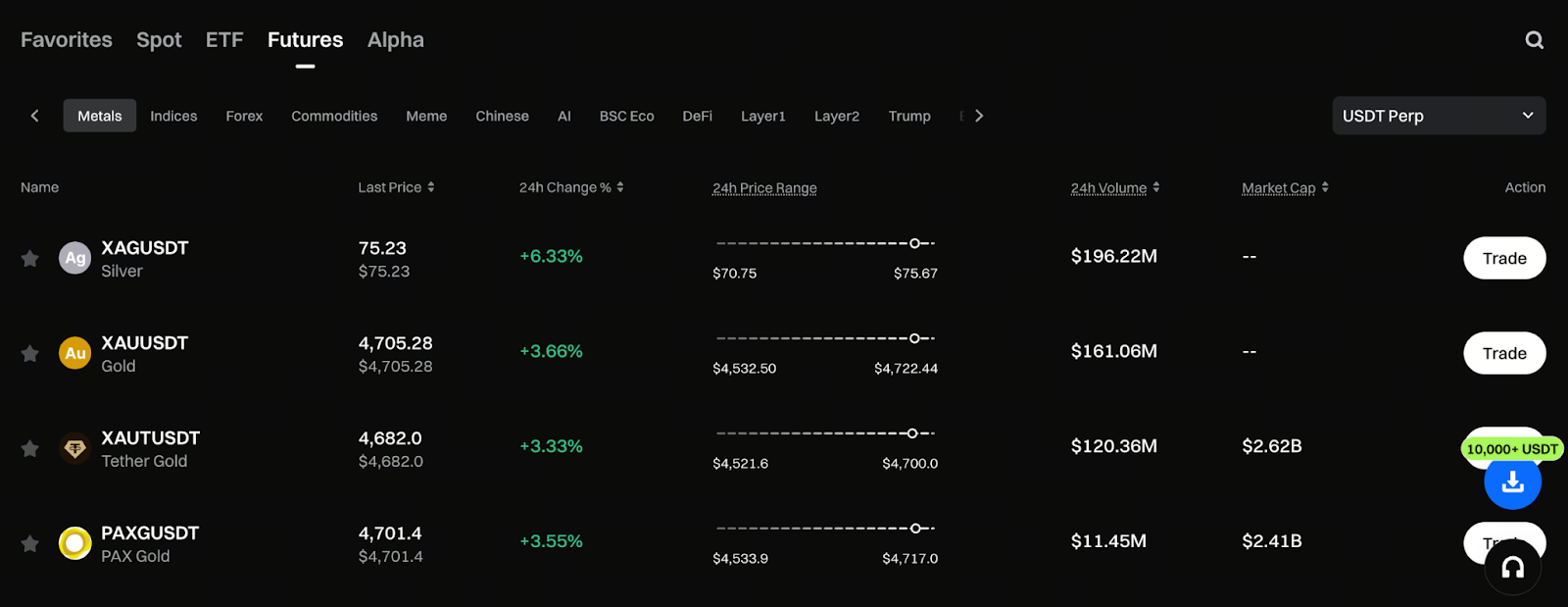 In today’s rapidly changing markets, flexible trading tools are essential. The Gate Metals section offers perpetual futures trading for gold and silver, giving investors greater flexibility to engage with the market.
Unlike traditional futures, perpetual futures have no set expiration date, allowing traders to determine their holding period based on market trends. This design enables more adaptive strategies, free from settlement constraints. Additionally, the market settles in USDT, streamlining capital management so investors can quickly adjust positions and asset allocation as conditions change.
Start trading in the Gate Metals section now: https://www.gate.com/price/futures/category-metals/usdt
Flexibility of Perpetual Futures Trading
Perpetual futures are gaining popularity among traders thanks to their flexible features.
-
No expiration date means traders can freely adjust holding periods in response to market movements, without worrying about contract settlement.
-
Leverage enhances capital efficiency, enabling participation in larger markets with less capital.
-
However, leverage also magnifies market swings, making prudent management of position size and capital ratios critical.
The Role of Risk Management in Trading
In volatile markets, risk management is the cornerstone of any trading strategy. Robust trading systems typically incorporate a range of mechanisms to help investors control risk, including:
- Dynamic Margin System
The system adjusts margin requirements in line with market volatility to keep risk at reasonable levels.
- Auto Close Position Mechanism
If position risk becomes excessive, the system automatically closes positions to prevent further losses.
- Funding Rate Mechanism
The funding rate balances long and short positions and impacts the cost of holding positions.
These features help traders pursue returns while maintaining stability throughout the trading process.
Common Precious Metals Trading Strategies
Traders employ various strategies based on market dynamics and personal preferences. In the precious metals market, the most common approaches include:
- Short-Term Volatility Trading
Entering and exiting positions quickly based on short-term price movements, with strict stop-loss and take-profit settings to manage risk.
- Trend-Following Trading
Taking positions in the direction of a clear market trend and adjusting strategies as the trend develops.
- Asset Hedge Allocation
Including precious metals in a portfolio to reduce overall volatility during turbulent markets.
- Market Arbitrage Strategies
Exploiting price differences between markets or products to uncover potential arbitrage opportunities.
Each strategy suits different market conditions, and investors should adjust according to their risk tolerance and trading style.
Conclusion
As global economic and financial markets continue to evolve, gold and silver remain highly regarded assets. Their price movements often mirror market sentiment and macroeconomic shifts, offering traders a range of opportunities. With perpetual futures trading tools available in the Gate Metals section, investors can participate in the precious metals market with greater agility and adjust strategies as markets change. In an era of persistent uncertainty, pairing the right trading tools with sound risk management is key to maintaining a steady pace in volatile environments.
Related Articles

AI-Native Settlement Layers: How United Stables Is Building the Next Financial Rail

The ve(3,3) Flywheel Explained: How AERO Tokenomics Powers Aerodrome’s DeFi Economy

How Does PAXG Work? In-Depth Overview of the Physical Gold Tokenization Mechanism

Aerodrome Tokenomics: How ve(3,3) Powers Base's Most Profitable DEX

How is the price of PAXG determined? Pegging mechanism, trading depth, and influencing factors
