Gate Metals Zone: A Multi-Asset Trading Gateway and Risk Control Tool in Volatile Markets

2026-03-05 03:13:47
Beginner
Quick Reads
As volatility intensifies in global precious metals markets and capital continues to rotate among assets, Gate has introduced its Metals Section, incorporating gold, silver, and similar assets into its perpetual contract framework. The section delivers 24/7 trading, integrated risk controls, and streamlined settlement. This article examines the section’s positioning, key functions, and use cases, enabling investors to seize opportunities and manage risks associated with these innovative trading instruments.

Why the Metals Section Is Essential in Today’s Market Environment
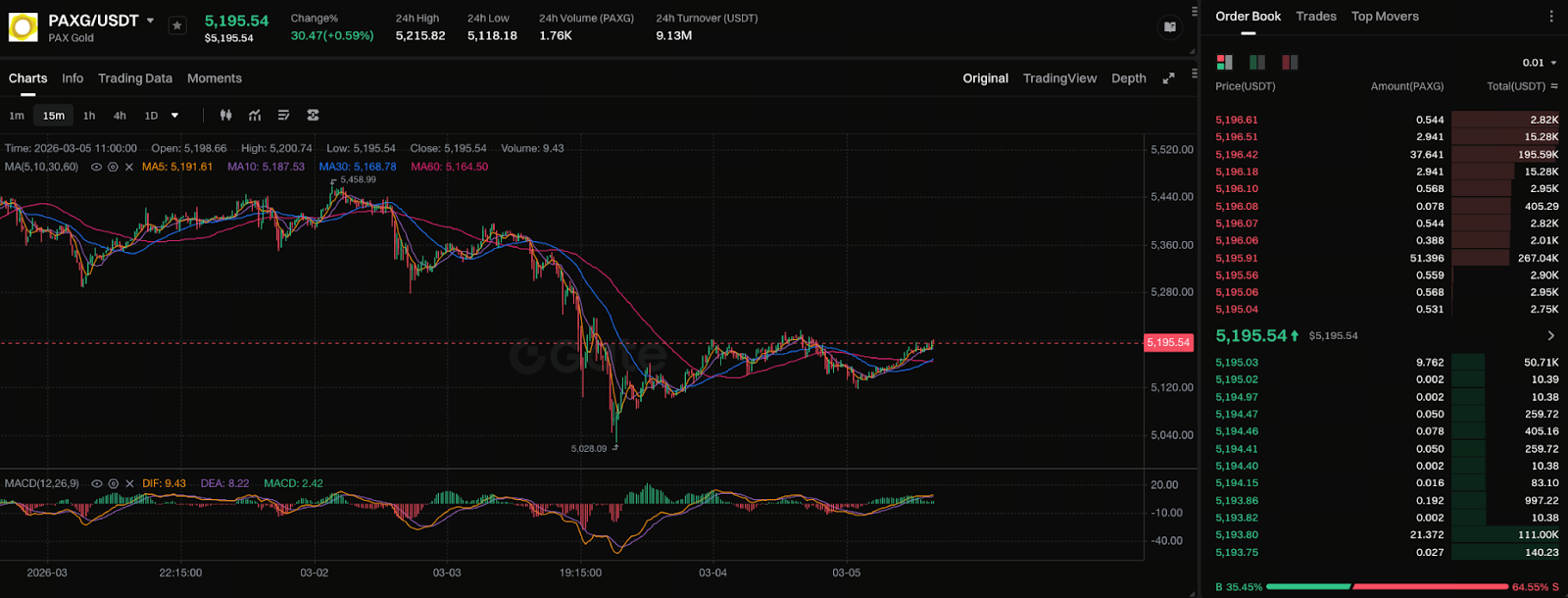
Why the Metals Section Is Essential in Today's Market Environment
Image: https://www.gate.com/trade/PAXG_USDT

Precious metals have consistently served as safe havens and stores of value in the global financial system. The recent market has seen pronounced capital rotation and heightened volatility. Restrictions during traditional trading hours and operational costs across platforms hinder traders from executing strategies quickly. By integrating metals like gold (XAU) and silver (XAG) into a unified trading system, investors can hedge, conduct swing trading, and manage cross-asset allocations more efficiently on a single platform. This also highlights the practical need for connecting TradFi and Crypto: offering standardized, tradable contracts that bring traditional assets into the crypto trading experience.

Core Mechanisms and Product Design of Gate Metals Section

  • Contract Structure: Metals are introduced to Gate’s contract system via perpetual contracts, eliminating the time constraints of expiration dates and allowing flexible entry and exit.
  • Settlement Unit: USDT-based settlement reduces conversion costs across currencies and markets, improving clarity in capital management.
  • Pricing and Risk Control: Utilizes a composite index price and a multi-layered risk control framework to ensure stable price discovery and enforceable risk management.
  • Trading Entry Experience: The dedicated section enables users to switch metals contracts, adjust leverage, and set stop-loss orders directly from the contract page, reducing friction from frequent market switching.

3. Marginal Gains and Cost Considerations of 24/7 Trading

Round-the-clock trading provides greater flexibility during volatile periods, especially when macro news, geopolitical events, or data releases occur. Investors can instantly adjust positions and implement stop-loss or take-profit strategies. However, 24/7 trading demands stricter capital management, especially in high-volatility phases where leverage and slippage costs may rise. Prudent position control, stop-loss strategies, and hedging approaches are therefore crucial to maximizing the benefits of this section.

4. Risk Control Framework: Margin, Forced Liquidation, and Funding Rate Dynamics

The Metals Section on Gate adopts the platform’s established risk control logic, including:

  • Margin Management: Dynamically maintains position safety boundaries to prevent forced liquidation caused by short-term volatility.
  • Forced Liquidation Mechanism: Activates forced liquidation when funds are insufficient, protecting both account and market stability.
  • Funding Rate: Long-term holding costs fluctuate with market funding conditions, so monitoring rate changes and their impact on trading costs is essential.

For traders, understanding and monitoring these mechanisms is fundamental to achieving stable returns in volatile environments.

5. User Profiles and Practical Strategies (Beginner to Advanced)

  • Beginner/Conservative: Use small positions and low leverage for swing trading, focusing on learning the trading interface and risk control settings while gradually building discipline.
  • Intermediate/Hedging: Use metal perpetual contracts as hedging tools for existing investment portfolios, combining with other assets for cross-market hedging and risk management optimization.
  • Advanced/Strategic: Explore cross-asset arbitrage, cross-market pricing spreads, and strategies with forex or index derivatives, seeking excess returns under strict risk control.
  • Key Points: Set clear stop-loss and target levels, build positions in stages, monitor real-time funding rates and order depth, and avoid excessive leverage expansion.

6. Synergy with Traditional Financial Assets and Future Outlook

The launch of the Metals Section expands Gate’s asset matrix and marks a concrete step toward deep integration between TradFi and Crypto. As more standardized derivatives from traditional asset classes enter the crypto trading ecosystem, users will further enhance their capabilities for multi-asset allocation, risk management, and strategy execution on a single platform.

Author: Max
Disclaimer
* The information is not intended to be and does not constitute financial advice or any other recommendation of any sort offered or endorsed by Gate.
* This article may not be reproduced, transmitted or copied without referencing Gate. Contravention is an infringement of Copyright Act and may be subject to legal action.

Related Articles

AI-Native Settlement Layers: How United Stables Is Building the Next Financial Rail

Beginner

AI-Native Settlement Layers: How United Stables Is Building the Next Financial Rail

Stablecoins were originally designed as dollar substitutes within exchanges, primarily used for asset pricing and trade settlement. As on-chain financial ecosystems have matured, their role has expanded beyond simple payments to include collateral assets, cross-chain liquidity mediums, and unified settlement units. In particular, as AI systems and automated agents begin to participate directly in economic activity, demand has risen sharply for programmable value units capable of instant settlement. This shift is pushing stablecoins toward the role of foundational financial infrastructure.
2026-02-24 06:51:41
The ve(3,3) Flywheel Explained: How AERO Tokenomics Powers Aerodrome’s DeFi Economy

Beginner

The ve(3,3) Flywheel Explained: How AERO Tokenomics Powers Aerodrome’s DeFi Economy

In the competition for DeFi liquidity, high-inflation mining alone is no longer enough to build lasting advantages. Aerodrome applies the ve(3,3) economic model to redesign token emissions, voting mechanisms, and revenue distribution, creating a liquidity flywheel centered on governance and cash flow. This article examines AERO tokenomics, the veAERO locking mechanism, and protocol revenue models to explain how Aerodrome builds a sustainable DeFi economic system.
2026-02-10 04:41:32
How Does PAXG Work? In-Depth Overview of the Physical Gold Tokenization Mechanism

Beginner

How Does PAXG Work? In-Depth Overview of the Physical Gold Tokenization Mechanism

PAXG (Pax Gold) is a tokenized asset backed by physical gold, issued by the fintech company Paxos and traded on the Ethereum blockchain as an ERC-20 token. The core concept is to tokenize physical gold on-chain, with each PAXG token representing ownership of a certain amount of gold. This structure enables investors to hold and trade gold in the form of a digital asset.
2026-03-09 09:30:10
Aerodrome Tokenomics: How ve(3,3) Powers Base's Most Profitable DEX

Beginner

Aerodrome Tokenomics: How ve(3,3) Powers Base's Most Profitable DEX

AERO is the native token of Aerodrome Finance, a core decentralized exchange and liquidity protocol in the Base ecosystem. It is primarily used for liquidity incentives and ecosystem operations. veAERO is a governance NFT that users receive by locking AERO, representing both voting power and the right to share protocol revenue. Through a dual track structure of AERO as a utility token and veAERO as a governance credential, Aerodrome separates liquidity usage value from long term governance power, allowing participants to act as liquidity providers, governance decision makers, and revenue sharers within the same system.
2026-02-10 04:44:29
How is the price of PAXG determined? Pegging mechanism, trading depth, and influencing factors

Beginner

How is the price of PAXG determined? Pegging mechanism, trading depth, and influencing factors

PAXG (Pax Gold) is a tokenized asset backed by physical gold reserves, launched by fintech firm Paxos and issued as an ERC-20 token on the Ethereum blockchain. The core concept is to digitally represent real-world gold assets, allowing investors to hold and trade gold via the blockchain network. Because each PAXG token corresponds to a specific quantity of physical gold, its price is theoretically expected to closely track the global gold market.
2026-03-09 09:26:51
Hybrid Collateral Stablecoins: Inside United Stables' Stability and Yield Architecture
Beginner

Hybrid Collateral Stablecoins: Inside United Stables' Stability and Yield Architecture

In the early stages of the crypto market, traditional stablecoins mainly relied on single-reserve or single-collateral models. Their primary focus was price stability and payment convenience, which allowed them to become foundational tools for on-chain trading and capital flows. As the market has entered a more mature financial phase, however, this structure has begun to reveal limitations, including high concentration risk and the difficulty of balancing liquidity with yield. These constraints have driven the evolution toward multi-layer collateral and portfolio-based designs, such as the dual-layer hybrid collateral architecture proposed by United Stables, which seeks to redefine the underlying logic of stable assets.
2026-02-24 06:49:50
